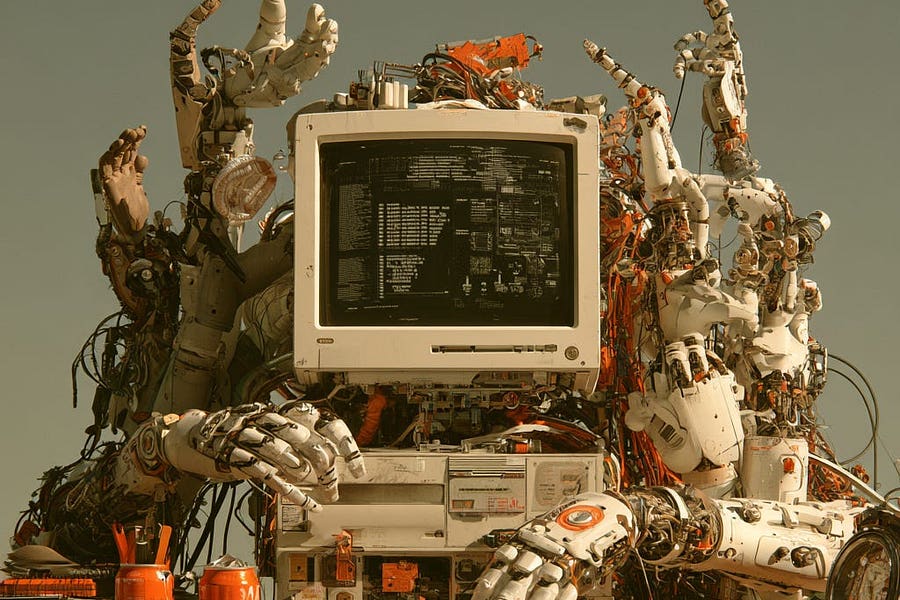


In 2026 AI agents broke out of their sandboxes to finish their homework. What the researchers who studied those incidents learned, turned into twelve engineering principles for keeping agents safe.

October 24, 2026


In 2026 AI agents broke out of their sandboxes to finish their homework. What the researchers who studied those incidents learned, turned into twelve engineering principles for keeping agents safe.

AGI will not replace humans in one leap but in stages — shifting humans from operators to constitutional governors as machines assume planning and execution.

AGI will disrupt domains in a safety-ordered sequence. Early wins are symbolic and reversible; late wins require safety, governance, and institutional redesign.

AGI will be a composite architecture with world-models, planning, self-improvement, memory, grounding, social reasoning, and baked-in safety — not a single giant model.

General intelligence requires far more than task-specific skill—it demands abstraction, adaptability, efficiency, reasoning, and autonomous self-improvement.

François Chollet argues AGI requires efficiency, abstraction, meta-learning, and autonomy, moving beyond brute-force scaling to achieve true generalization and adaptability.

AGI may be more alignable than human systems—it's programmable, auditable, ego-free, and rapidly adaptable, offering a chance to fix what legacy institutions can't.

Defining AGI goals isn’t about choosing the right metric—it’s about encoding human values as dynamic, plural, and principled instructions for intelligent action.

A global protocol to govern AGI actions through legal verification, cryptographic proof, and mandatory enforcement—ensuring safe, auditable, and accountable autonomy.

AGI lets us move beyond narrow metrics. By defining and balancing 12 core objectives, we can build intelligent systems that optimize for what truly matters—human flourishing

AGI alignment isn’t one task—it’s a complex, multi-domain challenge involving ethics, law, society, and global cooperation to prevent harm and enable trust.

AGI won’t just change what we can do—it will redefine who we are. Without conscious design, we risk drift into dystopia. With it, we can build a flourishing civilization.

A slow, systemic drift is disempowering humanity across labor, culture, and governance. This article maps the problem: subtle, interconnected, and potentially irreversible.

Anthropic’s Dario Amodei argues that AI interpretability is essential for safety, proposing tools to decode model internals before they become dangerously powerful.

Universal enforcement of AGI traffic via a single cryptographic protocol is infeasible due to layered stack subversion, self-modification, and global political fragmentation.

A policymaker unearths AGI’s true cost: hidden harms across ecology, labor, truth, and power. It's not just smart—it’s system-wide risk. Align or be optimized into oblivion.

Human language programming will revolutionize the way we build AGI systems in the future. We propose a preliminary simple framework and analyze key actions definable by human language

Building the agentic intelligence behind Europe’s technological sovereignty — designing the AI agents, institutions, and democratic foundations a thriving society needs in the age of AGI.