




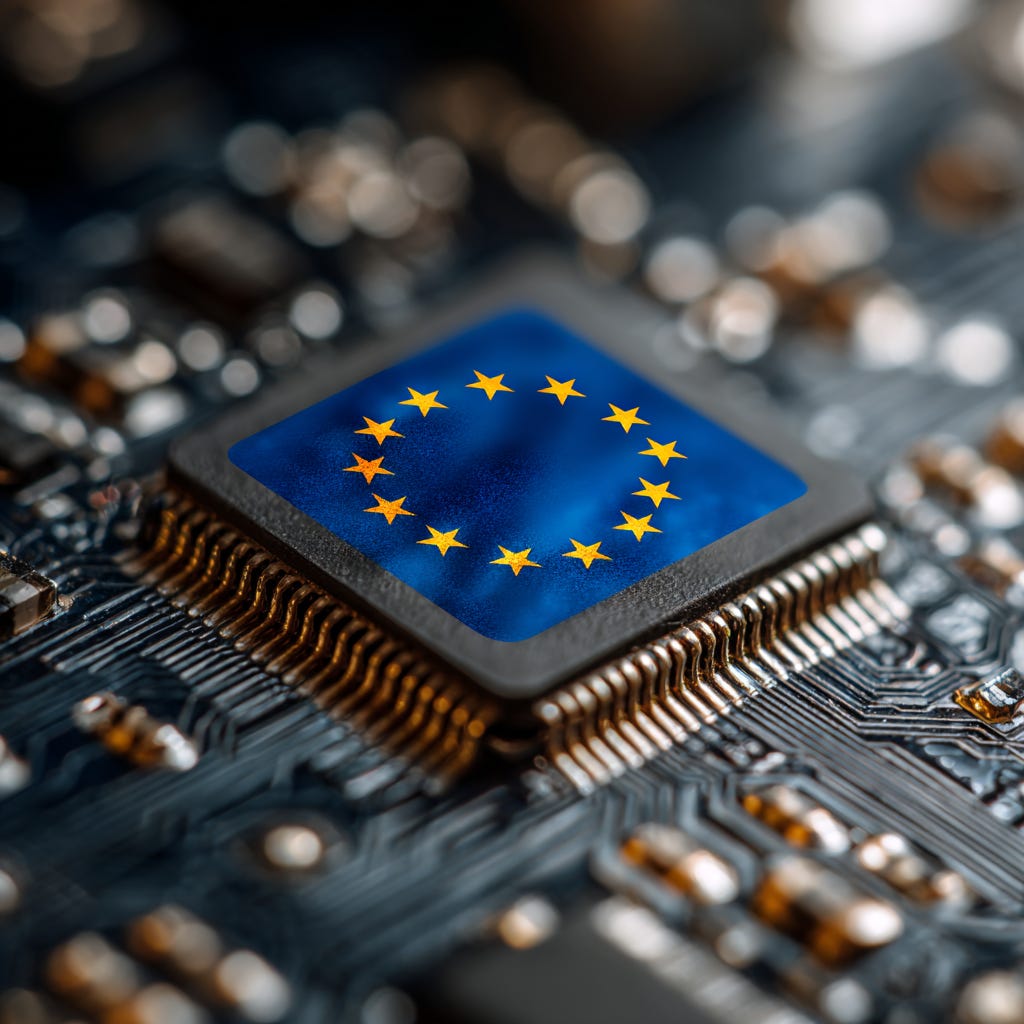
Europeâs debate about âtechnological sovereigntyâ is often framed as pride or protectionism. That framing is too shallow. The real question is whether Europe can remain a self-governing civilization in a world where intelligence, infrastructure, and industrial capacity are increasingly encoded in software, models, chips, and cloud platforms.
Sovereignty used to mean borders, armies, currency, and the rule of law. Today it also means who controls the computational substrate that runs public administration, finance, healthcare, logistics, energy systems, and the information environment. When the backbone of society depends on infrastructure owned and governed elsewhere, sovereignty becomes conditionalâgranted by contracts, pricing, export controls, and distant legal regimes.
This is not a call for isolation. Europe benefits enormously from open markets, scientific exchange, and allied cooperation. But openness without capacity creates asymmetry: you can be âopenâ while others hold the keys to your critical systems. The point of sovereignty is optionalityâEurope can collaborate by choice, not by necessity.
Technological sovereignty is therefore best understood as risk management for a complex society. It is a response to concentration risk in cloud and platforms, jurisdictional risk around data and AI, and supply-chain risk in semiconductors, raw materials, and energy-intensive compute. These dependencies rarely hurt in calm times; they become decisive under stressâcrisis, coercion, war, sanctions, or systemic cyber failure.
At the same time, sovereignty is an economic strategy. The future value of the economy will compound around the owners of platforms, models, standards, and the learning loops created by data and usage. If Europe only âusesâ advanced technology but doesnât own strategic layers of the stack, it will pay rents indefinitely while watching talent, profits, and strategic control drift elsewhere.
There is also a democratic dimension. Modern politics now runs through digital intermediaries: recommender systems, ad-tech, identity, and the content generation capabilities of AI. If the information environment is governed primarily by external actors, enforcement of European rights and democratic safeguards becomes fragile, slow, and reactive.
Sovereignty also determines trust. Europeans will not adopt AI broadly in government, health, and education if they believe systems are opaque, unaccountable, or vulnerable to external access. Trust is not a marketing issue; it is built through enforceable governance and infrastructure that makes privacy, security, and auditability real.
Finally, Europeâs sovereignty must be compatible with its climate and social goals. AI and cloud growth are energy- and resource-intensive; without the ability to steer infrastructure design, Europe risks importing an economic model that clashes with affordability, grid constraints, and decarbonization commitments. Sovereignty is the ability to optimize technology for Europeâs priorities rather than accept someone elseâs defaults.
Summary
A) Control of critical dependencies
Reduce dependency on foreign tech giants
Europeâs core digital stack (cloud, platforms, AI tooling) is dominated by non-EU actors, turning infrastructure into a policy constraint. Sovereignty means lowering lock-in and ensuring Europe can act without âpermission-by-platform.âData sovereignty and privacy protection
If Europe canât control jurisdiction, access, and data flows, it canât reliably enforce its own rights regime. This is the foundation layer for trustworthy AI, public-sector digitization, and regulated industries.Cybersecurity and infrastructure resilience
Without operational cyber resilience, sovereignty is performative. The point isnât âno foreign tech,â but hardened systems, supply-chain assurance, and survivability under attack.National security and defense autonomy
Defense increasingly depends on AI, secure compute, satellites, comms, chips, and cyber. Autonomy means Europe can deter and operate even when external supply or priorities shift.Supply chain resilience in critical technologies
Chips, raw materials, energy systems, and manufacturing tools define whether Europe can build and sustain modern tech at scale. Resilience is about securing continuity under shocks, not about total self-sufficiency.Strategic autonomy in geopolitics
Tech dependencies become geopolitical leverage (export controls, sanctions, vendor constraints). Sovereignty increases Europeâs freedom of action: Europe cooperates by choice, not necessity.
B) Capability to compete and capture value
Economic competitiveness and innovation leadership
If Europe doesnât build frontier capability (compute + talent + scale-up), it will remain a standards-taker and productivity laggard. Sovereignty is a competitiveness strategy: build the capabilities that set the pace.Capturing economic value and jobs inside Europe
Using technology isnât the same as owning the compounding assets (IP, platforms, distribution, learning loops). Sovereignty is about value capture: profits, jobs, and strategic control staying in Europe.Shaping global standards and tech governance
Standards lock in architectures and markets for a decade. If Europe doesnât lead key standards (AI eval, industrial data formats, cybersecurity certification, identity), it inherits othersâ assumptions and rents.
C) Legitimacy, trust, and long-run resilience
Protecting European values and democracy
If the information environment and AI-mediated public discourse are governed by external actors, democratic resilience becomes contingent. Sovereignty here means enforceable governance: auditability, accountability, and protection against manipulation at scale.Building public trust in technology
Trust determines adoption speed in government, healthcare, education, and finance. Sovereignty strengthens trust when it produces visible control: privacy-by-design, enforceable rules, and reliable public infrastructure (e.g., identity).Aligning tech with sustainability and social goals
AI/cloud are energy- and resource-intensive; if Europe doesnât steer infrastructure design, the digital transition can clash with climate goals and affordability. Sovereignty means Europe can optimize for its priorities (decarbonization, inclusion, resilience), not import someone elseâs cost model.
Sovereignty Areas
1) Reducing dependency on foreign tech giants
1) Strategic rationale
Europeâs dependence on non-European platforms (cloud, AI stacks, operating systems, developer tooling, app ecosystems) converts core capabilities into external dependencies. In a crisis (trade conflict, sanctions, extraterritorial legal orders, geopolitical misalignment), dependency becomes a policy constraint: Europe may not be able to execute sovereign decisions without permission-by-infrastructure.
2) Scale and shape of the issue
The European Commissionâs State of the Digital Decade reporting notes that the EU relies on foreign countries for over 80% of digital products, services, infrastructure, and IP.
Cloud is the clearest example of concentration risk: the three US hyperscalers account for ~65% of the EU cloud market, while EU providersâ share fell to under ~16% (with the largest EU operator cited at only ~2%).
This is not just âmarket shareâ; it is dependency embedded into production (identity, security tooling, logs, workflow engines, pricing power, vendor lock-in).
3) Market conditions + Europeâs readiness
Demand is exploding (AI workloads pull everything into cloud + GPUs), which reinforces hyperscaler advantage through scale economics.
Europe does have assets (industrial base, strong telcos, some sovereign-cloud initiatives), but readiness is uneven: the market is fragmented and procurement often rewards scale and incumbency rather than strategic resilience.
4) How it manifests right now
Public sector and regulated industries increasingly run on US-owned stacks (cloud + IAM + SIEM + data services), creating single points of failure and lock-in.
âSovereign cloudâ offerings frequently still depend on hyperscaler core technology, meaning sovereignty is partial (branding + hosting) rather than full-stack control.
5) Practical solutions (how to solve it)
Procurement as industrial policy: mandate âstrategic autonomy criteriaâ (portability, exit costs, EU jurisdiction guarantees, auditability) in public procurement; give preference to EU providers where feasible while keeping interoperability requirements.
Portability + switching costs as a regulated metric: treat cloud lock-in like a competition issue; require standardized portability interfaces, mandatory export tools, and transparent egress pricing (competition enforcement + technical standards).
Build EU compute capacity as a public utility layer: accelerate EuroHPC AI Factories / gigafactory direction so European AI workloads can run on EU-controlled infrastructure.
Targeted scale-up of European cloud: pick a small set of EU âreference stacksâ (sovereign IaaS/PaaS + identity + observability + secure storage) and fund them to reach credible scale (capacity, regions, compliance, developer experience).
6) Who can lead this in Europe
European Commission top-level: Ursula von der Leyen (Commission President).
Tech sovereignty portfolio: Henna Virkkunen (Executive Vice-President for Tech Sovereignty, Security and Democracy).
DG execution layer: DG CONNECT / Digital Services leadership.
Capital & scale: EIB President Nadia Calviño (critical for financing âEU-scaleâ infrastructure and industrial capacity).
Industrial leaders: Deutsche Telekom / OVHcloud / SAP (cloud), plus sectoral champions who can act as anchor customers.
2) Economic competitiveness and innovation leadership
1) Strategic rationale
If Europe doesnât control key technologies, it becomes a price taker and platform dependent economy: value capture shifts to whoever owns the platforms, models, and core infrastructure. That translates into weaker productivity growth, reduced bargaining power in trade, and slower diffusion of frontier capabilities into the real economy.
2) Scale and shape of the issue
The challenge is structural: the global âAI + cloud + semiconductorâ stack is increasingly winner-take-most due to scale effects (data, compute, distribution). Europeâs reliance on foreign digital tech (again: 80%+) indicates the competitiveness risk is systemic, not marginal.
3) Market conditions + Europeâs readiness
Europe has strong research, strong industrial domains (manufacturing, automotive, energy, health), and some emerging AI champions.
But two readiness gaps dominate:
scale-up gap (late-stage capital, fast go-to-market, unified market access),
compute gap (training/inference at frontier scale requires infrastructure Europe hasnât yet matchedâhence AI Factories / gigafactories focus).
4) How it manifests right now
Europe regulates AI and digital markets aggressively, but the innovation capacity (compute + capital + platform reach) still concentrates elsewhere; even Europeâs top AI startups publicly worry about compliance burdens and pace.
Public and private organizations often adopt âbest-availableâ foreign tooling because local alternatives donât match scale, reliability, or ecosystem pull (developers, integrations, managed services).
5) Practical solutions (how to solve it)
Pick battles where Europe can win: industrial AI, robotics/automation, energy systems, health regulation tech, multilingual productivity AIâthen fund âEU lighthouse deploymentsâ at scale.
Compute access as a competitiveness policy: make EuroHPC AI Factories a developer-facing capability (credits, tooling, model hubs) so startups can train/serve models without hyperscaler dependence.
Simplify and unify scale-up rules: create a true EU-wide â28th regimeâ style operating path (single corporate, tax, and employment frameworks for startups scaling across the EU), paired with aggressive reduction of administrative drag for SMEs (without weakening core safeguards).
EIB-backed âsovereignty dealsâ: debt + guarantees for compute, chips, and industrial AI deploymentsâturning sovereignty from slogans into bankable projects.
6) Who can lead this in Europe
Commission leadership: von der Leyen + Virkkunen to align competitiveness with sovereignty.
National engines: France (Macron) and Germany (Chancellor Friedrich Merz) as the key political motors for EU-scale industrial policy.
Finance + execution: EIB (Calviño) as the scaling instrument; EuroHPC governance for compute rollout.
3) Capturing economic value and jobs inside Europe
1) Strategic rationale
Even if Europe uses advanced technology, it doesnât automatically capture the value. Value capture depends on who owns:
IP (models, chips, software),
platforms (cloud + app ecosystems),
distribution (enterprise relationships),
and the âlearning loopsâ (data and usage feedback that improve products).
Without sovereignty, Europe risks turning into a high-end customer rather than an owner of compounding assets.
2) Scale and shape of the issue
The EU cloud market is large and growing fast (partly due to AI), but dominance by non-EU hyperscalers means a big share of margins and strategic control accrues outside Europe.
This is the core ârent extractionâ problem: Europe pays for critical services while its own firms struggle to reach scale.
3) Market conditions + Europeâs readiness
Europe has meaningful strengths: deep industrial customers, world-class niche leaders, a strong regulatory environment for trust (which can be a market advantage).
Readiness problem: European firms often canât compete on scale economics aloneâso they need smart leverage: procurement, standards, federated infrastructure, and focus on defensible verticals.
4) How it manifests right now
Public money flows outward: governments and critical industries procure foreign cloud/AI solutions because theyâre integrated, mature, and available now.
âSovereignâ layers without sovereignty: local hosting wrapped around foreign core stacks (still leaves strategic dependency and value leakage).
AI compliance load can disproportionately hit smaller European providers unless implementation is made pragmatic and supportive (sandboxes, guidance, templates).
5) Practical solutions (how to solve it)
Anchor customers at EU scale: large, multi-country procurement programs for EU providers (cloud, cybersecurity, AI tooling) with strict portability + security requirementsâso EU firms get predictable demand and can invest.
Targeted vertical sovereignty: instead of generic âEU everything,â win the layers where Europe already has the customer base: industrial AI, regulated compliance stacks, multilingual public-sector assistants, secure health AI.
De-risk scale-up: EIB guarantees + blended finance for expansion, and EU-wide reference architectures to reduce integration costs.
Make regulation an advantage: use AI Act timelines and sandboxes to create a âtrust brandâ for European AI, while keeping implementation predictable and innovation-friendly.
6) Who can lead this in Europe
Commission + sovereignty portfolio: Virkkunen for execution alignment across security, democracy, and tech sovereignty.
EIB + capital markets: Calviño to build âscale financingâ that Europe historically lacked.
National-level industrial policy: Macron (France), Merz (Germany) as the core coalition to drive EU-wide procurement + infrastructure + simplification.
Industry champions (as builders + anchor customers): ASML (hardware ecosystem), SAP (enterprise distribution), Deutsche Telekom (cloud + networks), plus leading European AI firms highlighted by policymakers (e.g., Mistral, DeepL, Aleph Alpha).
4) Data sovereignty and privacy protection
1) Strategic rationale
Data is the âtraining fuelâ for AI and the operating substrate for modern economies. If Europe canât control where sensitive data lives, who can access it, and under which legal regime itâs processed, then Europeâs privacy model, industrial strategy, and security posture become partially contingent on foreign jurisdiction and foreign business incentives.
2) Scale and shape of the issue
This is not just âprivacy.â Itâs a jurisdiction + cloud concentration + data-flow problem:
Jurisdiction: if the provider is under a non-EU legal regime, EU data can be exposed to extraterritorial access demands.
Concentration: cloud and platform dominance centralizes data gravity outside Europe (making switching harder, and enforcement weaker).
Data-flow: cross-border data movement becomes a structural dependency for health, finance, defense supply chains, and government services.
Europe is trying to address the market mechanics with âdata economyâ law. For example, the EU Data Act is applicable from 12 Sept 2025 and is positioned as a major step toward a fair EU data economy.
In health specifically, the European Health Data Space (EHDS) regulation was published in March 2025 and entered into force 26 March 2025, starting a transition phase toward application.
3) Market conditions + Europeâs readiness
Market conditions: data is increasingly tied to dominant cloud platforms and AI model providers; data portability is often theoretical because switching costs are real (identity, logs, integrations, proprietary services).
Readiness: Europe is strong in regulation and governance design (GDPR-era leadership), and it is building common-sector data frameworks (EHDS), but execution is uneven across member states and sectors.
4) How it manifests right now
Regulators and lawmakers constantly run into the same wall: âEU rules, non-EU stacks.â Enforcement becomes slow and political, not technical and routine.
Data-sharing initiatives (especially in health and public sector) move slowly because organizations donât trust that sensitive data will remain under EU controlâso adoption lags, and AI training datasets remain fragmented.
5) Practical solutions (how we solve it)
Make âjurisdictional controlâ a procurement requirement for critical workloads (health, defense, identity, core registries): mandatory EU legal control + independent auditability.
Force portability to become real: require measurable exit plans (time, cost, data formats, dependency mapping) as a condition for large public and regulated contracts; align with Data Actâs direction on cloud switching and interoperability.
Create EU-grade sector data utilities (starting with health, energy, manufacturing): shared reference architectures + shared consent/permissions + secure compute environments, so data can be used for AI without creating a single foreign âgravity well.â
6) Who can lead this in Europe
European Data Protection Supervisor (EDPS): Wojciech Wiewiórowski (as listed by EDPS).
EDPB Chair: Anu Talus (plus deputy chairs).
Commission leadership for tech sovereignty: Henna Virkkunen (Exec VP for Tech Sovereignty, Security & Democracy).
Sector leaders: major public health systems and regulators (EHDS), plus EU-scale cloud and cybersecurity providers as implementers.
5) Cybersecurity and resilience of digital infrastructure
1) Strategic rationale
If Europe canât defend its networks and supply chains, sovereignty is mostly symbolic. Cybersecurity is the enabler of autonomy: secure infrastructure is what makes âEU controlâ credible under stress (crisis, sabotage, coercion).
2) Scale and shape of the issue
The issue has three interacting layers:
Critical infrastructure exposure (energy, health, transport, public administration).
Supply-chain cyber risk (dependencies on software components, cloud services, managed security tooling).
Regulatory fragmentation (different levels of readiness and enforcement across member states and sectors).
The EU is actively evolving the framework. The Commissionâs NIS2 policy page notes that on 20 Jan 2026 the Commission proposed targeted amendments to increase legal clarity and simplify compliance.
3) Market conditions + Europeâs readiness
Market: attackers industrialize; defenders face talent shortages; compliance becomes expensive; and cloud concentration turns one vendor outage into systemic risk.
Readiness: Europe is relatively advanced on the regulatory scaffolding (NIS2 + certification), but operational maturity is uneven, especially outside finance/telecom.
Europe also has an EU-wide certification approach: ENISA describes EU cybersecurity certification as aiming to harmonize security assurance recognition across the Union.
4) How it manifests right now
Firms struggle to comply with NIS2 in multiple sectors; uneven national transposition and legacy infrastructure complicate implementation.
The EU cloud cybersecurity label debate (EUCS) shows the tension between âtechnical security certificationâ and âsovereignty expectationsâ (like localization/jurisdiction). Reuters reported industry groups urging adoption of an EUCS draft that was tweaked in ways seen as friendlier to major US cloud providers.
5) Practical solutions (how we solve it)
Operationalize NIS2: focus on measurable baseline controls (asset inventory, identity, segmentation, logging, incident response drills) with sector-specific playbooks; build âcompliance acceleratorsâ for SMEs.
EU-wide âsecure-by-defaultâ procurement: make certification + SBOM + vulnerability disclosure + patch SLAs mandatory for any supplier to critical entities; tie public contracts to demonstrated cyber maturity.
Cyber-resilience through diversity: reduce monoculture risk by requiring multi-region / multi-provider strategies for critical workloads and tested failover plans.
Scale European cyber industry: fund champions in identity security, endpoint, OT security, cloud security posture management, and threat intelâpaired with EU procurement as anchor demand.
6) Who can lead this in Europe
ENISA Executive Director: Juhan Lepassaar.
Commission tech sovereignty lead: Henna Virkkunen.
Implementation backbone: national cybersecurity authorities (e.g., NÃKIB in Czechia, BSI in Germany, ANSSI in France) aligned through ENISA frameworks.
Cloud certification governance: ENISA + Commission (EUCS discussions).
6) National security and defense autonomy
1) Strategic rationale
Defense autonomy is not âEurope goes alone.â It means Europe can deter, operate, sustain, and decide even if allies are distracted or priorities diverge. Tech sovereignty is now central to defense: ISR, satellites, comms, cyber, drones, semiconductors, and AI-enabled decision support.
2) Scale and shape of the issue
The issue is a capability + industrial base + procurement fragmentation problem:
Capability: gaps in ammunition, air defense, drones, space resilience, cyber.
Industrial base: production capacity and supply-chain depth are insufficient for prolonged stress.
Procurement: many national systems, slow joint acquisition, limited standardization.
The EUâs Strategic Compass (approved 22 March 2022) is explicitly framed as an action plan with concrete objectives to strengthen EU security and defence policy by 2030.
Europe is also funding the defense industrial base: the European Defence Fund (EDF) has an overall budget of â¬7.953bn for 2021â2027 (EUR-Lex summary).
And defense industrial reinforcement is actively expanding (e.g., Reuters reported Parliament approval of the EDIP defense investment programme).
3) Market conditions + Europeâs readiness
Market: security demand is up sharply since 2022; defense production is capacity-constrained; supply chains are globally interdependent.
Readiness: Europe has strong pockets (some world-class defense firms; space assets; strong R&D), but scale and speed are the bottlenecks. Joint procurement and industrial ramp-up are improving, but still behind the urgency curve.
4) How it manifests right now
Europe remains heavily dependent on non-EU suppliers for key platforms and components (and is constrained by allied export controls and political conditions).
Political debate persists over âbuy Europeanâ vs âbuy allied,â showing that autonomy is partially a governance and coalition issue, not just a technology issue.
5) Practical solutions (how we solve it)
Standardize + jointly procure at scale: build EU-wide reference requirements for drones, secure comms, counter-UAS, ammo, and air defense; commit to multi-year joint contracts so industry can invest.
Defense tech + dual-use acceleration: treat AI/cyber/space/robotics as dual-use accelerators; fast-track trials and procurement pathways for proven systems.
Industrial capacity ramp: use EDF + EDIP and national funds to expand manufacturing capacity, supply-chain depth, and component sourcing rules (with realistic allied exceptions where needed).
Secure compute for defense AI: create classified / sovereign compute zones (EU-controlled) for training and inference of defense-relevant models, with strict supply-chain assurance.
6) Who can lead this in Europe
High Representative / Vice-President: Kaja Kallas (HR/VP).
Commissioner for Defence and Space: Andrius Kubilius.
European Defence Agency (EDA) Chief Executive: André Denk (listed by EU institutions).
Member-state âindustrial motorsâ: France + Germany + Poland + Nordics/Baltics (capability urgency + industrial policy), working through EU instruments (EDF/EDIP/EDA).
7) Protecting European values and democracy in the digital sphere
1) Strategic rationale
If the information environment (platform rules, ranking algorithms, recommender systems, ad-tech, and now generative AI) is controlled by external actors, Europeâs democratic resilience becomes dependent on foreign corporate incentives and foreign political constraints. Tech sovereignty here is less about âowning everythingâ and more about ensuring governability: Europe must be able to enforce rules that protect citizens, elections, minors, and fundamental rights.
2) Scale and shape of the issue
This is a systemic-risk problem: disinformation, manipulation, unsafe content, and opaque algorithmic influence are not isolated eventsâthey are features of large-scale attention markets. The EUâs response is explicitly regulatory and institutional: the Digital Services Act (DSA) creates obligations and enforcement pathways for systemic risks on platforms.
AI adds a second layer: high-capability systems can generate persuasive content at scale and automate influence operationsâso governance becomes inseparable from sovereignty.
3) Market conditions + Europeâs readiness
Market: dominant platforms have global scale advantages; enforcement is complex because platforms are transnational and technically opaque.
Readiness: Europe is strong on ârulesâ and is building enforcement capacity. The DSA applies broadly (with phased scope), and the AI Act is now on a staged implementation timeline.
However, readiness is uneven across member states (regulators, capacity, coordination), and technical auditing capability is still catching up to platform complexity.
4) How it manifests right now
The DSA has moved from theory to concrete enforcement and tooling: the Commission released an age-verification blueprint designed to be privacy-preserving and interoperable with the future EU Digital Identity Wallet.
The EU is piloting practical mechanisms to protect minors and standardize compliance expectations across countries (a real example of âvalues translated into infrastructureâ).
The AI Act timeline shows Europe choosing to regulate in phases rather than pause; key obligations start applying before full applicability.
5) Practical solutions (how we solve it)
Build âauditability infrastructureâ: require verifiable logging, researcher-access interfaces, and standardized risk reporting for very large platforms; fund independent auditing capacity (labs + regulators + academia).
Treat safety tooling as shared European public goods: reference implementations for age verification, content provenance, and risk monitoringâso compliance doesnât depend on each platformâs proprietary interpretation.
Make AI governance enforceable: create EU-grade testing and incident reporting for high-impact models; support âcompliance kitsâ for SMEs so regulation doesnât only advantage hyperscalers.
6) Who can lead this in Europe
Henna Virkkunen (Executive Vice-President for Tech Sovereignty, Security and Democracy).
Michael McGrath (Commissioner for Democracy, Justice, the Rule of Law and Consumer Protection).
European Commission (DSA enforcement role) as the central actor for very large platforms + cross-border coordination.
8) Shaping global standards and tech governance
1) Strategic rationale
Standards are geopolitical leverage. Whoever sets technical standards influences supply chains, interoperability, security norms, and often captures IP rents. If Europe doesnât lead, it becomes a standards-taker, adopting othersâ architectures, security assumptions, and licensing ecosystems.
2) Scale and shape of the issue
Europe has explicit policy intent to lead globally on standards: the Commission published an EU Strategy on Standardisation focused on setting global standards for a resilient, green and digital Single Market.
The strategic battleground is widening: AI safety testing methods, cybersecurity certification, industrial data formats, 6G, post-quantum cryptography, and digital identity all have âstandard-setting momentsâ that lock in trajectories for a decade.
3) Market conditions + Europeâs readiness
Market: standards are shaped by consortium dynamics (industry coalitions, big-tech reference implementations, open-source dominance, and national security constraints).
Readiness: Europe is strong in regulated markets and has credible institutions (EU standardization bodies and the Commissionâs policy leverage), but it often lacks the scale of platform ecosystems that push standards through adoption-by-default.
4) How it manifests right now
Europe tries to export governance via regulation (DSA/DMA/AI Act), and tries to export technical direction via standardisation strategyâbut platform-layer defaults still frequently come from outside Europe.
The EUâs approach is increasingly: law + standards + certification as a combined sovereignty stack (rather than âindustrial dominance onlyâ).
5) Practical solutions (how we solve it)
Pick 5â7 âstandard battlefrontsâ and over-invest (AI evaluation and red-teaming standards; industrial data spaces; cybersecurity certification for cloud; EU digital identity; post-quantum crypto; 6G security).
Fund reference implementations: standards win when developers can implement them cheaply; Europe should bankroll open, high-quality reference stacks that become global baselines.
Tie standards to procurement: require conformance to EU-led standards in public and regulated procurement to create immediate market pull (standards become adoption, not just documents).
6) Who can lead this in Europe
Stéphane Séjourné (Executive Vice-President for Prosperity and Industrial Strategy; Industry, SMEs and the Single Market).
Ekaterina Zaharieva (Commissioner for Startups, Research and Innovation) to align R&D and tech diffusion with standard leadership.
European standardisation organisations (CEN/CENELEC/ETSI) as the execution layerâplus Commission coordination through the standardisation strategy.
9) Supply chain resilience in critical technologies
1) Strategic rationale
If Europe cannot secure critical inputs (chips, raw materials, energy systems, key manufacturing tools), then its digital and green transitions are contingentâvulnerable to shocks, coercion, export controls, and strategic scarcity. Sovereignty here means continuity of capability under stress.
2) Scale and shape of the issue
Europe has moved from âefficiency supply chainsâ to âsecurity supply chains.â Three major legal/industrial pillars illustrate the scale:
European Chips Act entered into force 21 Sept 2023.
Critical Raw Materials Act entered into force 23 May 2024.
Net-Zero Industry Act entered into force 29 June 2024.
Reality check: Europeâs chip ambitions have faced major scrutiny; the European Court of Auditors assessed the microchip strategy and flagged that targets are unlikely at current trajectory.
Industry and governments are already pushing âChips Act 2.0â (including an all-EU Dutch-led Semicon Coalition).
3) Market conditions + Europeâs readiness
Market: capital intensity is huge; time-to-build is long; global subsidies (US/China/Asia) are aggressive; and talent bottlenecks are real.
Readiness: Europe has exceptional nodes (ASML, strong power electronics, industrial engineering), but scaling manufacturing and securing materials are the hard parts. Policy is now alignedâbut execution speed and coordination remain the limiting factors (per the auditorsâ critique and industry calls).
4) How it manifests right now
Projects stall or shift when subsidy approvals, permitting, or energy constraints collide with global competition; Europe remains exposed to external cycles and decisions.
The EU is increasingly writing resilience into industrial policy (NZIAâs intent to boost domestic net-zero manufacturing; CRMA to secure materials), showing the sovereignty logic is now mainstream rather than fringe.
5) Practical solutions (how we solve it)
Stop pretending one metric wins (e.g., â20% of global chipsâ): reframe toward critical capability assurance (power chips, sensors, secure supply for defense/energy/industry) + targeted advanced nodes where feasible.
Permit-and-build acceleration: single fast-track pathways for fabs, grid upgrades, and net-zero manufacturing (NZIA logic), with pre-approved sites and standard environmental compliance templates.
Materials security as a system: expand EU recycling + refining + substitution R&D; sign long-term offtake agreements; build strategic reserves where appropriate (CRMA intent).
Chips Act 2.0 focused on the full stack: not only fabsâalso design, materials, equipment, packaging, and workforce (exactly what industry has been calling for).
6) Who can lead this in Europe
Stéphane Séjourné (industry, SMEs, single market) as the industrial-policy integrator.
Ekaterina Zaharieva (research + innovation) for the long-cycle pipeline: materials, packaging, next-gen manufacturing methods.
Dan Jørgensen (Energy and Housing) because supply-chain resilience now depends on grid capacity, energy price stability, and secure energy systems (fabs and AI compute are energy-constrained industries).
Member-state coalitions like the Semicon Coalition (political momentum + funding alignment).
10) Strategic autonomy in geopolitics
1) Strategic rationale
Tech dependence becomes foreign-policy dependence. âOpen strategic autonomyâ is explicitly about the EUâs ability to make its own choices while staying open and engaged internationally.
2) Scale and shape of the issue
This is a leverage problem: if critical compute, cloud, chips, or security tooling sit under non-EU jurisdiction, then export controls, sanctions, or vendor restrictions can indirectly constrain EU policy options. It also shows up as research-security risk (malign influence, dual-use leakage) and âas open as possible, as closed as necessaryâ cooperation.
3) Market conditions + Europeâs readiness
Markets for frontier AI and advanced semiconductors are increasingly strategic and policy-shaped (subsidies, export controls, national security reviews).
Europe is building a governance stance (âopen but safeâ), but readiness is uneven across Member States and sectors.
4) How it manifests right now
Europe is pressured to align with alliesâ tech controls and regulatory expectations, while simultaneously trying to maintain competitiveness and avoid dependency traps.
The Commission is explicitly tying âtech sovereigntyâ to security and democracy mandates at the top of the College.
5) Practical solutions (how we solve it)
Dependency mapping as a security discipline: require critical sectors to maintain a live âstrategic dependency registerâ (compute, cloud, identity, chips, comms) with tested contingency plans.
Alliance-compatible sovereignty: build EU capabilities (compute, cyber, identity, key chip supply) while designing interoperability with trusted partnersâso Europe can cooperate by choice, not necessity.
Research security playbooks: standardize due diligence, access controls, and safe collaboration pathways across EU R&I programs to keep cooperation open but protected.
6) Who can lead this in Europe
Kaja Kallas (High Representative / Vice-President).
Henna Virkkunen (Exec VP for Tech Sovereignty, Security and Democracy).
Andrius Kubilius (Commissioner for Defence and Space).
Stéphane Séjourné (Exec VP for Prosperity and Industrial Strategy).
Separately, Eurobarometer-reported trust in the EU reached 52% (highest since 2007) in a 2025 pollâuseful political capital for major tech transitions.
3) Market conditions + Europeâs readiness
Market incentives donât naturally optimize for trust; they optimize for growth, engagement, and cost.
Europeâs comparative advantage is credible institutions + rule-of-law governanceâif translated into usable infrastructure, not only legislation.
4) How it manifests right now
Identity, age verification, and cross-border authentication are flashpoints: people want digital convenience but fear surveillance and misuse.
Europe is trying to institutionalize trust via the EU Digital Identity Framework, which entered into force on 20 May 2024, and requires Member States to offer at least one EU Digital Identity Wallet by 2026.
5) Practical solutions (how we solve it)
Trust-by-architecture: require privacy-preserving defaults (data minimization, selective disclosure, strong encryption) for identity, wallets, and AI systems used in public services.
Visible enforcement + clarity: publish clear compliance playbooks and run high-credibility audits (especially for high-impact AI and very large platforms), so trust comes from evidence, not promises.
Make trustworthy options competitive: public procurement should reward demonstrable trust properties (auditability, transparency, portability, EU-jurisdiction controls), creating market pull for âtrust-gradeâ European vendors.
6) Who can lead this in Europe
Henna Virkkunen (tech sovereignty + democracy mandate).
National digital identity / eIDAS implementers (interior/digital ministries) as delivery owners for wallets by 2026.
Eurobarometer + Commission services as the feedback loop (measure trust/adoption and adjust policy).
12) Aligning tech with sustainability and social goals
1) Strategic rationale
AI and cloud are becoming energy- and resource-intensive. If Europe canât steer infrastructure design, the digital transition can undermine climate goals and increase energy vulnerability. Sovereignty here means the ability to optimize for EU priorities (decarbonisation, resilience, inclusion) rather than importing someone elseâs cost model.
2) Scale and shape of the issue
Data centres already represent about 3% of EU electricity consumption, and demand is expected to rise sharply due to AI workloads.
Europe maintains an EU Code of Conduct framework with best-practice guidelines for data-centre energy efficiency (updated regularly, including 2024 and 2025 editions).
3) Market conditions + Europeâs readiness
Market push: hyperscale AI drives rapid buildout; energy and grid constraints become binding.
Readiness: Europe has strong policy tools and technical guidance (JRC best practices), but faces permitting, grid, and cost constraints, plus local opposition to new builds.
4) How it manifests right now
The EU is preparing an energy-efficiency policy package for data centres, explicitly motivated by AI-driven load growth.
Increasing tension between âbuild more compute fastâ vs âkeep electricity affordable + meet climate targets.â
5) Practical solutions (how we solve it)
Sovereign compute with green constraints: make new AI compute capacity conditional on energy-efficiency best practices, heat reuse, and clean power sourcingâusing the EU Code of Conduct best-practice baseline as an operational standard.
Grid-first industrial policy: treat grid upgrades and permitting as the critical path for AI competitiveness (fast-track connection, flexibility markets, local generation).
Social-value targeting: prioritize AI deployment where Europe gets outsized social ROI (health system productivity, education tooling across EU languages, public admin automation) and measure outcomes publicly to sustain legitimacy.
6) Who can lead this in Europe
Dan Jørgensen (EU Energy Commissioner) as a key actor on the data-centre energy package and broader energy constraints of AI infrastructure.
Stéphane Séjourné (industrial strategy; sovereignty in crucial sectors/technologies).
JRC / Commission technical capability (EU Code of Conduct best-practice program as an implementation spine).
Recent Posts

The Agentic Economy: The Arguments
September 13, 2026

The ČVUT Playbook: What Czech Technical University Should Actually Do
September 10, 2026