




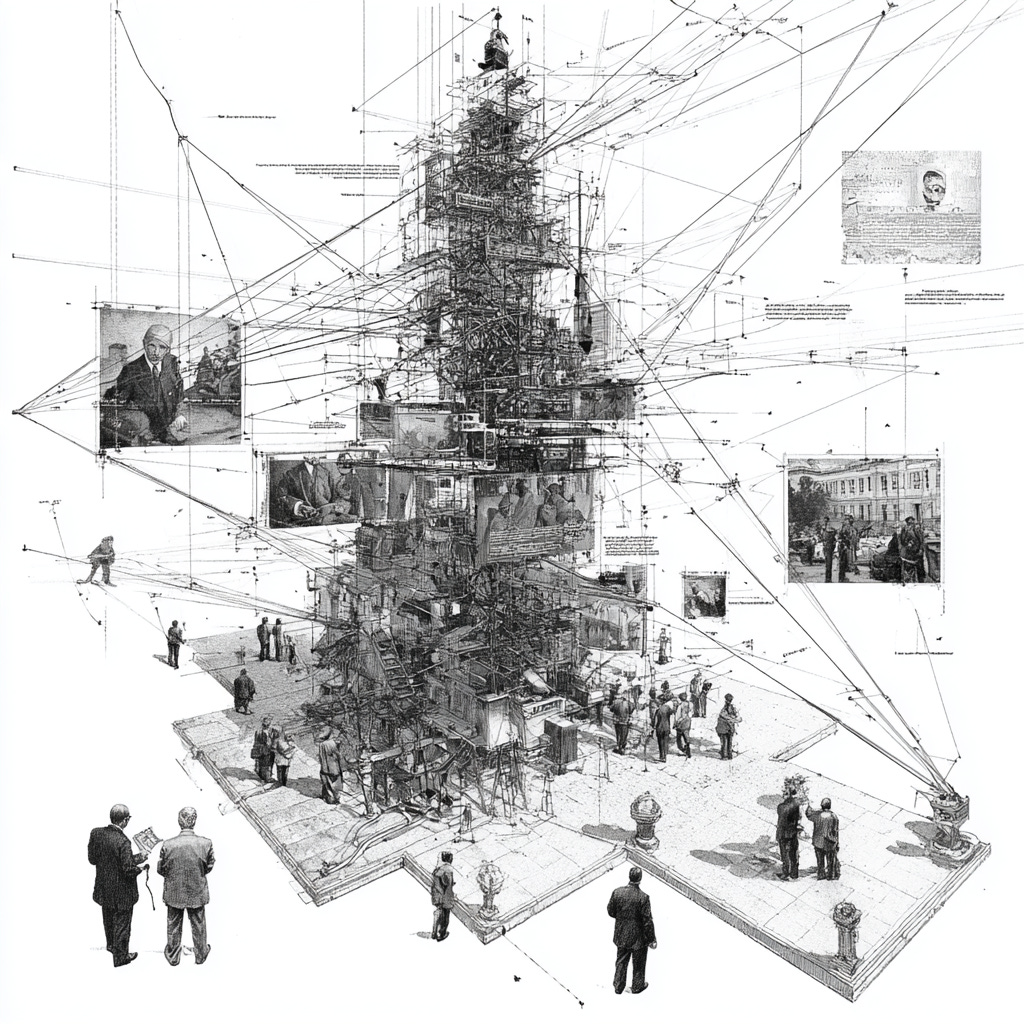
Democracy is usually measured in votes, institutions, constitutions, and rights. But those are surface indicators. The deeper question is whether a society can systematically convert human potential into visible, improving, scalable contribution. A powerful democracy is not one where people merely participate; it is one where people build, challenge, refine, rise, and compound their impact over time.
Every society contains enormous latent capability. Intelligence, creativity, dissent, ambition, and pattern recognition are unevenly distributed but widely present. The central test of democracy is whether it lowers the friction between potential and first action, and whether it keeps that action alive long enough to matter. If activation fails, talent stays private. If selection fails, merit dies quietly. If mobility fails, cynicism replaces ambition.
The Contribution Engine is a structural model of how individual ability turns into societal strength. It begins with activation: whether people dare to try. It moves through signal formation: whether what they produce is coherent and grounded. It passes through exposure and survival: whether ideas can withstand social friction. It then reaches selection and improvement: whether merit wins and learning compounds. Finally, it culminates in mobility and recursion: whether contribution turns into leverage and raises the baseline for everyone else.
This architecture reveals something uncomfortable. Most democratic failure does not occur through overt repression. It happens through subtle distortions: initiation thresholds rise silently; proximity outweighs merit; dissent becomes socially expensive; feedback becomes shallow; credit leaks upward; roles freeze; and upward paths become opaque. The system still looks openâbut its compounding capacity decays.
In the agentic era, where machines execute at scale and humans increasingly govern goals, constraints, and rule systems, the bottleneck shifts upstream. Execution becomes cheaper; framing becomes decisive. The quality of information, the integrity of selection, and the speed of updating matter more than ever. If the human layer that sets objectives is distorted, automated systems will amplify those distortions with ruthless efficiency.
This is why the architecture of contribution is now a strategic issue. A democracy that protects speech but fails at merit-based selection will ossify. A society that encourages innovation but blocks status mobility will lose its most capable people. A culture that rewards consistency over updating will become brittle under uncertainty. Strength in the modern world depends less on control and more on learning velocity.
At its core, democratic power is the rate at which a society can transform distributed intelligence into coordinated, adaptive action. That transformation requires low activation friction, high signal integrity, safe dissent, fair filtering, real opportunity conversion, and long-term compounding. Remove any one of these and the system degrades quietly before it collapses visibly.
A strong democracy is not loud. It is generative. It produces more capable citizens each cycle, and it allows contribution to translate into influence without demanding conformity. When the engine works, competence rises, mobility expands, and the future becomes believable.
Summary
Group I: Activation Drivers
Goal of the group: convert latent potential into first attemptsâthe systemâs âboot sequence.â
1) Initiation Threshold
What it controls: the transition from âidea in headâ â âfirst action.â
System role: sets how many people even enter the contribution pipeline.
Hidden implication: lowering initiation threshold increases volume of attempts exponentially; raising it filters out not only low-quality attempts but also high-quality-but-risk-averse contributors (often the conscientious, the socially punished, the nonconforming).
2) Risk Surface
What it controls: perceived danger of contributing (social, economic, reputational).
System role: determines whether contributors persist after first exposure.
Hidden implication: when risk surface is high, society selects for either the reckless or the politically protectedânot for the most competent.
3) Attention Sovereignty
What it controls: ability to sustain deep focus.
System role: sets the maximum complexity of output an average person can produce.
Hidden implication: attention fragmentation doesnât just reduce productivity; it simplifies politics (shorter horizons, reactive coalitions, performative conflict).
4) Cognitive Bandwidth
What it controls: how much mental capacity remains after stress/uncertainty.
System role: sets population-wide âreasoning depth under load.â
Hidden implication: societies can look âirrationalâ politically when whatâs really happening is bandwidth collapse from precarity + overload + chaos.
5) Future Visibility
What it controls: whether effort has believable payoff.
System role: determines sustained investment into skill-building and long projects.
Hidden implication: if future visibility is low, even highly capable people shift into short-term optimization, cynicism, exit, or conformity.
Group-level diagnostic:
If this layer is weak, you donât get âbad contributions.â You get no contributions (or only contributions from insiders/extremes).
Group II: Signal Formation
Goal of the group: convert raw perception into usable signalâthe systemâs âidea quality engine.â
6) Reality Contact
What it controls: closeness to real constraints and consequences.
System role: ensures proposals are grounded rather than ideological theater.
Hidden implication: without reality contact, societies inflate confidence while degrading accuracyâhigh certainty, low validity.
7) Information Integrity
What it controls: whether inputs to cognition are reliable.
System role: protects the model from garbage-in/garbage-out.
Hidden implication: low integrity doesnât just produce false beliefs; it destroys coordination because people canât share a stable reference frame.
8) Framing Competence
What it controls: ability to compress complexity into coherent models.
System role: makes problems decidable rather than emotionally argued.
Hidden implication: in low-framing societies, debates are âvalues vs valuesâ because the system canât hold a shared model of trade-offs.
9) Translation Capacity
What it controls: whether internal complexity becomes communicable.
System role: determines whether insight becomes adoptable by others.
Hidden implication: low translation punishes deep thinkers and rewards confident simplifiers; it biases the system toward rhetorical dominance over conceptual power.
Group-level diagnostic:
If this layer is weak, you get noise masquerading as contributionâlots of output, low value, high polarization, low coordination.
Group III: Exposure & Survival
Goal of the group: get signal into the public arena and keep the contributor intactâthis is the âsocial membrane.â
10) Expression Channel Availability
What it controls: whether there are real outlets for contribution.
System role: turns private intelligence into public signal.
Hidden implication: when channels are captured or scarce, contribution becomes either underground or routed through patronage.
11) Dissent Protection
What it controls: whether critique can exist without destruction.
System role: supplies the systemâs error-correction mechanism.
Hidden implication: without dissent protection, institutions become blind. The system looks stable until it hits a wall, then breaks catastrophically.
12) Social Courage Training
What it controls: whether people can confront conflict without collapse.
System role: converts disagreement into refinement rather than escalation.
Hidden implication: courage isnât âbraveryâ; itâs a learned capacity to stay coherent under social heat. Without it, societies choose either silence or tribal war.
Group-level diagnostic:
If this layer is weak, you get self-censorship, conformity, and the rise of extreme voices (because moderate critique is punished).
Group IV: Selection & Improvement
Goal of the group: decide what gets taken seriously, and whether it improvesâthis is the âmerit filter + learning loop.â
13) Gatekeeper Density
What it controls: how many chokepoints exist.
System role: determines innovation velocity and outsider accessibility.
Hidden implication: more gates means more politics. Contributors spend effort on access management instead of quality improvement.
14) Merit vs Proximity Ratio
What it controls: whether quality beats connections.
System role: defines whether the system is an engine of mobility or an engine of elite reproduction.
Hidden implication: this is the most central anti-elitism variable. A society can have free speech and still be closed if proximity dominates selection.
15) Feedback Fidelity
What it controls: whether evaluation produces usable improvement data.
System role: drives the steepness of learning curves.
Hidden implication: low-fidelity feedback creates resentment and stagnation; people canât update because the system wonât tell them how.
16) Update Culture
What it controls: whether changing your mind increases or decreases status.
System role: controls system adaptability under uncertainty.
Hidden implication: âpunish updatingâ produces rigid ideology; âreward updatingâ produces compounding intelligence.
Group-level diagnostic:
If this layer is weak, you get bad selection (wrong things win) and no refinement (even good things donât improve). The system becomes self-sealing.
Group V: Mobility & Conversion
Goal of the group: convert validated contribution into leverageâopportunity, resources, influence. This is where contribution becomes durable.
17) Credit Retention
What it controls: whether creators keep attribution.
System role: ties contribution to personal mobility incentives.
Hidden implication: if credit leaks, only people who already have power keep benefitting. Everyone else learns âdonât contribute; itâll be stolen.â
18) Opportunity Access
What it controls: whether good work opens doors.
System role: makes contribution rational as a life strategy.
Hidden implication: without opportunity conversion, societies trap competence. People either exit or become bitter cynics.
19) Role Elasticity
What it controls: whether roles can expand with ability.
System role: retains high performers inside the system.
Hidden implication: rigid roles cause high-capacity people to route around institutions (found startups, leave public sector, leave country).
20) Resource Accessibility
What it controls: access to tools, capital, teams, infrastructure.
System role: determines whether ideas remain âopinionsâ or become reality.
Hidden implication: when resources are captured, societies look creative but donât build; they become commentators, not producers.
Group-level diagnostic:
If this layer is weak, contribution exists but doesnât compound into capacity. The system becomes extractive: it takes ideas without building contributors.
Group VI: Amplification & Recursion
Goal of the group: turn individual contribution into societal compoundingâthe long-term multiplier.
21) Network Multiplier
What it controls: connectivity among capable people.
System role: converts linear output into combinatorial progress.
Hidden implication: innovation is rarely solitary; itâs a graph phenomenon. Bad networks cause repeated reinvention and slow diffusion.
22) Social Proof Propagation
What it controls: whether success trajectories are visible and believable.
System role: feeds back into Activation by lowering initiation threshold.
Hidden implication: if social proof is dominated by elites/celebrities, ordinary competence feels irrelevant â motivation collapses.
23) Non-Conformity Shield
What it controls: whether high-variance thinkers survive early rejection.
System role: keeps the system from collapsing into lowest-common-denominator outputs.
Hidden implication: breakthroughs look strange before they look correct. A society without this shield selects for social smoothness over truth.
24) Compounding Baseline
What it controls: whether each cycle raises the starting point of the next.
System role: institutional memory + reusable infrastructure + durable norms.
Hidden implication: without compounding baseline, societies burn talent rebuilding basics each decade; progress becomes episodic, not cumulative.
Group-level diagnostic:
If this layer is weak, the society fails at long-term accumulationâit may have bursts of success but no durable upgrade of collective capacity.
The Drivers
I. ACTIVATION DRIVERS
(Energy & Initiation Layer of the Contribution Engine)
These five determine whether a person ever crosses from potential â action.
If this layer fails, nothing downstream matters.
1. Initiation Threshold
Simple Explanation
How hard is it for someone to go from âI have an ideaâ to âI will tryâ?
Longer Definition
The Initiation Threshold is the psychological and structural barrier between internal intention and first external action. It is the friction level that determines whether potential contributors begin participating in public, economic, or intellectual systems.
It includes emotional cost, bureaucratic friction, social risk, and uncertainty about consequences.
Low threshold = more attempts.
High threshold = paralysis.
Why Itâs Important
Most talent dies before exposure. Not because people lack intelligence â but because starting feels too costly.
Societies collapse contribution not by censorship â but by making initiation expensive.
If initiation requires:
permission,
perfection,
credentials,
ideological alignment,
then contribution becomes rare and elite-controlled.
A strong democracy lowers this threshold deliberately.
How It Works
Idea appears internally.
Person evaluates risk vs reward.
Person estimates effort required to start.
Person estimates probability of humiliation or failure.
Person decides to act or withdraw.
The threshold is crossed when perceived cost < perceived value.
Small reductions in friction massively increase participation volume.
Drivers & Strategic Design
1. Bureaucratic Friction
Driver: Number of steps required to start.
Strategy: Default-open channels. Reduce formal barriers. Minimize permission requirements.
2. Social Judgment Risk
Driver: Fear of embarrassment.
Strategy: Normalize drafts, prototypes, public iteration.
3. Clarity of Process
Driver: Knowing where to start.
Strategy: Public maps: âHow to propose,â âHow to publish,â âHow to build.â
4. Entry Cost
Driver: Financial or time cost of first action.
Strategy: Micro-grants, free tools, shared infrastructure.
5. Psychological Climate
Driver: Culture of ridicule vs culture of experimentation.
Strategy: Public reward for attempts, not just success.
2. Risk Surface
Simple Explanation
How dangerous is it to try publicly?
Longer Definition
Risk Surface describes the total exposure level a contributor faces when expressing, proposing, or building something visible.
It includes:
reputational risk,
economic retaliation,
social exclusion,
legal vulnerability,
online mob effects.
The higher the risk surface, the fewer contributors dare to participate.
Why Itâs Important
Even brilliant people self-censor if consequences are asymmetric.
High-risk environments create:
conformity,
silence,
safe mediocrity.
Low-risk environments create:
dissent,
innovation,
courageous critique.
The real test of democracy is not whether you can speak â but whether speaking destroys you.
How It Works
Person publishes idea.
System reacts (praise, critique, attack, silence).
Person updates internal risk model.
Future contribution frequency adjusts.
Risk Surface shapes long-term output volume.
Drivers & Strategic Design
1. Legal Protection
Strategy: Strong anti-retaliation laws.
2. Cultural Norms Around Disagreement
Strategy: Separate disagreement from moral condemnation.
3. Employer Retaliation Policies
Strategy: Protect off-duty speech and civic engagement.
4. Platform Dynamics
Strategy: Design moderation that reduces mob amplification.
5. Exit Credibility
Strategy: Ensure people can leave toxic environments without ruin.
3. Attention Sovereignty
Simple Explanation
Can you focus long enough to build something real?
Longer Definition
Attention Sovereignty is the degree to which individuals control their cognitive focus rather than being constantly fragmented by noise, media, or institutional overload.
Contribution requires sustained depth. Without it, people produce fragments, not systems.
Why Itâs Important
The most sophisticated democracy in the world collapses if its citizens cannot hold coherent thought.
Shallow attention produces:
reactive politics,
outrage cycles,
zero long-term projects.
Depth produces:
strategy,
innovation,
durable institutions.
How It Works
Information streams compete for attention.
Interruptions reset cognitive progress.
Fragmented focus reduces complexity capacity.
Reduced complexity capacity lowers quality of contribution.
Focus is an amplifier of intelligence.
Drivers & Strategic Design
1. Media Incentive Structures
Strategy: Reduce outrage economics; promote long-form.
2. Work Overload Culture
Strategy: Encourage protected deep-work time.
3. Digital Architecture
Strategy: Tools that support focus over distraction.
4. Educational Training
Strategy: Teach attention discipline as a civic skill.
5. Public Norms
Strategy: Prestige depth over performative busyness.
4. Cognitive Bandwidth
Simple Explanation
Do you have enough mental capacity left after survival to think clearly?
Longer Definition
Cognitive Bandwidth refers to the available mental processing capacity after stress, uncertainty, and emotional load are accounted for.
Scarcity (financial, social, psychological) consumes bandwidth and reduces higher-order thinking.
When people operate under chronic stress, executive function declines.
Why Itâs Important
Talent under stress behaves like mediocrity.
If large segments of society operate in survival mode:
strategic thinking disappears,
polarization rises,
simplifications dominate.
Democracy requires surplus cognition.
How It Works
Financial insecurity â mental load.
Mental load â reduced working memory.
Reduced working memory â simplified reasoning.
Simplified reasoning â poorer contributions.
Bandwidth is a multiplier on intelligence.
Drivers & Strategic Design
1. Economic Stability
Strategy: Reduce extreme precarity.
2. Administrative Complexity
Strategy: Simplify bureaucratic processes.
3. Health Infrastructure
Strategy: Mental health access as productivity investment.
4. Predictability of Rules
Strategy: Reduce uncertainty shock.
5. Crisis Frequency
Strategy: Build institutional resilience to reduce chaos.
5. Future Visibility
Simple Explanation
Can you see a believable path where your effort leads somewhere?
Longer Definition
Future Visibility is the clarity and credibility of upward or meaningful trajectories available to individuals.
If people cannot see:
mobility,
recognition,
influence,
impact,
they reduce effort investment.
Humans invest energy when future payoff is believable.
Why Itâs Important
When mobility looks fake, cynicism grows.
Cynicism kills long-term projects.
People stop trying not because they are lazy â but because expected return collapses.
How It Works
Person evaluates current position.
Person estimates upward path probability.
If perceived probability low â effort decreases.
If credible path exists â effort increases.
Visibility drives contribution volume.
Drivers & Strategic Design
1. Transparent Promotion Criteria
Strategy: Make advancement pathways explicit.
2. Public Success Stories
Strategy: Highlight real mobility cases.
3. Open Competence Registries
Strategy: Track and surface emerging talent.
4. Role Diversity
Strategy: Provide multiple impact pathways.
5. Anti-Elite Closure
Strategy: Prevent frozen hierarchies.
Summary of Activation Layer
If these five are strong:
More people start.
More people risk.
More people focus.
More people think deeply.
More people persist long enough to matter.
Activation is not about intelligence.
Itâs about reducing the friction between potential and first action.
II. SIGNAL FORMATION
(Turning perception into a usable contribution)
If Activation is about starting,
Signal Formation is about not being useless.
This layer determines whether raw thought becomes something structured, understandable, and valuable.
We go deep again.
6. Reality Contact
Simple Explanation
Are you actually touching real problems, or just talking about them?
Longer Definition
Reality Contact is the frequency and intensity with which a person engages directly with real-world constraints, consequences, users, failures, and trade-offs.
It determines whether ideas are grounded or abstract theater.
Without reality contact, contribution becomes ideological, speculative, or performative.
With strong reality contact, ideas are shaped by friction.
Why Itâs Important
Most intellectual failure comes from distance.
Distance creates:
moral oversimplification,
impractical proposals,
false certainty.
Reality contact introduces humility and precision.
The best democracies create constant citizen contact with real trade-offs.
How It Works
Person encounters constraint.
Constraint modifies assumption.
Assumption becomes refined hypothesis.
Hypothesis survives only if workable.
Reality is the compression algorithm of thought.
Drivers & Strategy
1. Proximity to consequences
Strategy: Encourage field exposure, cross-sector immersion.
2. Transparency of outcomes
Strategy: Make policy and system results visible.
3. Public data access
Strategy: Open performance metrics.
4. Citizen participation
Strategy: Involve people in real implementation processes.
5. Feedback loops from users
Strategy: Shorten distance between decision and impact.
7. Information Integrity
Simple Explanation
Are the facts youâre building on actually true?
Longer Definition
Information Integrity is the reliability, verifiability, and shared legitimacy of the data and narratives circulating within society.
Without integrity, signal formation collapses into noise.
You cannot build valid proposals on corrupted inputs.
Why Itâs Important
Garbage input â garbage output.
Low information integrity produces:
conspiracy spirals,
manipulation,
mass confusion,
fractured reality.
Democracy requires shared anchors.
Not identical opinions â shared facts.
How It Works
Person consumes information.
Person evaluates credibility.
Person builds mental model.
Model influences proposal quality.
Corrupted information corrupts contribution at scale.
Drivers & Strategy
1. Independent journalism
Strategy: Protect non-captured media ecosystems.
2. Fact-verification norms
Strategy: Normalize source transparency.
3. Platform algorithm design
Strategy: Reduce outrage amplification.
4. Media literacy education
Strategy: Teach signal detection skills.
5. Institutional transparency
Strategy: Reduce rumor incentives.
8. Framing Competence
Simple Explanation
Can you turn complexity into something coherent?
Longer Definition
Framing Competence is the ability to compress messy, multi-variable situations into structured models that preserve important trade-offs.
It is the difference between opinion and analysis.
It transforms confusion into usable architecture.
Why Itâs Important
Without framing:
people argue past each other,
problems stay undefined,
energy dissipates.
Framing is the backbone of contribution.
Democracy needs citizens who can model reality, not just react to it.
How It Works
Raw complexity enters.
Person identifies variables.
Variables are structured into relationships.
Trade-offs become visible.
Solution space becomes navigable.
Framing reduces chaos to decisionable form.
Drivers & Strategy
1. Systems-thinking education
Strategy: Teach modeling, not memorization.
2. Debate culture
Strategy: Encourage structured argument formats.
3. Exposure to complexity
Strategy: Avoid oversimplified narratives.
4. Mentorship
Strategy: Pair younger contributors with experienced modelers.
5. Incentives for depth
Strategy: Reward analytical clarity publicly.
9. Translation Capacity
Simple Explanation
Can you make your idea understandable to others?
Longer Definition
Translation Capacity is the ability to convert internal complexity into accessible language, visuals, prototypes, or demonstrations that others can grasp and evaluate.
Many brilliant people fail here.
If you cannot translate, you cannot scale.
Why Itâs Important
Ideas die not because theyâre wrong â but because theyâre unclear.
Translation enables:
collaboration,
adoption,
funding,
implementation.
Democracy depends on shared understanding.
How It Works
Internal model exists.
Person encodes model into communicable format.
Audience decodes and responds.
Misalignment is detected and refined.
Translation is the bridge between cognition and society.
Drivers & Strategy
1. Communication training
Strategy: Teach narrative clarity and visual explanation.
2. Prototype culture
Strategy: Encourage showing instead of telling.
3. Cross-domain dialogue
Strategy: Force ideas to survive outside their niche.
4. Platform design
Strategy: Support long-form and visual explanation.
5. Feedback loops
Strategy: Measure comprehension, not applause.
Summary of Signal Formation Layer
This layer answers one question:
Is the thing you are contributing structured, grounded, and understandable?
If Activation is energy,
Signal Formation is quality.
Without this layer:
democracy becomes noise,
debates become shouting,
policy becomes symbolic,
innovation becomes shallow.
With this layer strong:
ideas survive friction,
trade-offs are visible,
discourse improves,
solutions become realistic.
III. EXPOSURE & SURVIVAL
(Where ideas leave the individual and enter the social arena)
Activation gives energy.
Signal Formation gives quality.
But this layer decides:
Does the idea survive contact with society â or get crushed?
Most contribution systems fail here.
We go deep again.
10. Expression Channel Availability
Simple Explanation
Are there real places where you can put your idea into the world?
Longer Definition
Expression Channel Availability is the presence of accessible, functional outlets through which individuals can publish, propose, build, or test their ideas.
This includes:
media,
civic forums,
startup ecosystems,
internal company suggestion systems,
public consultations,
digital platforms.
Without channels, contribution suffocates before evaluation.
Why Itâs Important
If there is nowhere to express, intelligence becomes private frustration.
Expression channels convert internal thought â social signal.
Societies with weak channels produce:
underground resentment,
informal gossip networks,
zero institutional learning.
How It Works
Person has idea.
Person identifies outlet.
Outlet accepts or blocks submission.
Idea becomes visible or remains invisible.
If outlets are captured, limited, or hostile, contribution volume drops.
Drivers & Strategy
1. Platform pluralism
Strategy: Avoid concentration of speech control.
2. Institutional suggestion systems
Strategy: Companies and governments must have real intake channels.
3. Low-cost publishing
Strategy: Reduce financial and technical barriers.
4. Moderation transparency
Strategy: Make removal rules explicit and consistent.
5. Protection of alternative media
Strategy: Encourage decentralized expression environments.
11. Dissent Protection
Simple Explanation
Can you challenge power or majority opinion without being destroyed?
Longer Definition
Dissent Protection is the structural and cultural safeguard that prevents contributors from suffering disproportionate punishment when expressing disagreement, critique, or alternative proposals.
It protects:
whistleblowers,
reformers,
minority viewpoints,
uncomfortable truth-tellers.
Without dissent protection, the system selects conformity over competence.
Why Itâs Important
High-performing systems require internal correction.
Correction requires critique.
Critique requires safety.
Without dissent protection:
problems go uncorrected,
power ossifies,
innovation slows,
corruption rises.
How It Works
Contributor challenges dominant view.
System response determines future risk model.
If dissent survives â signal improves.
If dissent is punished â silence spreads.
Dissent protection determines intellectual courage density.
Drivers & Strategy
1. Legal safeguards
Strategy: Protect whistleblowers and minority speech.
2. Norm separation
Strategy: Separate criticism from moral condemnation.
3. Leadership modeling
Strategy: Leaders reward internal challenge publicly.
4. Appeal mechanisms
Strategy: Clear recourse against unfair suppression.
5. Cultural framing
Strategy: Frame dissent as system strengthening, not sabotage.
12. Social Courage Training
Simple Explanation
Have people learned how to disagree constructively?
Longer Definition
Social Courage Training refers to the cultural and educational reinforcement of behaviors that allow individuals to engage in difficult conversations, withstand social friction, and maintain integrity under pressure.
It is not innate.
It is learned.
Without training, people default to:
avoidance,
aggression,
tribal alignment,
silence.
Why Itâs Important
Democracy requires confrontation with complexity.
But confrontation without skill leads to chaos.
Social courage is the bridge between dissent and progress.
If people cannot withstand disagreement without emotional collapse, contribution collapses.
How It Works
Person expresses disagreement.
Emotional response triggered.
Skill determines whether discussion escalates or refines.
If refined â collective intelligence increases.
If escalated â fragmentation increases.
This node determines polarization trajectory.
Drivers & Strategy
1. Debate education
Strategy: Teach structured argument and steel-manning.
2. Emotional regulation training
Strategy: Normalize calm disagreement.
3. Conflict exposure
Strategy: Controlled exposure to opposing views.
4. Media modeling
Strategy: Highlight high-quality disagreement examples.
5. Prestige alignment
Strategy: Elevate those who change minds respectfully.
Summary of Exposure & Survival Layer
This layer answers:
When contribution becomes visible, does society refine it â or attack it?
If weak:
People retreat.
Conformity dominates.
Surface harmony hides deep stagnation.
If strong:
Critique sharpens ideas.
Dissent improves systems.
Courage compounds.
Activation creates attempts.
Signal Formation creates quality.
Exposure & Survival determines whether quality can live long enough to matter.
IV. SELECTION & IMPROVEMENT
(Where ideas are filtered, refined, and either elevated or buried)
Activation creates attempts.
Signal Formation creates quality.
Exposure makes it visible.
Now this layer answers:
Does the system select the best signal â or the most convenient signal?
This is where democracies either become meritocratic enginesâ¦
or elite-preserving machines.
We go deep.
13. Gatekeeper Density
Simple Explanation
How many people or institutions stand between your idea and opportunity?
Longer Definition
Gatekeeper Density is the number and rigidity of approval points that a contribution must pass through before reaching impact.
Each gate increases friction.
Each discretionary gate increases bias risk.
High gatekeeper density compresses innovation.
Why Itâs Important
Every extra approval layer:
slows iteration,
favors insiders,
increases political navigation costs.
When density is high, contributors spend more energy managing access than improving quality.
Low density systems produce velocity.
High density systems produce compliance.
How It Works
Idea enters evaluation.
Passes through multiple authority nodes.
Each node applies criteria (explicit or implicit).
Friction accumulates.
Many ideas die before merit is tested.
Gatekeeper Density controls system speed.
Drivers & Strategy
1. Number of formal approvals
Strategy: Collapse redundant approval layers.
2. Discretion vs rule-based criteria
Strategy: Replace vague discretion with explicit standards.
3. Concentration of power
Strategy: Decentralize evaluation nodes.
4. Administrative burden
Strategy: Simplify submission requirements.
5. Transparency of rejection
Strategy: Force explanation at each gate.
14. Merit vs Proximity Ratio
Simple Explanation
Does quality matter more than who you know?
Longer Definition
Merit vs Proximity Ratio measures whether contribution is evaluated based on intrinsic quality or on relational closeness to power centers.
High merit ratio = open mobility.
High proximity ratio = closed elite reinforcement.
This is the core determinant of status mobility.
Why Itâs Important
When proximity beats merit:
outsiders stop trying,
insiders optimize politics,
competence drains out.
Even small distortions compound over time.
This is where democracies silently fail.
How It Works
Proposal evaluated.
Evaluator subconsciously weighs:
familiarity,
loyalty,
shared identity,
past affiliation.
If proximity weight > merit weight â distortion.
Over time, system quality declines.
Drivers & Strategy
1. Blind evaluation systems
Strategy: Remove identity markers when possible.
2. Transparent scoring criteria
Strategy: Publish weighting systems.
3. Rotating evaluators
Strategy: Prevent static networks.
4. External audits
Strategy: Review promotion and funding patterns.
5. Public performance tracking
Strategy: Tie decisions to measurable outcomes.
15. Feedback Fidelity
Simple Explanation
When you are evaluated, do you actually learn something useful?
Longer Definition
Feedback Fidelity measures whether critique contains actionable information that enables improvement, rather than vague dismissal or ideological rejection.
High fidelity feedback accelerates growth.
Low fidelity feedback produces stagnation or resentment.
This is the refinement engine.
Why Itâs Important
If contributors cannot extract improvement data from rejection:
iteration slows,
emotional cost rises,
competence plateaus.
High-fidelity systems produce steep learning curves.
Low-fidelity systems produce bitterness.
How It Works
Contribution evaluated.
Evaluator produces response.
Response either:
identifies concrete improvement variables,
or signals only approval/rejection.
Contributor updates model accordingly.
Feedback quality determines iteration velocity.
Drivers & Strategy
1. Structured evaluation templates
Strategy: Force specific criteria-based comments.
2. Reviewer training
Strategy: Train evaluators in constructive critique.
3. Iteration windows
Strategy: Allow revision after feedback.
4. Incentives for mentoring
Strategy: Reward evaluators who develop talent.
5. Time allocation
Strategy: Prevent rushed superficial review.
16. Update Culture
Simple Explanation
Does changing your mind increase or decrease your status?
Longer Definition
Update Culture is the social norm around belief revision, error correction, and public acknowledgment of improvement.
If updating reduces status, people defend bad positions.
If updating increases status, intelligence compounds.
This is one of the most powerful multipliers in the entire system.
Why Itâs Important
Without update culture:
polarization rises,
errors persist,
systems stagnate.
With strong update culture:
learning accelerates,
collaboration improves,
humility becomes strength.
The difference between stagnation and progress often lies here.
How It Works
New evidence appears.
Contributor reassesses position.
Social response determines future update willingness.
If rewarded â faster learning loops.
If punished â rigidity increases.
Update Culture controls system adaptability.
Drivers & Strategy
1. Public examples of leaders revising views
Strategy: Model updating as strength.
2. Remove âgotchaâ incentives
Strategy: Discourage humiliation culture.
3. Structured debate formats
Strategy: Include âwhat changed my mindâ sections.
4. Reputation tied to accuracy over consistency
Strategy: Reward predictive success, not stubbornness.
5. Long-term tracking
Strategy: Evaluate contributors over accuracy trajectory.
Summary of Selection & Improvement Layer
This layer determines:
Whether quality survives.
Whether outsiders can rise.
Whether contributors grow.
Whether learning compounds.
If this layer fails:
Elites freeze.
Innovation slows.
Cynicism grows.
Brain drain begins.
If this layer works:
Status mobility accelerates.
Systems self-correct.
Intelligence compounds across generations.
V. MOBILITY & CONVERSION
(Where validated contribution turns into power, opportunity, and real-world scale)
This layer determines:
Does impact translate into influence and capacity â or does it evaporate?
If this layer fails, even good systems stagnate.
17. Credit Retention
Simple Explanation
When you create something valuable, do people know it was you?
Longer Definition
Credit Retention is the ability of a contributor to preserve visible authorship and recognition for their work as it moves through institutions, companies, or public systems.
If credit leaks upward or sideways, status mobility collapses.
Contribution must convert into reputation.
Why Itâs Important
Without credit retention:
Incentive drops.
Talent withdraws.
Middle layers absorb innovation.
Cynicism rises.
Credit is the currency that fuels the next contribution cycle.
How It Works
Contribution produces value.
Value is observed.
Attribution is either:
preserved and visible,
diluted,
or reassigned.
Future opportunity is adjusted accordingly.
Credit retention defines mobility fairness.
Drivers & Strategy
1. Transparent authorship tracking
Strategy: Publicly attribute contributions.
2. Recognition systems
Strategy: Reward creators, not only leaders.
3. Anti-appropriation norms
Strategy: Penalize credit theft.
4. Documentation culture
Strategy: Record contribution history.
5. Distributed acknowledgment
Strategy: Avoid âsingle heroâ narratives.
18. Opportunity Access
Simple Explanation
Does good work open new doors?
Longer Definition
Opportunity Access is the conversion rate between validated contribution and new roles, projects, funding, or decision-making positions.
If good work does not create new opportunity, the system stalls.
Mobility requires conversion.
Why Itâs Important
When opportunity remains closed:
competence has no upward path,
influence concentrates,
effort declines.
This is the main engine of status mobility.
How It Works
Contribution validated.
System assesses contributor.
Contributor either:
receives new responsibility,
gains access to projects,
or stays static.
Static outcomes reduce future attempts.
Opportunity access controls ambition levels.
Drivers & Strategy
1. Transparent promotion paths
Strategy: Clear criteria for advancement.
2. Open calls for leadership roles
Strategy: Reduce hidden appointments.
3. Public talent pipelines
Strategy: Surface rising contributors.
4. Cross-sector mobility
Strategy: Enable movement between institutions.
5. Performance-based access
Strategy: Tie opportunities to measurable outcomes.
19. Role Elasticity
Simple Explanation
Can your role expand as your ability expands?
Longer Definition
Role Elasticity measures whether institutional positions adapt to growing competence or remain rigid and predefined.
Rigid roles trap talent.
Elastic roles allow influence to scale with ability.
Why Itâs Important
When roles are fixed:
ambitious people leave,
systems become stagnant,
informal power networks emerge.
Elastic roles allow contributors to grow without exiting the system.
How It Works
Contributor demonstrates increasing capacity.
Institution either:
expands scope of authority,
or confines individual to narrow function.
Expansion increases impact.
Confinement creates frustration.
Role elasticity controls retention of high performers.
Drivers & Strategy
1. Flexible job structures
Strategy: Allow evolving responsibilities.
2. Modular authority systems
Strategy: Add decision rights gradually.
3. Project-based leadership
Strategy: Rotate leadership by competence.
4. Performance review tied to growth
Strategy: Recognize capability expansion.
5. Reduced hierarchy rigidity
Strategy: Flatten unnecessary layers.
20. Resource Accessibility
Simple Explanation
Can you access the tools and capital needed to scale your idea?
Longer Definition
Resource Accessibility is the ability to convert validated ideas into funded, supported, and operational initiatives.
It includes:
funding,
infrastructure,
talent,
technical capacity.
Without resources, contribution stays theoretical.
Why Itâs Important
Many democracies fail not at idea generation â but at scaling.
When resources are captured by incumbents:
new entrants stall,
innovation clusters shrink,
status mobility freezes.
Resource flow determines systemic dynamism.
How It Works
Idea validated.
Contributor seeks resources.
Allocation process either:
enables scaling,
or blocks through favoritism or scarcity.
Scaled impact compounds status.
Resource flow determines who builds the future.
Drivers & Strategy
1. Competitive funding mechanisms
Strategy: Transparent grant systems.
2. Open infrastructure access
Strategy: Shared labs, platforms, compute.
3. Decentralized capital pools
Strategy: Reduce concentration risk.
4. Micro-funding pathways
Strategy: Support early-stage experimentation.
5. Outcome-based allocation
Strategy: Tie scaling to demonstrated performance.
Summary of Mobility & Conversion Layer
This layer determines:
Whether contribution compounds.
Whether talent stays.
Whether influence reflects competence.
Whether systems refresh themselves.
If this layer fails:
Elite ossification.
Brain drain.
Informal patronage networks.
Cynical disengagement.
If this layer works:
Influence tracks impact.
Roles evolve with ability.
Resources flow toward performance.
Democratic strength compounds.
VI. AMPLIFICATION & RECURSION
(Where contribution compounds and becomes civilizational force)
Everything before this determines whether contribution happens.
This layer determines:
Does contribution scale and permanently upgrade the system â
or does it reset every generation?
This is the compounding layer.
21. Network Multiplier
Simple Explanation
Can your contribution connect with other capable people and grow bigger than you?
Longer Definition
Network Multiplier measures how easily individual contributors connect with other high-capacity individuals across domains, institutions, and hierarchies.
Contribution becomes power when it connects.
Isolated brilliance scales slowly.
Connected brilliance scales exponentially.
Why Itâs Important
Innovation and governance are combinatorial.
When networks are open and fluid:
ideas cross-pollinate,
speed increases,
blind spots shrink.
When networks are closed:
cliques dominate,
information recycles,
stagnation follows.
Network density determines system intelligence.
How It Works
Contributor produces value.
Network visibility determines who sees it.
Connections form.
Collaboration amplifies output.
Collective output exceeds individual output.
Network multiplier converts linear impact â exponential impact.
Drivers & Strategy
1. Cross-domain forums
Strategy: Mix disciplines intentionally.
2. Transparent collaboration platforms
Strategy: Publicly visible project spaces.
3. Reduced hierarchy barriers
Strategy: Enable access across levels.
4. Incentives for collaboration
Strategy: Reward shared credit outcomes.
5. Geographic mobility
Strategy: Enable movement between clusters.
22. Social Proof Propagation
Simple Explanation
Do people see real examples of contribution working?
Longer Definition
Social Proof Propagation refers to the visibility and replication of successful contributions across society.
When success stories are visible and credible, initiation increases.
Humans copy trajectories they see.
Why Itâs Important
If upward mobility is invisible:
effort drops,
cynicism rises,
myths replace reality.
Visible contribution success lowers initiation threshold for others.
This node feeds back into Activation.
How It Works
Contributor succeeds.
Success becomes public.
Others observe.
Perceived feasibility increases.
More people initiate.
This is the cultural amplification loop.
Drivers & Strategy
1. Transparent success tracking
Strategy: Publicly show who built what.
2. Non-elite storytelling
Strategy: Highlight diverse contributors.
3. Data-driven reporting
Strategy: Tie narratives to measurable impact.
4. Avoid mythologizing
Strategy: Show process, not just outcome.
5. Institutional celebration
Strategy: Reward constructive contribution publicly.
23. Non-Conformity Shield
Simple Explanation
Can unconventional thinkers survive long enough to matter?
Longer Definition
Non-Conformity Shield is the structural protection of individuals whose cognitive style, identity, or approach deviates from dominant norms but produces valuable signal.
Every breakthrough initially looks strange.
Without protection, high-variance thinkers are filtered out prematurely.
Why Itâs Important
Homogeneity creates safety â not progress.
Innovation requires variance.
Variance requires protection.
Systems without this shield select for comfort, not capability.
How It Works
Divergent idea emerges.
Social system reacts.
If shield exists â idea enters evaluation.
If shield absent â idea suppressed early.
This node protects future breakthroughs.
Drivers & Strategy
1. Blind evaluation systems
Strategy: Reduce bias against unconventional profiles.
2. Cultural tolerance norms
Strategy: Separate âdifferentâ from âdangerous.â
3. Institutional experimentation quotas
Strategy: Allocate space for high-variance projects.
4. Neurodiversity inclusion
Strategy: Design roles that leverage atypical cognition.
5. Anti-ridicule norms
Strategy: Penalize dismissal without evaluation.
24. Compounding Baseline
Simple Explanation
Does each contribution make the next one easier?
Longer Definition
Compounding Baseline is the accumulated structural improvement created by past contributions.
It determines whether society upgrades its starting point after each cycle â or resets to zero.
Compounding occurs when:
knowledge is preserved,
institutions adapt,
networks expand,
credibility increases.
Why Itâs Important
Civilizational strength is compounding intelligence.
If gains are not preserved:
history repeats,
talent wastes effort rebuilding,
institutions remain fragile.
Compounding is the difference between temporary success and durable strength.
How It Works
Contribution creates new capability.
Capability is institutionalized.
Future contributors start from higher base.
Baseline intelligence rises.
Without compounding, cycles stagnate.
Drivers & Strategy
1. Knowledge preservation systems
Strategy: Archive lessons transparently.
2. Institutional memory
Strategy: Prevent loss during leadership turnover.
3. Long-term incentive alignment
Strategy: Reward durable impact.
4. Infrastructure permanence
Strategy: Maintain shared platforms.
5. Cross-generational mentoring
Strategy: Transfer accumulated wisdom.
Recent Posts

The Agentic Economy: The Arguments
September 13, 2026

The ČVUT Playbook: What Czech Technical University Should Actually Do
September 10, 2026