



Axiocracy: The Future of Capitalism
October 27, 2026

Prepared by the ENSI Foresight Division. Built on the 183-document primary library assembled for this programme — NBER, IZA, the ILO, the OECD, the World Bank, UNU-WIDER, Nature, the Stockholm Resilience Centre, arXiv and thirty other institutions — and written without new sourcing, as a forecast tested against evidence already in hand. Compiled 24 October 2026.
Full manifesto at https://axiocracy.org
Something is changing in the relationship between a firm and the people who do its work, and the usual description of it is wrong in a way that matters for everyone planning around it.
The usual description is mass displacement: agents get good enough, firms fire at scale, and the fired go off to start things. The evidence in this library does not support that sequence. The OECD’s employer and worker surveys across seven countries found no measured job-level or wage effect from AI adoption, with early adopters adjusting through slowed hiring rather than dismissals. The ILO’s global task-exposure scoring finds only clerical work highly exposed, at 24% of clerical tasks against 1–4% for every other occupational group — and automation-exposed employment running from 0.4% in low-income countries to 5.5% in high-income ones. Acemoglu’s bottom-up estimate caps the whole productivity effect at no more than 0.66% of total factor productivity over ten years, and under 0.53% once genuinely hard-to-learn tasks are separated out, against the 7%-of-global-GDP forecasts in circulation.
So the first correction: this arrives as a hiring freeze, not a firing wave. And that is not a milder version of the same thing — it is a different event with a different victim. A firing wave falls on incumbents, who have tenure, severance, networks, savings and a track record. A hiring freeze falls on entrants, who have none of those. The surge in one-person companies will therefore be supplied disproportionately by people who never got in, not by people pushed out — and that inverts almost every assumption about what support the transition needs.
What the evidence does support is a change in the unit of account. Three things are happening at once, and together they point somewhere specific.
First, judgement is becoming the scarce input, and judgement does not sit in software. This is the oldest argument in the library and it has been repurposed by circumstance. Hayek’s claim about dispersed knowledge was never about computation — the socialist calculation debate established decades later that the arithmetic is tractable, with sparsity reducing a ten-million-product plan from an infeasible 10²¹ operations to roughly seventeen minutes. His actual objection was about the acquisition of local, tacit, fast-changing knowledge, and nobody in eighty years has answered it. That objection is now the strongest available case for why a person operating agents outperforms a system: not because the person computes better, but because the person holds the coefficients. A unit consisting of one operator plus a stack of agents has the leverage of software and the local knowledge of a specialist, which is a combination that did not previously exist at a price any firm could pay.
Second, firms are discovering they can buy an owned outcome instead of filling a role. Once a function’s output is separately attributable, a firm can contract for the result and let someone else hold the method. This is where the specialisation argument becomes concrete, and where most of this report’s analytical work is done: not every corporate function can be packaged this way, the ones that can are identifiable in advance, and the test is sharper than “is it repetitive.”
Third, the people doing the work want the ownership, and will take it one way or another. This is the part firms are least prepared for. A specialist who holds the method, the relationships and the agent stack has an exit option that a role-holder does not. Keeping such a person requires giving them something that looks like ownership — and the historical record on whether incumbents actually do that is the most important evidence in this report, because it is unambiguous and it is discouraging.
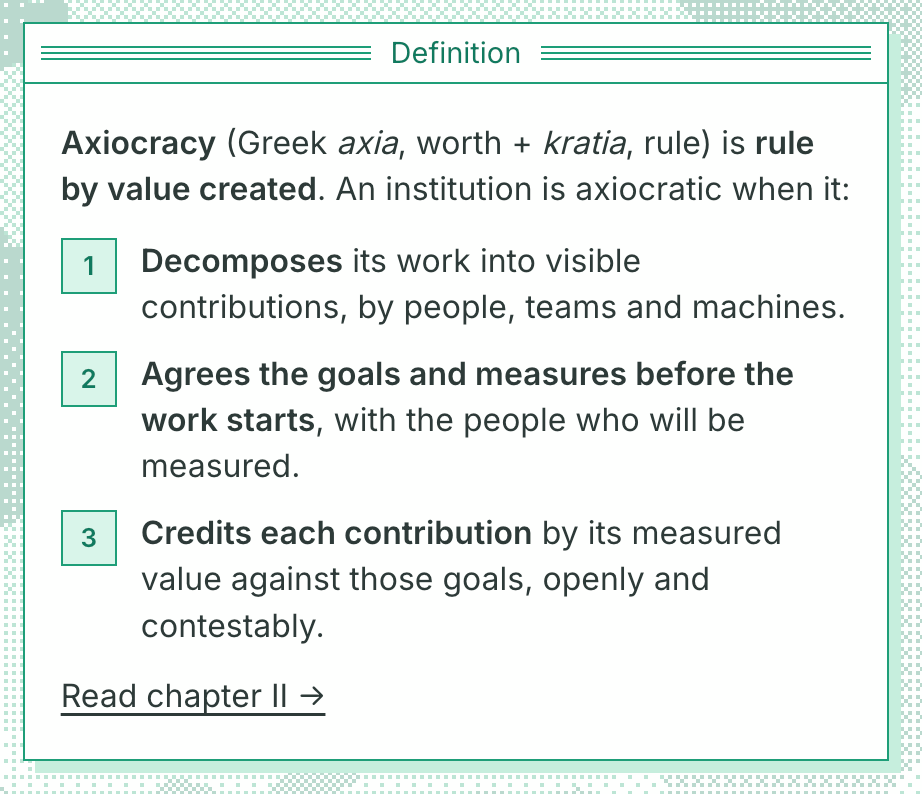
Call the resulting arrangement axiocracy — rule by measured worth, in which standing inside and outside a firm derives from attributable contribution rather than position. The name carries a claim, and the claim should be stated so it can be doubted: that value will be measured well. Nothing in this library supports that. The strongest finding on measurement regimes is that they change behaviour long before they measure correctly, and that what cannot be counted gets discounted. An axiocracy that measures badly is not a meritocracy with noise; it is a system that systematically reallocates reward toward whatever happens to be legible. That is the central risk in the whole shift and it is treated as such below.
One more framing point, because it determines whether any of this is stable. The companion report in this series found that institutions work in matched sets — Hall and Soskice’s complementarity result, where institutional practices cluster non-randomly across nations and importing one component into an economy lacking its complements buys the cost without the return. Every protective institution we have was built for the employment relationship. Denmark, the best-protected labour market in the OECD, with 82% bargaining coverage against the UK’s 27%, leaves the solo self-employed and zero-hours workers outside the model entirely. A shift toward micro-suppliers therefore moves people out from under every guardrail simultaneously, and the guardrails do not follow automatically. That is the binding constraint on axiocracy being an improvement rather than a redistribution of risk downward.
The shift arrives as a hiring freeze, not a firing wave. The OECD finds no measured employment or wage effect, with adjustment via slowed hiring; the ILO finds only clerical work highly exposed at 24% of tasks. The burden lands on entrants, not incumbents.
Judgement, not code, is the scarce input. Hayek’s dispersed-knowledge objection was never answered, and it is now the best available explanation for why one operator plus agents beats a system — the operator holds the coefficients.
The unit of value becomes the owned process, not the filled role — and only functions with attributable output, a clean handover boundary and tolerable error cost can be packaged that way.
Measurement becomes the constitution, and the unmeasurable gets dropped. This is axiocracy’s defining risk; nothing in the evidence suggests measurement regimes measure well before they start changing behaviour.
Incumbents will grant P&L, not ownership. Kremer’s observation that “ESOPs transfer ownership of the firms to workers without transferring control” is why they scale — and Mondragón’s cooperative share of employment fell from 86% in 1991 to 29.5% in 2007 because members do not admit members.
The capital-rental design is the escape from the trap that has kept cooperatives at 0.38% of world employment. Brzustowski and Caselli find a cooperative economy at 73% of capitalist output purely through under-sizing — and that if individuals own capital and cooperatives rent it, “the cooperative economy becomes isomorphic to the capitalist one.”
Returns will follow a power law. In the nearest existing analogue of autonomous production, 5% of open-source developers — roughly 3,000 people — produce over 96% of the usage value, and the median successful free-software project has one contributor.
A credible floor is the precondition for the entrepreneurship, not a substitute for it. Kenyan recipients invested in new enterprises because income was guaranteed for twelve years — and lost the entire gain to one shock.
Buyer power replaces employer power. Labour markets already run an average concentration index of 3,157 with a wage-concentration elasticity of −0.127, a 17% wage penalty across the distribution; converting workers into suppliers converts that into procurement power over micro-firms with no employment protection at all.
Reputation becomes infrastructure, and it does not exist yet. If the unit of value is an owned process with a named owner, a portable verifiable record of delivery is the scarce asset — and there is currently no such record.
Specialisation can now go deeper than any firm ever permitted. The historical ceiling on the division of labour was never cognitive — it was that a narrow specialist could not operate alone. Agents supply the adjacent competencies, so the minimum viable scope of a specialist collapses.
Of the ten parameters that decide robustness, only two are about capability. The other eight concern who can measure, who can leave, who can be replaced and who carries the downside — and most are currently set against the unit.
Part One maps specialisation inside a large corporation. It proposes a five-part test for whether a function can become a performance-valued unit, applies it to roughly thirty corporate functions, and sorts them into three tiers. The test matters more than the list, because the list will date and the test will not.
Part Two sets out the ten principles of the shift, each tied to evidence already in the library rather than to extrapolation. Where a principle rests on an analogy rather than a measurement, it says so.
Part Three sets the control surface — the ten parameters that determine whether the arrangement is robust, selected by scoring thirty-two candidates on leverage, evidence, actionability and failure asymmetry. Only two of the ten turn out to be about capability.
Part Four states what breaks it — the three failure modes that would turn axiocracy from a redistribution of agency into a redistribution of risk.
Most discussion of which work can be packaged into an autonomous unit uses the wrong criterion. “Is it repetitive?” sorts badly: plenty of repetitive work is impossible to hand over because nobody can say whether it was done well, and plenty of judgement-heavy work hands over cleanly because the output is a decision someone either accepts or rejects.
Five properties determine whether a corporate function can become a performance-valued unit. A function needs all five. There is also a sixth condition that acts as a veto rather than a score.
1. Attributable output. Can this unit’s contribution be separated from everything else that moved at the same time? This is the binding constraint far more often than capability is. Lead generation passes easily — meetings booked, pipeline created, cost per qualified opportunity. Internal communications fails: the output is real and almost impossible to isolate. Note that attribution is not the same as measurement. Plenty of functions produce abundant numbers that cannot be causally assigned to the unit producing them, and axiocracy will mistake the second for the first constantly.
2. A clean handover boundary. Can the work be specified going in and received coming out, without the receiver having to reconstruct the method? A unit whose output requires the client to understand its internals has not been separated; it has been renamed.
3. Agent leverage. Does one operator with a stack of agents actually replace a team, rather than becoming a bottleneck in front of one? The honest test is whether the operator’s time scales sub-linearly with volume. Where it does not, the unit is a person with extra steps.
4. Low asset specificity. Can the unit serve more than one client without rebuilding itself? This property does no work for capability and all the work for power, which is why it is the most under-discussed of the five and gets its own treatment below.
5. Tolerable error cost. When the unit is wrong, can the firm absorb it? Not “will it be wrong” — everything is sometimes wrong — but whether the failure is recoverable, visible in time, and bounded in size.
The veto: transferable accountability. Some functions cannot be externalised at any price, because the consequence cannot be moved. Where a regulator, a court or a board holds the firm responsible regardless of who performed the work, the firm may buy the labour but it cannot buy the accountability — and a unit that carries the work without the consequence is not an owner of anything. This veto is what will keep far more work inside firms than capability alone would predict.
Here is the prediction worth taking away from this section, and it falls out of the fourth property rather than from any judgement about skill.
A specialist whose unit can serve other clients will be offered ownership. A specialist whose unit cannot will be offered a dashboard and a bonus.
The mechanism is exit, not merit. A unit built on the firm’s proprietary data, its internal systems, its particular customer relationships and its idiosyncratic processes has nowhere to go — and a firm facing a specialist with no exit option has no reason to concede anything structural. A unit built on a transferable method, its own tooling and its own relationships can walk, and the firm must either match what the market would pay for the whole unit or lose it.
This cuts across the capability tiers in an uncomfortable way. Some of the most valuable in-house specialists will have the least leverage, precisely because their value is firm-specific. And some of the most ordinary functions will be the first to win real autonomy, because they are the easiest to take elsewhere. The evidence for this pattern is not from the agent era but from the ownership literature, and it is discussed in Part Two under principles five and six.
These functions pass all five tests today, with error costs that are bounded and attribution that is already instrumented in most large firms. Each is listed with the attributable unit of output that makes it packageable.
Outbound lead generation and prospecting — qualified opportunities created, cost per opportunity, pipeline conversion by source. The cleanest case in the corporation: the output is a dated, named, countable object.
Recruitment sourcing and screening — qualified candidates presented per role, time to shortlist, shortlist-to-offer rate. Note the boundary: the hiring decision fails the accountability veto in most jurisdictions and stays inside.
Onboarding — time to productivity, 30/60/90-day completion, provisioning accuracy, first-90-day attrition. A strong candidate precisely because its output is a measurable state change in a specific person on a specific date.
Content production and documentation — assets shipped against brief, coverage of the documentation surface, support-ticket deflection attributable to published material.
Localisation — languages covered, turnaround, defect rate on review. Already an external market, which is the tell.
Organic acquisition and search — non-brand traffic, ranking coverage, assisted conversions.
Paid acquisition — cost per acquisition against a target, contribution margin on spend. Fully instrumented and already frequently external.
Bookkeeping and month-end close — days to close, restatement rate, reconciliation exceptions outstanding.
Receivables and collections — days sales outstanding, recovery rate by ageing bucket, dispute resolution time. One of the few where the unit’s performance is directly convertible to cash, which makes performance-based pricing trivial.
Payables and invoice processing — invoices per period, exception rate, duplicate-payment and early-payment-discount capture.
CRM hygiene and data enrichment — record completeness, duplicate rate, decay rate against verified sources.
Tier-one customer support — first-contact resolution, time to resolution by band, escalation rate, satisfaction on closed contacts. Note the Indian gig-economy evidence below on what happens when the escalation path to a human is removed — a failure mode this function invites.
Test authoring and regression — coverage against the change surface, escaped-defect rate, time from build to signal.
Competitive and market intelligence — briefs delivered against a watch list, lead time on material competitor events.
Procurement sourcing — cycle time, savings against baseline, supplier qualification throughput. The award decision hits the accountability veto and stays.
Compliance evidence collection — control coverage, evidence freshness, audit findings attributable to missing documentation. The evidence gathering packages; the compliance opinion does not.
First-pass contract review — contracts triaged, deviation flags against a clause playbook, cycle time to legal. Legal sign-off stays inside under the veto.
Reporting and data pipeline operation — pipeline uptime, freshness against SLA, reconciliation to source of record.
These fail one property as currently organised, and the failure is usually attribution or error cost rather than capability. Each can be made into a unit, but only after the firm does the work of defining what the unit is accountable for. Most firms will skip that work and then conclude the function “can’t be outsourced.”
Sales engineering and solution design — attribution is entangled with the account team. Fixable by scoping to technical-win rate on qualified opportunities.
Financial planning and forecasting — forecast accuracy is measurable but the unit does not control the outcome it forecasts. Scope to forecast error and cycle time, never to the result.
Pricing analytics — high leverage, high error cost, and attribution confounded by everything else in the market. Needs a containment design: recommendations with a human decision gate.
Learning and development design — the output is a capability change that takes quarters to appear. Packageable against completion and assessed competence, which are proxies and should be labelled as such.
Internal communications — fails attribution badly. Possible only against narrow instrumented objectives such as policy acknowledgement or enrolment rates.
HR business partnering — part transactional and packageable, part judgement under the accountability veto. The split is the design work.
Partner and channel management — attribution shared with the partner. Scope to partner-sourced pipeline and enablement milestones.
Security monitoring and triage — tier-one triage packages on mean time to detect and false-positive rate; incident response carries non-transferable accountability.
Product analytics — packageable on question throughput and decision support; dangerous if scoped to outcomes the unit does not control.
Customer success and renewals — renewal rate is attributable but heavily confounded by product quality. Workable with a clear split between the unit’s motions and the product’s effects.
Payroll and benefits administration — high attributability and very low error tolerance. Already externalised in much of the market, which is the proof it works; the constraint is accuracy, not measurability.
These fail on attribution, firm-specific tacit knowledge, or the accountability veto. The prediction is that they stay inside and that the people doing them become more central as the tier-one layer thins, because they are what the firm still irreducibly is.
Strategy and capital allocation — the output is a judgement whose quality is revealed over years, with no counterfactual. Not measurable in any period short enough to pay against.
Culture and leadership — fails attribution completely; also the thing that determines whether every tier-one unit cooperates.
Board, governance and fiduciary duty — the accountability veto in its purest form.
Crisis management — error cost unbounded, and the knowledge needed is almost entirely firm-specific and relational.
Safety-critical engineering — error cost unbounded and the liability is not transferable regardless of contract.
Regulatory and institutional relationships — the asset is a relationship held in a person’s standing with a named counterparty, which cannot be specified at an interface.
Mergers, acquisitions and divestment — rare, enormous, unmeasurable per instance.
Litigation strategy and privileged advice — privilege and accountability both resist externalisation.
Three consequences follow, and all three are already visible in adjacent evidence.
The firm hollows in the middle, not at the bottom. Tier one is where the measurable, interface-clean work sits, and much of it is currently performed by early-career staff as their route into the organisation. Removing it does not primarily remove jobs from the people currently doing it — the OECD’s finding is that adjustment comes through slowed hiring — it removes the entry ladder. The firm retains tier three, buys tier one, and discovers in five years that it has no internal supply of people who understand how the tier-one work actually behaves.
Coordination cost becomes the real constraint, and it is routinely underestimated. A firm running thirty external performance-valued units has replaced management with procurement, and procurement at that granularity is itself a substantial function. The honest version of this transition includes a new internal capability — specifying, contracting, measuring and arbitrating across many small suppliers — which is not free and which nobody budgets for. The commons literature in this library is pointed on this: Ostrom’s design principles make monitoring by monitors accountable to the users a load-bearing requirement, and the experimental result is that externally imposed rules with weak inspection probability produced more defection than communication alone. Imposed measurement without accountable monitoring makes cooperation worse, not better.
The displacement story is the wrong shape. The OECD’s seven-country employer and worker surveys found no measured job-level or wage effect, with early adopters adjusting through slowed hiring rather than dismissals — while simultaneously recording that 27% of employment sits in high-automation-risk occupations and three in five workers expect to lose their job to AI within a decade. Both things are true: the fear is widespread and the dismissals are not happening. The ILO’s task-level scoring explains why the effect is smaller than expected — only clerical work is highly exposed, at 24% of clerical tasks, against 1–4% for every other occupational group, with automation-exposed employment at 0.4% of employment in low-income countries rising to only 5.5% in high-income ones. And Acemoglu’s estimate caps the aggregate productivity gain at 0.66% of TFP over ten years, under 0.53% once hard-to-learn tasks are separated.
Three consequences, all of which cut against the standard planning assumption.
The burden falls on entrants. A freeze is invisible in the unemployment statistics of incumbents and devastating for people trying to get in. The people who will populate the new one-person companies are therefore not experienced specialists leaving with a client list; they are disproportionately people who never acquired the client list, the method or the institutional knowledge in the first place. Support designed for displaced mid-career professionals will miss them entirely.
The effects are gendered. The ILO finds 3.7% of global female employment automation-exposed against 1.4% of male, and 7.8% against 2.9% in high-income countries — and Acemoglu independently finds negative real-earnings effects concentrated on low-education women. Clerical work is where the exposure is, and clerical work is not evenly distributed.
The timeline is longer than the discourse and the pressure is more specific. Nothing here supports a cliff. What it supports is a decade of entry-level thinning, concentrated in administrative and clerical functions, which is precisely the tier-one layer mapped in Part One.
The case for a person in front of an agent stack is usually made on quality grounds and loses, because quality is improving. The durable case is informational, and it is the oldest unanswered argument in economics.
The socialist calculation debate resolved the computational question decades ago, and resolved it against the Austrians: exploiting the sparsity of a technical-coefficient matrix reduces a ten-million-product allocation from roughly 10²¹ operations — about 1.5 million years — to approximately seventeen minutes, and the one implemented-and-timed model scales polynomially at O(n^3.3). Computation was never the binding constraint.
What was never answered is Hayek’s actual objection, which concerned the acquisition of dispersed, local, tacit, fast-changing knowledge rather than the arithmetic performed on it once acquired. Cockshott and Cottrell concede the point explicitly: their argument “says nothing about the task of gathering the vast amount of data required.” And the catastrophic demonstration is in the famine evidence — the Great Leap Forward killed 17 to 30 million people with aggregate food production at least 205% above survival needs, because quotas set from stale data systematically over-procured the most productive regions. The model generating that result holds even under a utilitarian planner with no regional favouritism. It was not malice and it was not insufficient compute. It was an information architecture that could not see the present.
Transpose that to the firm. A software system acts on the state of the world as recorded. An operator acts on the state of the world as encountered — the deal that is about to go sideways for reasons nobody logged, the candidate whose hesitation means something, the process exception that is a signal rather than noise. The operator’s value is not that they work faster than the system but that they hold coefficients the system does not have. That is why an agent-operated unit can outperform both a pure software deployment and a conventional team, and it is a genuinely robust argument rather than a transitional one: the asymmetry does not close as models improve, because it is about the acquisition of local knowledge rather than the processing of it.
The honest limit: this argument predicts operators beat systems where local knowledge is decisive and predicts nothing where it is not. In high-volume, low-variance, fully instrumented work, the system wins and should.
A role is an input. A process with a named owner and an attributable number is an output. The shift from buying the first to buying the second is the actual content of axiocracy, and it has a precedent worth examining because it ran the experiment on whether accountability without pay change does anything.
Germany’s 1994 reform abolished mandatory one-third board representation for newly incorporated stock corporations while grandfathering it for older cohorts — a clean legal discontinuity, tested across the universe of German social security records. The results are a double negative that is directly instructive here. On wages: nothing. Point estimates of +0.4% to +2.3%, with confidence intervals ruling out anything above 4%, no change in the within-firm wage structure, an insignificant labour-share change of −0.03, and identical rent-sharing elasticities of about 0.07 in both groups. Giving workers formal standing in the governance of the firm did not move their pay at all.
But the same study refutes the forty-year-old objection that worker involvement destroys capital: codetermined firms hold significantly more fixed assets per worker and produce 2 to 8% more value added per worker, with no revenue, employment or profitability penalty.
Read across to process ownership, the lesson is precise and unwelcome to both camps. Formal ownership of a process reliably improves how the work is done and does not, by itself, change what the owner is paid. Firms that offer “ownership” as a substitute for compensation are making an offer the evidence says is empty on the pay dimension and real on the performance dimension — which is exactly why they will make it, and exactly why specialists should price it accordingly.
If standing derives from attributable contribution, then the measurement regime is the political system. This is axiocracy’s defining risk and the library is unusually direct about it.
Measurement changes behaviour long before it measures well. The founding beyond-GDP text states the mechanism — “what we measure affects what we do; and if our measurements are flawed, decisions may be distorted” — and then insists on a discipline almost everyone subsequently abandoned: a dashboard of indicators interpretable as variations in underlying stocks, with environmental aspects on a separate physical footing, and explicitly no composite index, because combining current performance with sustainability into one number is like a car meter “that added up in one single number the current speed of the vehicle and the remaining level of gasoline.” Fifteen years later the dashboards had been replaced by exactly the composite indices the Commission warned against. A performance-valued-unit economy will make the same mistake faster, because a single score is what a procurement process wants.
And measurement alone changes nothing without teeth. The evaluation evidence is consistent: dashboards have no demonstrated effect on decisions. Where decisions did change — Wales cancelling a major road scheme, New Zealand legislating child-poverty targets — the effective element was a statutory duty plus a named officeholder plus a budget gate, and the defeating mechanism, named by Wales’s own Commissioner, was short-term output-based performance measures imposed on public bodies. That is the exact failure mode an axiocracy invites: units optimising the measured output while the thing the measure stood for degrades.
Two specific predictions follow.
The unmeasurable will be systematically underpaid, and it is not the low-value work. Part One’s tier three — strategy, culture, governance, relationships, crisis judgement — fails attribution completely. In a system allocating reward by attributable contribution, this work either gets dropped or gets protected by people powerful enough to exempt themselves from measurement. Both outcomes are bad, and the second is more likely, which produces the structural irony: the people with the most power in an axiocracy will be those whose contribution the system cannot measure.
Attribution will be confused with measurement constantly. Plenty of functions emit abundant numbers that cannot be causally assigned to the unit producing them. Marketing attribution is the canonical case and the corporate-power literature supplies the general warning: the headline markup series everyone cited turned out to imply roughly 70% of GDP as pure economic profit and a capital output elasticity of −0.25, with an independent reconstruction finding no rise at all. Confident numbers, wrong object. An axiocracy running on that quality of attribution will reward noise.
This is the principle most likely to be wrong in the optimistic direction, so the evidence deserves to be stated at full strength.
Kremer’s observation explains why employee ownership scales at all: “ESOPs transfer ownership of the firms to workers without transferring control.” That is usually read as a criticism. It is better read as the reason the form survives — firms concede the cash-flow claim and keep the decision rights, and that trade is one they will make.
And successful worker-owned organisations do not scale by admitting members. Mondragón’s cooperative share of employment fell from 86% in 1991 to 29.5% in 2007 — not because cooperatives failed but because the group grew by acquiring subsidiaries staffed with non-members. The detail is damning: at one plant workers bought in at €13,000 each under what a union delegate described as blackmail, almost 80% joined for job security, and only 7% could state the group’s cooperative principles a year later. Basque members openly refused to cooperativise the Chinese and Slovak plants on the grounds that their own jobs would be at risk. Globally, worker-members number about 11.1 million — roughly 0.38% of world employment.
The mechanism generalises beyond cooperatives. Incumbent members have a rational interest in not admitting new ones. Apply that to a firm deciding whether its internal performance-valued units become genuine owners: the people who would have to approve the dilution are the people who would be diluted.
The corroborating evidence on voluntary corporate commitments is a census rather than a sample, and it is brutal. Of all 128 Business Roundtable signatories to the 2019 stakeholder statement, no bylaw changed, none conceded that signing required any change, and of the seventy with published director-incentive principles, every single one aligned directors with shareholders and none with stakeholders. Voluntary stakeholderism is not a weak form of structural change. It is a substitute for it.
Worker-owned units have a measured, systematic defect, and knowing what it is tells you how to design around it.
Start with the surprise: on performance, small worker-owned units beat their reputation decisively. Italian cooperatives are larger than conventional firms — median employment of 153 against 72 — French birth and death rates over two decades were 0.16 and 0.11 against 0.12 and 0.11 for all firms with employees, and on separately estimated production functions conventional firms would produce more using the cooperative technology. The predicted underinvestment does not appear. Four independent studies across the US, Italy and Uruguay agree they adjust pay rather than employment, which makes them counter-cyclical stabilisers.
So why are they 0.38% of world employment? Brzustowski and Caselli’s calibration puts a fully cooperative economy at 73% of capitalist output — a 28% welfare loss — and attributes the entire gap to static inefficiency from the units being too small, since their saving rate is actually slightly higher. Not productivity. Not capital access in the naive sense. Size. The same mechanism is independently identified as the cause of Yugoslavia’s growth collapse, where labour-managed firms restricted entry, job-finding and separation rates collapsed after 1965 and 10% of the labour force emigrated. Three separate literatures converge on under-sizing as the defect.
And then the finding that matters most for this entire report. The authors name the fix and leave it to future work: the static inefficiency exists because the units take their capital stock as given, and if you instead let individuals own capital and the units rent it, “the cooperative economy becomes isomorphic to the capitalist one.”
That is precisely the architecture a performance-valued unit inside or alongside a large firm actually has. The unit owns its method, its agent stack, its relationships and its accountability. It rents the firm’s capital, platform, data, compliance perimeter and distribution. Ownership of the process is separated from ownership of the capital the process runs on — which is the design that the one serious general-equilibrium model of this question says removes the defect.
This is the strongest structural argument in the report, and its limits should be stated plainly. It is a result from a calibrated model, not an observed outcome, and the authors are explicit that their 27% gap is an upper bound because “market power and concentration, environmental and other types of externalities, asymmetries in bargaining power vis-à-vis workers and labour-market monopsony… are omitted from the model, and so the deck is stacked against the cooperative economy.” The model also says nothing about agents. What it establishes is narrower and still important: the historical reason small autonomous units stayed marginal was a capital-ownership design problem, and the unit-rents-capital structure is the named solution.
The financing template exists too, and it is the most actionable mechanism in the whole library. Italy’s Legge Marcora lets workers facing a failing employer capitalise up to three years of advance unemployment benefits, matched one-to-one from a fund built on 3% of all Italian cooperatives’ annual surplus. The record: 257 buyouts, roughly 9,300 jobs, the state vehicle involved in 77.4% of them, survival at 13.12 years against a national firm average of 13.5 from a distressed starting point, and 78 new buyouts against 25 closures since 2009. A state wanting specialists to be able to buy their own process out of a restructuring firm does not need to invent an instrument. It needs to copy this one.
The nearest existing analogue to large-scale autonomous production is peer production, and its distribution is brutal.
Open source carries an $8.8 trillion demand-side replacement value — firms would spend 3.5× more on software without it — and 5% of developers, roughly 3,000 people, produce over 96% of that usage value. The structural facts are worse than the headline: the median free-software project has one contributor even among the successful ones, over 90% of remix uploads are never remixed, and seven collaborative encyclopedias failed before Wikipedia. The literature on this, its own leading scholars note, has selected on its dependent variable — we study the survivors.
Most of those 3,000 high-value developers are also paid by firms. The commons held up as the alternative to the market is substantially subsidised by it.
Three implications for a one-person-company surge.
The median outcome will be poor and the mean will look excellent. Aggregate statistics about the micro-enterprise sector will be dominated by a handful of units and will describe almost nobody’s experience. Anyone planning policy, products or a personal career from sector averages here will plan for a situation that does not exist.
Firm sponsorship will be the dominant funding mechanism, not independence. If the open-source pattern holds, the units that thrive will mostly be underwritten by a large client — which means the “separation from large companies” is likely to be a change in contractual form rather than in economic dependence. That is not nothing: contractual form determines who holds the method and who can walk. But it is a weaker claim than independence.
Survivorship bias will be the dominant epistemic problem of the next decade. The visible examples will be the 5%.
The most interesting mechanism in the transfer literature is not the size of the payment but its credibility over time, and it speaks directly to whether people will actually start things.
In the Kenyan long-term trial, recipients invested in new enterprises because the income was guaranteed for twelve years — the duration, not the amount, is what changed behaviour. And then the entire gain was lost to a single shock, which is the other half of the lesson. The three-year US trial at $1,000 a month found entrepreneurial intention up and entrepreneurial activity flat, with participation down 4.1 points, household earnings down 28 cents per dollar transferred, and the freed time going to leisure rather than to learning, childcare or exercise.
Put those together and the design requirement is specific. A short, generous transfer produces leisure. A long, credible, modest floor produces enterprise formation — and needs to be paired with insurance, because one shock erases the gain. An economy that wants people to own processes rather than hold roles has to make the downside of trying survivable for longer than a political cycle.
The universality finding complicates it usefully. Forty years of the Alaska Permanent Fund, at roughly $2,000 per person per year, show no employment effect at all and a 1.8-point rise in part-time work, with effects in tradables and none in non-tradables — consistent with universal payments generating the demand that buys back the labour they withdraw. The labour-supply penalty measured so precisely in the individually randomised trial may be an artefact of giving money to a few people inside a large economy rather than a property of unconditional income. That remains the most consequential open question in the field, and it is answerable.
Here is the failure mode that would make axiocracy a downgrade, and the evidence that it is already the default.
Concentration in labour markets is already severe. The average US labour-market Herfindahl index is 3,157 — well into the range that would block a merger in a product market — and the instrumented wage-concentration elasticity is −0.127, implying a 17% wage penalty moving from the 25th to the 75th percentile of concentration. This is the part of the corporate-power case that survives scrutiny, unlike the markup series, which is contested to destruction.
Convert workers into suppliers and that concentration becomes procurement power over micro-firms — and the supplier has none of what the employee had: no unfair-dismissal claim, no bargaining coverage, no notice period, no employer social contribution.
The gig-economy evidence shows exactly what this looks like operationally, in a market projected to employ over 23.5 million workers by 2029–30. Workers experience order distribution, pay and incentives through the app while believing humans decide — naming “supervisor,” “team leader,” “a team in Bangalore” — which produces a situation where the least advantaged party lacks the information and agency to contest decisions determining their livelihood. Selfie verification misfires, including one worker penalised for not wearing a company shirt while wearing it. Drivers are deactivated after customer complaints about accidents they did not cause. Chat support is the most-used feature and fails precisely on penalties, deactivations and payouts; workers want time-bound escalation to a human and regard chatbot-only paths as alienating. Note that this is the dark mirror of the whole thesis: not people controlling agents, but people managed by agents with no appeal.
And the protective institutions genuinely do not reach them. Denmark — 67% union density, 82% bargaining coverage, on-site representatives in one firm in two — leaves the solo self-employed and zero-hours workers outside the model entirely, with one in three Danish workers now in non-standard employment and 12% of wage earners buying private unemployment top-up insurance. If the best-protected labour market in the world does not cover micro-suppliers, no labour market currently does.
One genuinely hopeful finding sits in the same evidence, and it is worth holding onto. During a Delhi quick-commerce dispute, workers switched off their IDs over payout cuts while new hires earned more for identical work; some whose own pay was unchanged joined in solidarity; the company raised payouts and the strike ended. Collective action works even among atomised, nominally independent suppliers. The organisational form has to be invented, but the leverage exists.
If the unit of value is an owned process with a named owner, then a portable, verifiable record of what that owner has actually delivered becomes the scarce asset — the thing that replaces the employer’s name on a CV as the signal of competence.
The structural argument for why this matters is the strongest joint result in the framework literature, reached independently by three traditions: market outcomes are constituted by law and are therefore available for redesign. Employment credentials, professional licensure, limited liability, the enforceability of a reference — all of it is constructed, and all of it currently assumes an employment relationship. A supplier economy needs an equivalent and does not have one. Today a specialist’s track record lives in private references, platform-specific ratings that do not travel, and self-assertion.
Two cautions from the library, because this is the principle with the least direct evidence behind it.
Reputation systems distribute however their designer says they distribute. The data-dividend modelling is the warning: the same simulation produces near-equal payouts or a Gini of around 80 — twice the US income Gini — with a 2.5-to-1 median gender gap, depending entirely on a weighting transform nobody has voted on. A reputation layer is a distributive institution pretending to be a measurement one, and it will encode whatever its scoring function encodes.
And it runs into the complementarity constraint. Institutional practices cluster non-randomly, and importing one component into a system lacking its complements buys the cost without the return — the patent-specialisation evidence shows Germany’s innovation profile as “almost the mirror image” of America’s precisely because the institutions come in matched sets. A verifiable reputation layer without portable benefits, without collective bargaining for suppliers, and without an insurance floor is not a partial version of a functioning supplier economy. It is a more efficient market in people who have no protection.
The ten principles describe what the shift is. This section describes what has to be set correctly for it to hold together, which is a different question and the one a designer actually faces.
Think of these as the control surface. Each is a parameter with a range, not a binary; each can be moved by someone identifiable; and each has a direction in which the system degrades. Thirty-two candidates were generated and scored on leverage, evidence in the library, actionability and failure asymmetry; the ten below are what survived, with the remainder folded into them. The scoring is kept with the working files rather than hidden.
The single most useful thing to notice before the list: only two of the ten are about capability. The rest are about information, ownership and power. That ratio is the finding.
How cleanly can a unit’s contribution be separated from everything else that moved? This scored highest of all thirty-two because it has the worst failure asymmetry: set well, it makes a market in owned processes possible; set badly, it does not produce a noisy meritocracy, it produces a system that reliably reallocates reward toward whatever happens to be legible.
Two disciplines from the measurement literature apply directly, and both were abandoned by the field that invented them. First, a dashboard rather than a composite score — the beyond-GDP commission’s own analogy is that combining distinct quantities into one number is like a car meter adding current speed to remaining fuel, and within fifteen years the dashboards had been replaced by exactly the composite indices it warned against. A procurement process wants a single number; resisting that is the discipline. Second, the scoring function itself must be contestable. The data-dividend modelling is the warning: identical data produces near-equal payouts or a Gini of around 80 with a 2.5-to-1 median gender gap, depending entirely on a weighting transform nobody voted on.
Degrades toward: units optimising the proxy while the thing it stood for decays, and powerful people exempting themselves from measurement altogether.
This is the structural parameter, and it has the only general-equilibrium result in the library behind it. Small owned units historically stayed marginal not through low productivity but through under-sizing — a fully cooperative economy at 73% of capitalist output, with the entire gap attributable to units being too small. The named fix is precise: if individuals own capital and the units rent it, “the cooperative economy becomes isomorphic to the capitalist one.”
So the setting is: the unit owns method, agent stack, relationships and accountability; it rents capital, platform, data, compliance perimeter and distribution. Compliance-perimeter rental deserves naming separately, because it is what lets a one-person unit operate in a regulated activity at all.
Degrades toward: units that own neither — nominal autonomy with the firm’s tooling, the firm’s data and the firm’s clients, which is a cost centre with a dashboard.
Can the unit serve another client without rebuilding itself? This decides the distribution of gains, and it does so through leverage rather than merit. The prediction from Part One holds here as a parameter: low asset specificity buys ownership; high asset specificity buys a bonus.
Three sub-settings carry it. Interface standardisation — can the unit plug into a second client cheaply? Output portability — can it take its own work product and its own performance record with it? Switching-cost symmetry — is the firm’s cost of replacing the unit comparable to the unit’s cost of losing the firm? Where that symmetry is absent, every other parameter is negotiated under duress.
Degrades toward: the Mondragón outcome, where the organisation grows by adding people who are not members — cooperative employment falling from 86% in 1991 to 29.5% in 2007 — because the people who would approve the dilution are the ones diluted.
How many realistic clients does a unit have? The baseline is already poor: labour markets run an average concentration index of 3,157, with a wage-concentration elasticity of −0.127 implying a 17% penalty across the distribution. Convert workers into suppliers and that becomes procurement power over micro-firms stripped of every employment protection.
Three settings sit under this one. Supplier-side bargaining rights, because the leverage demonstrably exists — a Delhi quick-commerce dispute in which workers switched off their IDs ended with the company raising payouts. Portable benefits across clients, since the best-protected labour market in the OECD, at 82% bargaining coverage against the UK’s 27%, leaves the solo self-employed outside the model entirely. And appeal latency — a time-bound right of escalation to a human on any decision that terminates income, which is precisely where the gig evidence shows chat support failing: on penalties, deactivations and payouts, with drivers deactivated over accidents they did not cause.
Degrades toward: algorithmic management without the employment relationship.
How narrow can a viable unit be? This is where the genuinely new thing is happening, and it deserves stating as a mechanism rather than an aspiration.
The historical ceiling on the division of labour was never cognitive. It was that a narrow specialist could not operate alone — someone had to supply the adjacent competencies, the administration, the client acquisition, the quality control. The firm existed partly to supply them, and in exchange it set the minimum scope at which a person could function. Agents supply the adjacent competencies directly. The minimum viable scope of a specialist therefore collapses, and specialisation can go deeper than any firm structure previously permitted.
This also reallocates scarce judgement. If detail-oriented execution is absorbed, the people best at framing problems stop spending their hours on tasks that do not require framing — which is a reallocation of the input Part Two identified as the non-automatable residual. The Hayekian point is the reason it works rather than merely feeling better: value comes from holding local, tacit, fast-changing coefficients, and a deeper specialist holds denser coefficients over a narrower surface.
Degrades toward: false specialisation — units narrow enough to be fragile and not deep enough to be irreplaceable, with no second client and no accumulated advantage.
How long is the downside guaranteed? The mechanism evidence is unambiguous and counterintuitive: in the Kenyan long-term trial, recipients invested in new enterprises because income was guaranteed for twelve years. It was the duration that changed behaviour. The three-year trial at $1,000 a month produced entrepreneurial intention up and entrepreneurial activity flat, with freed hours going to leisure.
And the paired setting, shock insurance, is not optional: the Kenyan gain was entirely lost to a single shock. A floor that survives a political cycle but not a bad quarter produces no enterprise formation.
The universality finding is the encouraging footnote: forty years of a universal dividend at roughly $2,000 per person per year show no employment effect and a 1.8-point rise in part-time work, suggesting the labour-supply penalty measured in individually randomised trials may be an artefact of giving money to a few people inside a large economy.
Degrades toward: short, generous, discretionary support — which buys leisure and gratitude rather than risk-taking.
This is Ostrom’s design principle with the strongest empirical support, and the parameter most likely to be set wrong by people with good intentions. In her synthesis, monitor accountability was the strongest of eleven principles (supportive-to-unsupportive ratio 11.7). The experimental result is the one to remember: subjects who chose their own sanctioning system after communication achieved 90% of optimal net returns — the best outcome in any common-pool-resource experiment — while an externally imposed harvest limit with a one-in-sixteen inspection probability increased defection relative to communication alone.
Imposed measurement with weak enforcement produces worse cooperation than no measurement at all. An axiocracy that installs scoring from above, without the scored having standing to shape and contest it, is running the experiment that failed.
Degrades toward: surveillance that reduces the cooperation it was installed to verify.
Does a track record travel? If the unit of value is an owned process with a named owner, the portable verifiable record of delivery replaces the employer’s name as the signal of competence — and it does not currently exist in any form that survives leaving a platform.
The structural reason this is buildable rather than wishful is the strongest joint result in the framework literature, reached independently by three traditions: market outcomes are constituted by law and are therefore available for redesign. Credentials, licensure, limited liability and the enforceability of a reference are all constructed, and all currently presuppose employment.
Degrades toward: reputation held inside platforms as a lock-in asset, which converts parameter 3 to zero.
What fraction of a unit’s output depends on tacit, local, fast-changing knowledge rather than instrumented throughput? This parameter is largely discovered rather than set, which is why it scored lower on actionability and still belongs here: it determines which functions hold as owned units and which collapse back into software.
Where the judgement share is high, the operator’s advantage is durable, because Hayek’s objection concerned the acquisition of local knowledge rather than the processing of it, and no amount of model improvement closes an acquisition gap. Where it is low — high-volume, low-variance, fully instrumented work — the system should win and the unit is a person with extra steps.
Degrades toward: units defending work the judgement share no longer supports, which is a losing position held expensively.
How is value distributed across units? In the nearest existing analogue of autonomous production, 5% of developers — roughly 3,000 people — produce over 96% of the usage value, the median successful project has one contributor, and over 90% of remix uploads are never remixed. Most of those high-value contributors are paid by firms.
This scored maximum on both evidence and failure asymmetry and minimum on actionability, which is exactly why it must be designed for rather than hoped about. Sector averages in a power-law economy describe nobody’s experience. Any policy, product or career plan built on the mean here is built on a number no participant will ever encounter.
Degrades toward: a visible 5% generating the narrative while the 95% carry uninsured downside — and the aggregate statistics reporting that the sector is thriving.
Read the ten together and the conclusion is uncomfortable for the optimistic version of this forecast. Only specialisation depth and judgement share are about what people and agents can do. The other eight are about who can measure, who can leave, who can be replaced, and who carries the downside — and on the current default settings, most of them are set against the unit rather than for it.
That is not an argument against the shift. It is an argument that the shift is a design space rather than a destination, and that the parameters most determining of its outcome are the ones nobody currently owns.
Three failure modes would turn axiocracy from a redistribution of agency into a redistribution of risk. All three are defaults rather than tail risks, which is to say they happen unless someone acts.
One: measurement captured by the measurable. The regime rewards what it can attribute, the unattributable work degrades, and the people who do unattributable work and have power exempt themselves. The outcome is a system that calls itself a meritocracy while allocating by legibility. The guard is the discipline the beyond-GDP commission specified and the field abandoned: a dashboard rather than a composite score, indicators tied to underlying stocks, and separate treatment for what cannot be commensurated — plus Ostrom’s requirement that monitors be accountable to the monitored, since the experimental finding is that imposed rules with weak inspection produced more defection than communication alone.
Two: ownership language without ownership substance. Firms adopt the vocabulary — units, P&L, process owners — and concede no equity, no control and no right of exit. The evidence that this is the default is overwhelming: 128 of the world’s largest companies signed a stakeholder commitment and not one bylaw changed; Mondragón’s cooperative share fell from 86% to 29.5% because members do not admit members; and codetermination moved governance without moving pay by a measurable amount. The guard is structural rather than rhetorical, and the design is known: the unit owns its method and rents the capital, with a financing route — on the Marcora model — that lets it actually leave.
Three: micro-suppliers under concentrated buyers with no protective institutions. Labour-market concentration is already at 3,157 with a 17% wage penalty across the distribution; the gig evidence shows what attribution-by-algorithm does to people with no appeal; and the best-protected labour market in the OECD covers none of the self-employed. The guard does not currently exist and has to be built: bargaining rights that attach to suppliers rather than employees, portable benefits, a credible and durable floor paired with insurance, and a time-bound right of escalation to a human in any decision that terminates someone’s income.
The forecast this report set out to test was that a new variant of capitalism is emerging in which specialised units — people operating agents, owning a process, valued by attributable performance — displace the filled role as the unit of economic value, inside large firms and alongside them.
The direction survives the evidence. The timeline and the mechanism do not. It arrives through a hiring freeze rather than a firing wave, which means the people it creates are entrants rather than exiles. Its strongest theoretical support is not that agents are getting better but that Hayek’s dispersed-knowledge objection was never answered, so the operator who holds the local coefficients has an advantage that does not close as models improve. Its strongest structural support is a general-equilibrium result most people have never heard of: small autonomous units stayed marginal because they took their capital as given, and a unit that owns its method while renting the capital is the named escape from that trap.
And its strongest counter-evidence is about power rather than capability. The firms being asked to grant ownership have a clean historical record of granting its vocabulary instead. The protections that make a fluid labour market survivable cover employees and reach no further, even in Denmark. The returns to autonomous production follow a power law in which 5% of participants capture 96% of the value. And a system that allocates by measured worth will, on current measurement quality, allocate substantially by noise — while handing the most power to the people whose contribution it cannot measure at all.
The useful conclusion is not that this is good or bad. It is that three of the four things that determine which version happens are design choices available now: whether the unit rents capital or merely reports numbers; whether a durable floor paired with insurance exists to make trying survivable; and whether bargaining, benefits and appeal rights are rebuilt around the supplier rather than the employee. The fourth — measurement quality — is the one nobody is working on, and it is the one that decides whether the word axiocracy describes rule by worth or rule by what happened to be countable.
October 27, 2026
October 25, 2026

October 24, 2026