




The sector is the wrong unit
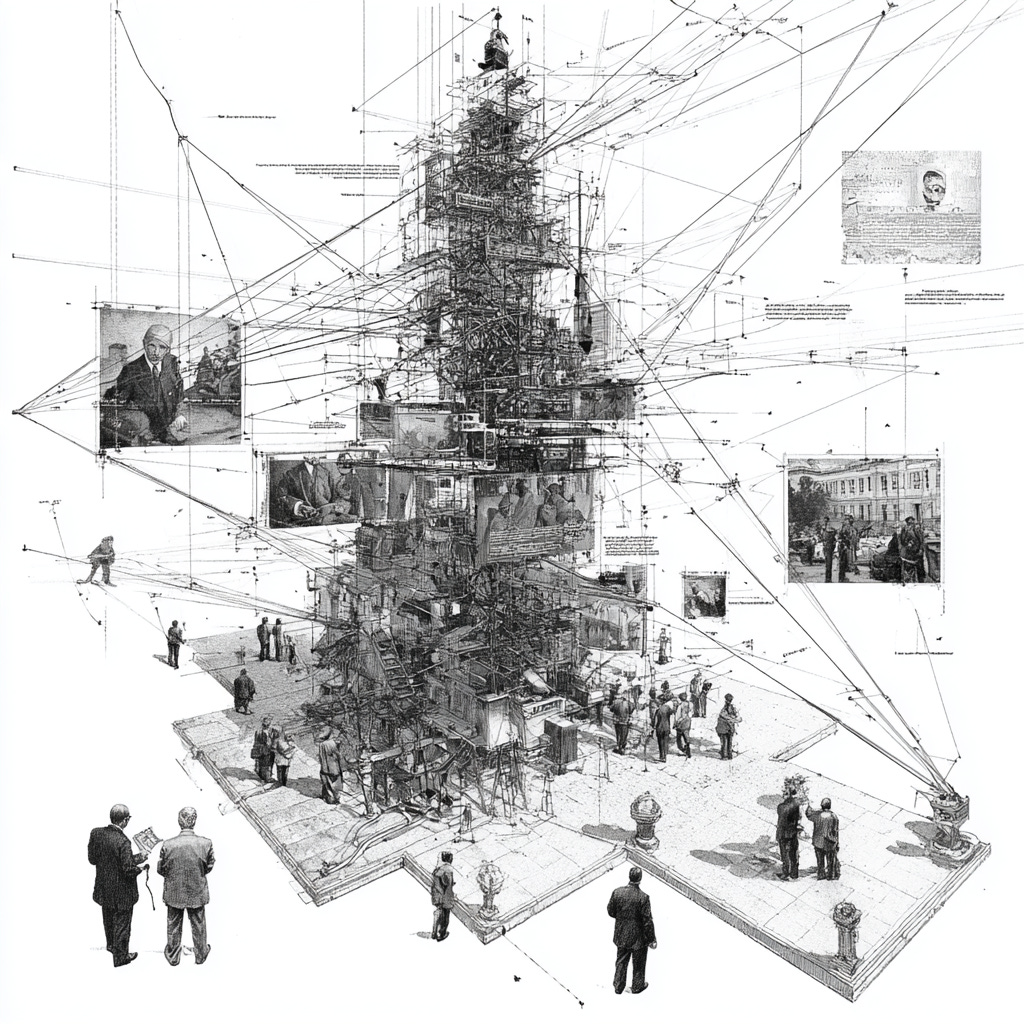
The default unit of analysis is the sector: education, healthcare, defense, energy, finance. We staff governments this way, fund research this way, and write about the world this way — one domain at a time, each with its own experts, its own journals, its own reform debate. The trouble is that the forces actually reshaping the world do not respect sector boundaries. When cognition becomes cheap, it does not get cheaper in education and stay expensive in government; it transforms every sector at once, and it transforms them through their interactions — the change in the economy alters the change in education alters the change in governance. Reasoning one sector at a time guarantees you will miss this, because the most important effects are precisely the cross-sector ones the sectoral frame cannot see. Systems-and-structure thinking refuses the sector as the unit and reasons instead about whole systems and the layers they sit in.
ENSI's organizing instrument for this is the civilization stack: the claim that a society is a layered system — governance, economy, knowledge, culture, and the rest — and that you have to read all the layers together because a force entering at one layer propagates through the others. The stack is not a metaphor; it is a commitment about the unit of analysis. It says that the right object to study is the whole structure and its layers, not any single floor of it, and that anyone reading the AI transition sector by sector is reading a system as if it were a list. Layers of reality: building a civilization extends the same move down to first principles, treating the layered structure itself as the thing to be understood before any sector can be understood. The stack is what you get when you take seriously that the system, not the sector, is real.
Structure before content
The deeper discipline beneath systems thinking is a preference for structure over content — for the shape of a thing over its particulars. Two problems that look entirely different at the level of content (a procurement bottleneck, a school's failure to develop talent) can share an identical structure (a throughput constraint, a misallocation across a gradient), and seeing the shared structure is worth more than mastering either set of particulars, because the structure is portable and the particulars are not. This is why ENSI's analytical pieces are so often explicit decompositions of structure: national AI strategy: layers reads a strategy as a layered architecture rather than a list of initiatives; software 3.0: components reads a technology shift as a set of structural components rather than a parade of products; resilient state: the strategic priorities reads national resilience as a structured set of capacities rather than a wish list. In each, the content is in service of exposing the structure, because the structure is the reusable part.
This is also why the writing takes the form it does. An article that has found a structure does not narrate it in flowing prose; it breaks it down — one component per section, each dissected along the same consistent set of aspects, so the structure is visible as a structure rather than dissolved into story. Decision-making complexity aspects lays out the dimensions of decision difficulty as an explicit matrix because the matrix is the structure; to hide it inside a narrative would be to obscure the very thing the article discovered. The breakdown form is not a stylistic habit but a direct consequence of systems thinking: when the content is a structure, the honest way to present it is structurally, with the components named and compared along shared axes, so the reader walks away with the architecture rather than an impression of it.
Layers propagate, so the analysis must too
The payoff of reasoning about whole systems is that you can trace propagation — how a change at one layer forces changes at the others — which is exactly the move single-sector analysis cannot make. The civilization stack exists to make propagation legible: a shift in the cost of cognition enters at one layer and the framework lets you follow it up and down the others, predicting second-order effects that a sector-bound reader never sees coming. Civilization metrics: perspectives on civilizational components is the attempt to measure the system at the level of its components rather than its sectors, on the principle that you cannot manage propagation you cannot measure. The recurring ENSI claim that intelligence is the load-bearing variable across government, science, education, and the economy is itself a propagation claim — it says one structural input runs through every layer, which is only a sayable sentence if you are already reasoning about the whole system rather than its floors.
There is a constraint discipline inside systems thinking that keeps it from floating off into grandiosity. Reasoning about whole systems invites a failure mode of its own: the cosmic overview that explains everything and predicts nothing, the "it's all connected" gesture that is true and useless. The method's guard against this is that the structure must be specified — named components, named layers, named aspects, named propagation paths — not merely invoked. A real systems analysis like resilient state: the strategic priorities is more concrete than a sectoral one, not less, because it has to say exactly which capacities exist, how they relate, and where the load passes between them. The test is whether the systems view yields specific, checkable structure; if it yields only the feeling of connectedness, the analysis has failed in the opposite direction from the sectoral one — too high instead of too narrow.
The structure is the durable asset
Systems-and-structure thinking is the fifth principle because it is what turns a set of insights into a body of knowledge that compounds. Content dates fast — the specific tools, the specific deployments, the specific numbers all go stale — but structure is durable, and a corpus organized around structures rather than sectors keeps its value as the particulars churn. The civilization stack, the complexity aspects, the strategy layers, the resilience capacities: these are the parts of ENSI's work most likely to still be useful when today's examples are obsolete, because a structure outlives the content that first revealed it. This is the quiet strategic reason the method reasons structurally — it is building an asset that appreciates while the news depreciates.
The wager of this principle is that the sector is an artifact of how we organize institutions, not a joint in how the world actually works, and that the writer who keeps reasoning one sector at a time will keep being blindsided by effects that arrive across the boundaries. The world is a layered system in which forces propagate, and the only analysis that can see the propagation is one that takes the whole system and its structure as the unit. Read the stack, not the sector. Find the structure, not the story. The particulars are where the attention goes; the structure is where the truth — and the durability — actually lives.
Further reading
Recent Posts

The Agentic Economy: The Arguments
September 13, 2026

The ČVUT Playbook: What Czech Technical University Should Actually Do
September 10, 2026