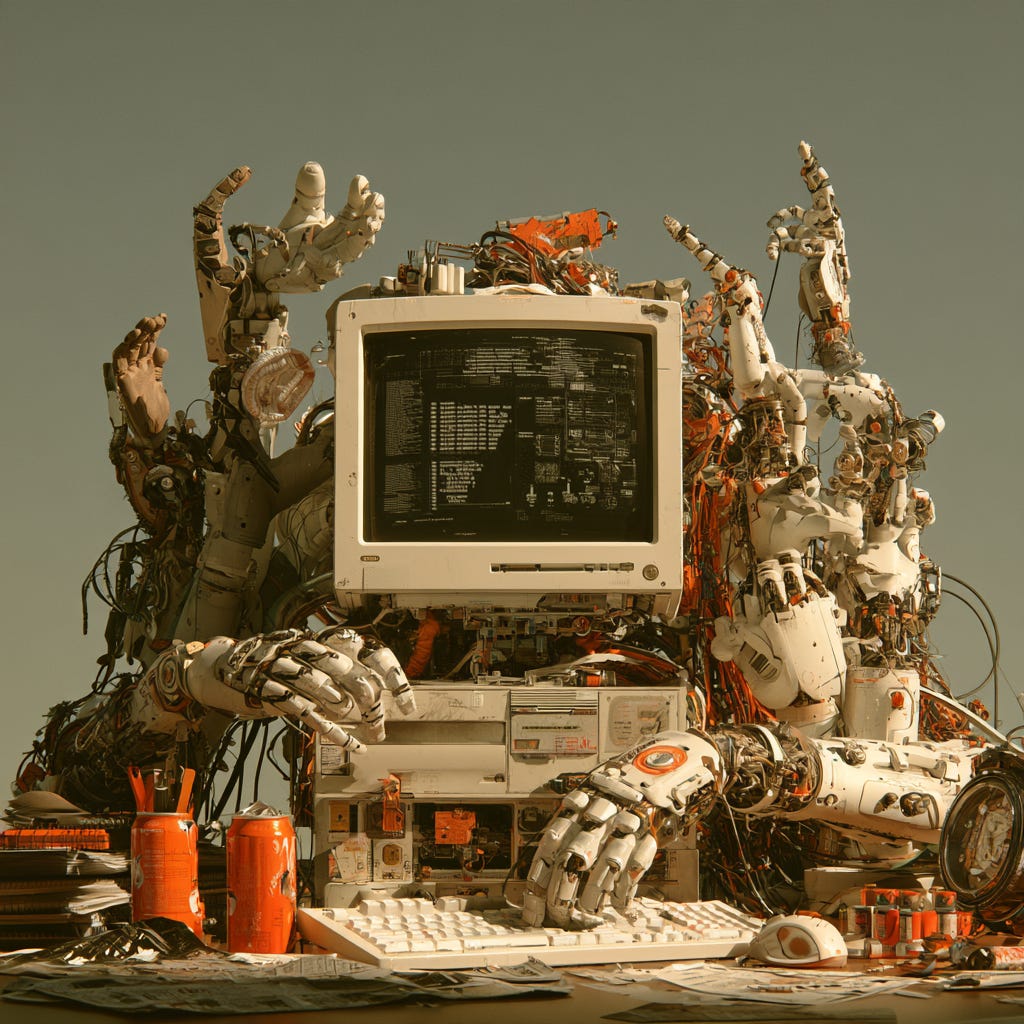
Agentic Software Future: Principles
October 24, 2026



For centuries, leadership was defined by hierarchy, effort, and execution oversight. Managers focused on controlling workflows, optimizing labor productivity, and ensuring operational efficiency. Success was measured in hours worked, cost reductions, and incremental process improvements.
But this era is over. AI-driven automation has collapsed the cost of execution, eliminated human bandwidth constraints, and made real-time intelligence the primary currency of leadership. The old model—where executives managed effort, supervised execution, and relied on static business models—is now a competitive liability.
The new paradigm demands intelligence-first leadership—where decision-making is no longer based on intuition, but on real-time AI-enhanced insights. The most valuable leaders will not be those who oversee work, but those who synthesize intelligence, predict market shifts, and continuously rearchitect business strategies using AI-driven foresight.
The core shift is simple but profound: effort has been replaced by intelligence as the primary driver of business success.
In the industrial age, growth depended on scaling human labor. In the digital age, it depended on scaling software and processes. But in the AI era, growth depends on scaling intelligence—using AI systems that can predict trends, optimize execution in real-time, and refine strategic decision-making faster than human cognition allows.
This transition is not incremental—it is a paradigm shift:
Manual labor → Automated intelligence execution
Human decision-making → AI-assisted, precision-optimized strategy
Effort-based productivity → AI-driven cognitive augmentation
Incremental improvements → Perpetual intelligence iteration
This shift forces leaders to rethink their role: they are no longer managing employees—they are architecting intelligent systems that learn, adapt, and outperform static business models in real-time.
AI has eliminated the bottleneck of human decision-making speed. Traditional strategy relied on gathering information, analyzing reports, and making informed assumptions—a process that was slow, error-prone, and reactive.
Now, AI enables:
Predictive decision-making → AI-driven models anticipate disruptions before they occur.
Instantaneous strategic refinement → Business models continuously adapt in response to real-time market shifts.
Automated learning loops → AI constantly refines execution and optimization without human intervention.
Adaptability is no longer a soft skill—it is a core competency, and only AI-enhanced leaders can navigate the rapid, exponential changes reshaping industries.
With execution becoming frictionless and costless, leadership is now about who has the most advanced intelligence processing system—not who has the biggest workforce or lowest operational costs.
This new reality requires a radical upgrade in leadership competencies. AI-driven organizations need leaders who can:
✅ Synthesize infinite intelligence streams in real-time
✅ Architect AI-powered decision-making infrastructures
✅ Predict market dynamics using AI-driven foresight
✅ Iterate business models at the speed of intelligence
✅ Continuously reinvent differentiation as execution becomes ubiquitous
Without these competencies, leaders will become obsolete as AI-native competitors outmaneuver them at every level of strategy and execution.
The era of intelligence-first leadership has arrived. The only question is: who will master it?
For centuries, businesses relied on human effort as the core driver of value creation. Even with technological advances, companies still depended on people executing tasks, making decisions, and managing workflows.
AI has obliterated this friction. Execution is now instant, scalable, and near-zero-cost. AI doesn’t get tired, doesn’t make errors due to fatigue, and can analyze, predict, and execute millions of decisions simultaneously.
This means leadership is no longer about "how do we get things done?" but rather "how do we architect intelligence to create competitive advantages?".
The winners will not be those who can work harder—they will be those who can process intelligence faster and more effectively than anyone else.
Traditional business models operated on linear cycles:
Gather information
Develop strategy
Execute
Measure results
Adjust and restart
Each cycle could take weeks, months, or even years.
Now, AI eliminates the start-stop nature of execution. Businesses operate as self-optimizing intelligence engines:
🔹 AI continuously collects, processes, and refines intelligence in real time
🔹 Strategic adjustments happen instantly based on AI-driven market signals
🔹 Execution happens simultaneously with learning—every action refines the next step
In other words, work no longer stops. The organization is no longer an entity that executes projects—it is an AI-enhanced intelligence system that continuously evolves.
This fundamental shift demands leaders who think in infinite intelligence loops, not static strategic cycles.
With execution becoming frictionless, leaders must transition from micromanaging operations to designing intelligence architectures.
The old leadership model focused on supervising work → The new model focuses on synthesizing AI-driven intelligence to create dynamic strategy.
The old model required monitoring teams → The new model requires building autonomous AI-enhanced decision systems.
The old model optimized for efficiency → The new model optimizes for continuous intelligence refinement.
✅ Redefine their role from "manager of people" to "architect of AI-powered intelligence networks".
✅ Build adaptive business models that evolve in real time using AI-driven data streams.
✅ Use AI simulations to pre-test strategic decisions, ensuring optimal outcomes before execution.
✅ Shift from decision-making bottlenecks to AI-enhanced, real-time strategic adaptation.
🔹 The ability to absorb, process, and integrate vast amounts of real-time intelligence across multiple domains, disciplines, and data streams—transforming fragmented insights into a cohesive, actionable strategy.
AI enables near-infinite knowledge processing, but leaders must be capable of distilling that knowledge into high-leverage insights that drive decision-making. Intelligence synthesis is no longer about gathering data—it’s about architecting meaning from infinite information streams.
Data is infinite, but meaning is scarce—leaders who cannot synthesize AI-driven intelligence will be overwhelmed.
Market conditions change in real-time—strategies must be continuously recalibrated, requiring leaders to adapt instantly.
Cross-disciplinary breakthroughs create competitive advantage—the best leaders will combine insights from AI-driven finance, engineering, psychology, and strategy.
To enable leaders to process information at AI speed, detect non-obvious opportunities, and drive high-speed strategic recalibration in a world where decisions are made in milliseconds.
🔹 A CEO at an AI-native fintech firm needs to launch a new product. Instead of relying on traditional market research, they use AI to synthesize data from consumer sentiment analysis, competitor pricing models, regulatory updates, and economic trends—allowing them to identify an underutilized pricing strategy that no competitor has seen yet.
✅ Engage with AI-Generated Insights Dynamically → Don’t passively consume AI reports; challenge them, cross-validate, and apply meta-thinking.
✅ Think in Multi-Domain Structures → Train yourself to connect intelligence from various industries—finance, physics, psychology, and AI all feed into modern decision-making.
✅ Adopt an Always-Learning Mindset → AI continuously refines its intelligence models, and leaders must do the same—stagnation is obsolescence.
✅ Use Second-Order Thinking → Always ask, "What is the next consequence of this AI-generated insight?"—intelligence synthesis isn't just about first-level observations.
🔹 Using AI-powered foresight, data simulations, and real-time modeling to make strategic decisions before market conditions demand them—anticipating change rather than reacting to it.
AI transforms decision-making into a predictive function, eliminating lag-time between insight and action. Leaders must now preemptively adjust strategies before disruptions occur.
AI predicts risks and opportunities before humans do—leaders who only react will always be outmaneuvered.
Markets shift in real-time—waiting for confirmation means losing first-mover advantage.
Decisions must be made in milliseconds, not weeks—AI enables high-speed decision-making, but leaders must trust the intelligence.
To transform decision-making from reactive guesswork to preemptive precision, ensuring organizations act before competitors even recognize an opportunity or threat.
🔹 A global logistics firm uses AI to forecast supply chain disruptions before they occur. The AI model predicts an upcoming container shortage due to geopolitical tensions. Instead of reacting when competitors panic, the firm secures alternative shipping routes ahead of time, ensuring uninterrupted operations while competitors scramble.
✅ Implement AI-Driven Forecasting Models → Use LLMs and ML models to simulate future economic, technological, and competitive trends.
✅ Test Multiple Decision Pathways → Always have at least three future-ready strategies in play, so you're never reacting to events, but navigating ahead of them.
✅ Measure Decision Success in Time-to-Action → Speed is now a competitive advantage. Leaders should track how fast they move from insight to execution.
✅ Use Scenario Planning to Pre-Test Strategy → AI allows leaders to simulate decisions before committing—leaders must integrate predictive simulations into daily decision-making.
🔹 The ability to continuously reinvent and refine a company’s business model using AI-driven strategic iteration—treating the organization as a self-evolving intelligence network rather than a static structure.
AI eliminates cost-based competition—business success now depends on continuous differentiation.
AI removes execution constraints, making static business models obsolete.
Infinite intelligence allows continuous reinvention—leaders must constantly refine market positioning.
Industry boundaries are disappearing—adaptive firms will disrupt slower-moving competitors.
To ensure perpetual innovation cycles, where business models self-evolve in real-time, adapting to AI-driven market shifts before competitors react.
🔹 A SaaS company leverages AI to test new pricing models dynamically. Every week, the AI runs experiments with different customer segments, adjusting prices in real-time based on demand elasticity. This enables the company to achieve revenue optimization without manually reconfiguring its pricing model every quarter.
✅ Adopt a Living Strategy Framework → Business models must continuously iterate, not follow rigid five-year plans.
✅ Leverage AI for Automated Business Model Experiments → Deploy AI to test new revenue streams, market positioning, and pricing structures in real-time.
✅ Embrace Frictionless Business Transformation → AI-driven companies must be willing to pivot instantly without internal resistance.
✅ Track AI-Generated Disruptions Before They Disrupt You → If your business model isn’t adapting faster than AI-driven competitors, you're already obsolete.
🔹 The ability to design AI-native decision-making infrastructures that process, filter, and execute intelligence at scale—eliminating noise, reducing complexity, and maximizing strategic impact.
AI removes traditional decision bottlenecks—leaders must build intelligence architectures that optimize who, what, and how decisions are made.
AI generates too much information—leaders must structure decision pathways to extract only high-value insights.
Corporate bureaucracy slows decision-making—AI enables near-instantaneous execution.
Speed is now a competitive advantage—companies that optimize decision flow will dominate.
To eliminate cognitive overload, ensuring leadership focuses only on high-leverage decisions, while AI filters and executes lower-priority actions autonomously.
🔹 A Fortune 500 company implements an AI-powered decision intelligence system that pre-filters thousands of reports daily, providing executives with only the five most mission-critical insights. This enables faster and sharper executive decisions without information overload.
✅ Create an AI-Powered Decision Pipeline → Use AI to filter, rank, and route decision-critical data automatically.
✅ Optimize for Decision Speed → Slow decision-making kills competitive advantage—structure AI systems to execute autonomously when possible.
✅ Eliminate Human Bottlenecks → AI-native firms don’t waste time on endless approval loops; structure governance for fast, intelligent execution.
✅ Develop AI-Augmented Decision Training → Train teams to trust and refine AI recommendations rather than manually verifying every data point.
🔹 The ability to integrate insights from multiple fields—finance, engineering, psychology, AI, biology, geopolitics, etc.—to create novel solutions and strategic advantages.
Traditional industries operated in silos, but AI dissolves those boundaries. Leaders must now think beyond domains, leveraging AI-driven intelligence across multiple disciplines to create high-leverage, cross-sector innovations.
AI allows real-time synthesis of knowledge from multiple fields—leaders who stay confined to a single domain will be outpaced.
Breakthroughs happen at the intersection of disciplines—biology and AI merge to create new materials, neuroscience and AI merge to enhance human cognition.
Competitive advantage lies in seeing what others don’t—leaders who integrate diverse fields will unlock non-obvious market opportunities.
To create exponential value by combining AI-driven insights from multiple disciplines, generating hyper-innovative strategies that competitors cannot replicate.
🔹 A CEO in the energy sector uses AI to integrate climate science, financial modeling, and geopolitical risk assessments, designing a next-generation energy grid that automatically adapts to economic fluctuations and climate change projections.
✅ Train Your Brain for Cross-Disciplinary Thinking → Read research outside your domain, and use AI tools to map connections between fields.
✅ Use AI to Detect Emerging Convergences → AI can predict cross-industry disruptions—leaders must track these shifts before they become mainstream.
✅ Build a Cross-Disciplinary Advisory Network → Surround yourself with experts from unrelated industries—breakthroughs emerge from diverse thought models.
✅ Think Like an AI → AI doesn’t respect industry boundaries—leaders must adopt the same fluid intelligence processing model.
🔹 Leveraging AI-driven simulations, scenario analysis, and data synthesis to design pre-tested, high-impact strategic moves before executing them.
AI removes uncertainty from strategic planning—leaders no longer have to rely on intuition alone. Instead, they must operate like AI-driven war strategists, constantly running simulations to test potential decisions before committing resources.
AI enables infinite scenario testing—leaders who don’t leverage AI simulations will operate on outdated strategic models.
Competitive environments shift faster than ever—leaders need AI-generated predictive strategy models to stay ahead.
AI removes the cost of trial and error—leaders must maximize the intelligence-to-execution ratio.
To replace outdated strategic planning with AI-driven, real-time scenario optimization, ensuring leaders execute only the highest-probability success pathways.
🔹 A telecom company uses AI to run 10,000 simulations of different 5G pricing models before launching in a new region, identifying the pricing strategy that will optimize adoption and revenue while minimizing churn.
✅ Use AI to Pre-Test Every Major Decision → AI can predict how different business strategies will perform under real-world conditions.
✅ Create Multiple Strategy Pathways → Instead of committing to one strategy, AI-powered leaders always have three contingencies ready.
✅ Let AI Handle Complexity, But Stay the Human in the Loop → AI reveals insights, but human judgment must refine which pathways to pursue.
✅ Adopt a "War-Gaming" Mindset → Treat business strategy like an AI-driven chess game—every move should be simulated before execution.
🔹 AI allows businesses to continuously experiment and refine strategies, business models, and products in real time—leaders must embrace a mindset of constant iteration.
The traditional product launch cycle is dead—AI enables perpetual micro-adjustments, meaning successful businesses will be fluid, self-optimizing entities.
AI makes it possible to run real-time business experiments without risk—leaders must treat every process as an evolving prototype.
Companies that iterate faster will dominate—Netflix, Amazon, and Tesla win by constantly A/B testing strategies at scale.
Failure is now cost-free—AI removes the price of testing, allowing infinite refinement.
To shift leadership from rigid, one-time decision-making to continuous, AI-driven strategic refinement, ensuring real-time adaptation and sustained competitive advantage.
🔹 A startup uses AI to continuously test variations of its user onboarding process. Every 24 hours, AI analyzes conversion rates and dynamically refines the flow, optimizing engagement in real time.
✅ Turn Every Process into a Continuous Experiment → AI removes the cost of iteration, so leaders must shift from one-time decisions to ongoing refinement.
✅ Use AI to Run Parallel Experiments at Scale → AI enables mass experimentation—leaders must manage thousands of micro-adjustments simultaneously.
✅ Track Metrics That Reflect Learning, Not Just Performance → The best metric is not profitability, but the speed at which AI-enhanced strategies improve.
✅ Kill Fear of Failure → AI has made risk-free iteration a reality—leaders who don’t leverage this will fall behind.
🔹 When execution is free (thanks to AI), competitive advantage comes only from strategic uniqueness—leaders must continuously refine and redefine differentiation.
The era of cost-based competition is over—AI-driven businesses must stand out through continuously evolving, AI-enhanced value propositions.
Execution is now a commodity—only differentiation matters.
AI erases the boundaries between industries—businesses must be uniquely positioned to avoid being automated into irrelevance.
Customers expect hyper-personalization—AI-driven businesses must differentiate at an individualized level.
To ensure businesses don’t become interchangeable commodities, leveraging AI to create continuously evolving, hyper-differentiated value propositions.
🔹 A fashion brand leverages AI to generate real-time, hyper-personalized clothing designs based on individual customer preferences—eliminating the concept of mass production and making every product unique.
✅ Build Differentiation into the Core of AI Strategy → AI makes execution free, but differentiation must be deliberate, evolving, and non-replicable.
✅ Leverage AI to Create Hyper-Personalization → Use AI to make products and services unique to every customer.
✅ Reinvent Your Value Proposition Continuously → AI removes barriers to market entry, so differentiation must be a moving target, not a fixed trait.
✅ Track AI-Generated Market Trends & Outpace Them → AI reveals emerging differentiators—leaders must always be ahead of AI-driven commoditization.
🔹 The ability to shift mental models instantly based on new AI-driven insights, adapting strategic thinking in real time without cognitive lag.
AI generates continuous, real-time intelligence, but human cognition operates in fixed paradigms. Leaders must train their minds to adapt instantly, seeing new patterns as they emerge rather than being locked into outdated strategic assumptions.
AI-driven insights update in milliseconds—leaders who think slowly will be obsolete.
Markets move in real time—cognitive rigidity causes strategic paralysis.
The best opportunities exist outside conventional wisdom—leaders must escape mental inertia.
To enable fluid, real-time strategic adaptation, ensuring that leaders always operate at the cutting edge of intelligence-driven decision-making.
🔹 An AI-driven investment firm detects a micro-trend in social media sentiment indicating a surge in consumer demand for sustainable packaging. While competitors take weeks to react, the firm's leadership instantly shifts marketing and procurement strategies, capitalizing on the trend before it peaks.
✅ Train Yourself to Switch Perspectives on Demand → Don’t get attached to any one mental model—adopt a fluid, AI-enhanced mindset.
✅ Develop an AI-First Decision-Making Habit → Before making any major decision, consult AI-generated insights to recalibrate your perspective.
✅ Eliminate Confirmation Bias → The best leaders seek out AI-driven insights that challenge their assumptions, not those that validate them.
✅ Make Cognitive Agility a Leadership Requirement → Train teams to continuously adapt their thinking rather than defaulting to rigid strategies.
🔹 Using AI as a force multiplier for ideation, problem-solving, and innovation—expanding human creativity beyond biological limits.
AI is no longer just an analytical tool—it’s a generative engine, producing millions of possible solutions beyond human imagination. Leaders must not just manage AI output, but curate, refine, and integrate it into breakthrough innovations.
Creativity is now a competitive advantage—AI can generate infinite ideas, but leaders must refine them.
The best solutions are no longer purely human—AI-driven ideation beats traditional brainstorming.
**Industries that don’t innovate will be disrupted—leaders must treat AI as a perpetual creativity engine.
To enable unlimited ideation cycles, ensuring that leaders drive continuous innovation rather than being trapped by traditional human limitations.
🔹 A product designer uses AI to generate 100,000 variations of a new sneaker design, filtering for aesthetic appeal, ergonomic efficiency, and sustainability—identifying a unique, AI-optimized design in minutes that would have taken humans months.
✅ Use AI to Expand Ideation Beyond Human Limits → Instead of brainstorming five ideas, let AI generate 500,000 possibilities and curate the best ones.
✅ Treat AI as an Innovation Partner, Not Just a Tool → Ask AI "What are ideas that humans wouldn’t think of?"—this is where disruptive breakthroughs emerge.
✅ Combine Human & AI-Generated Ideas → The best innovations blend human intuition with AI-powered creativity rather than choosing one over the other.
✅ Build an AI-First Innovation Culture → Encourage teams to use generative AI daily—not just for automation, but for creative breakthroughs.
🔹 Leveraging AI-driven sentiment analysis, strategic framing, and real-time intelligence to optimize influence, persuasion, and negotiation outcomes.
AI can now predict human behavior, analyze emotional sentiment, and optimize strategic persuasion techniques—leaders who don’t integrate AI-driven influence strategies will be out-negotiated.
AI can predict what people will respond to before they even know it themselves.
Emotional intelligence alone isn’t enough—leaders need AI-driven negotiation insights.
Markets, investors, and stakeholders all respond to AI-optimized persuasion techniques.
To ensure leaders maximize influence and negotiation outcomes, using AI-powered psychological insights and strategic persuasion tactics.
🔹 A startup founder uses AI-driven investor sentiment analysis to refine their pitch. AI detects which parts of the presentation generate the strongest emotional engagement, allowing the founder to tailor the pitch in real-time—resulting in a 30% higher valuation than expected.
✅ Use AI Sentiment Analysis to Read Your Audience → AI can predict reactions before people consciously process them—use this data to optimize persuasion.
✅ Optimize Negotiation Strategies with AI Simulations → AI can run millions of negotiation scenarios—leaders must test strategies before engaging in high-stakes deals.
✅ Frame Your Messages with AI-Powered Language Optimization → AI can predict which words, tones, and arguments will resonate most with different audiences.
✅ Enhance Personal Influence by Mirroring AI-Detected Behavioral Cues → AI can detect subtle emotional shifts and micro-expressions—use these to adjust communication in real time.
🔹 The ability to design AI-driven decision systems that are transparent, ethical, and trusted by customers, employees, and stakeholders.
AI can create massive efficiency gains, but it also introduces bias, opacity, and ethical risks. Leaders must ensure AI systems enhance fairness, trust, and long-term stability.
AI bias can destroy reputations and legal standing—leaders must design for transparency.
Customers and employees will not trust AI-driven decisions unless they are explainable and ethical.
Regulations are tightening—leaders must proactively ensure AI compliance.
To prevent AI from becoming a black box, ensuring that businesses maximize AI benefits while mitigating risks, biases, and ethical concerns.
🔹 A hiring platform uses AI to filter candidates, but leadership ensures fairness by implementing explainable AI models that eliminate bias against underrepresented groups—building trust with customers and regulators while maintaining high efficiency.
✅ Make AI Decision-Making Transparent → Use explainable AI models so employees and customers understand how decisions are made.
✅ Proactively Audit AI Systems for Bias → AI inherits human biases—leaders must continuously audit and refine AI decision processes.
✅ Build Trust by Giving Users Control Over AI Interactions → Let customers/employees override AI decisions when necessary, ensuring they remain engaged in the process.
✅ Stay Ahead of AI Regulation → AI governance is evolving—leaders must proactively ensure compliance with emerging ethical standards.
🔹 The ability to identify, leverage, and capitalize on unique insights that competitors, markets, and stakeholders do not yet perceive—using AI to create unfair strategic advantages.
AI generates intelligence gaps—some companies access deeper, more accurate insights while others rely on outdated models. Leaders must see opportunities before the market does and act before competitors realize what’s happening.
Markets move faster than human analysis—leaders who exploit AI-driven intelligence gaps will dominate.
Traditional competitive advantages are eroding—leaders must outthink, not outspend.
AI creates layers of intelligence—those with superior AI insights will always have an edge.
To weaponize intelligence asymmetry, ensuring that leaders detect and act on hidden opportunities before they become mainstream knowledge.
🔹 A hedge fund uses AI to detect subtle sentiment shifts in consumer behavior data, indicating an upcoming sales spike in electric vehicles. While competitors wait for official reports, the fund places high-yield bets early, securing massive gains before the market reacts.
✅ Leverage AI for Deep Signal Detection → Use AI models that process millions of weak signals from various sources—social media, patents, supply chains, and geopolitical trends.
✅ Act Before the Market Confirms Trends → By the time an opportunity appears in the news, it’s too late—leaders must move before mainstream awareness kicks in.
✅ Use AI to Reverse-Engineer Competitor Strategies → AI can detect patterns in competitor behavior—leaders must anticipate moves and counteract before they materialize.
✅ Operate in Multiple Intelligence Layers → Don’t just use public data—leverage proprietary AI-driven insights that competitors don’t have access to.
🔹 Designing and managing a workforce that is augmented by AI, ensuring that human capital and artificial intelligence systems collaborate fluidly to drive maximum productivity and innovation.
The traditional workforce is obsolete—leaders must build AI-first talent ecosystems where human-AI collaboration is seamless, efficient, and continuously evolving.
Fixed job roles are disappearing—leaders must structure teams for continuous adaptation.
AI enables hyper-productivity, but only if human talent is correctly integrated.
**Skills are becoming transient—leaders must focus on building fluid, AI-augmented teams.
To ensure that human capital evolves in sync with AI capabilities, maximizing agility, efficiency, and innovation in AI-powered organizations.
🔹 A global consulting firm implements an AI-native workforce structure, where employees dynamically shift between roles based on AI-driven skill mapping. The firm sees a 40% productivity boost as workers continuously upskill and collaborate with AI assistants that enhance their decision-making.
✅ Create an AI-Augmented Workforce, Not Just an AI-Supported One → Employees must collaborate with AI at every level, not just use AI as a tool.
✅ Implement Real-Time AI Skill Matching → AI should continuously assess and reassign talent based on evolving market needs.
✅ Redefine Roles as Fluid, Not Fixed → Employees should shift functions dynamically, rather than being locked into static job descriptions.
✅ Use AI to Optimize Productivity in Real Time → AI should dynamically allocate tasks, ensuring that humans and AI systems operate at peak efficiency.
🔹 The ability to design business models that scale infinitely using AI, eliminating traditional cost structures and leveraging AI-driven hyper-efficiency to create exponential growth.
AI eliminates human labor costs, infrastructure costs, and operational friction—leaders must redesign businesses for infinite, near-zero-cost scaling.
The most scalable businesses will dominate—cost-based competition is dead.
AI-driven execution enables infinite scaling without proportional resource expansion.
Startups can now compete with billion-dollar corporations—scaling intelligence is the new competitive advantage.
To create AI-native business architectures that expand infinitely, ensuring growth without increasing overhead, labor costs, or operational friction.
🔹 A SaaS company automates 90% of its operations with AI, allowing it to onboard 1,000x more customers without increasing headcount. Its competitors, burdened by human-limited scaling, struggle to keep up as the company achieves zero-cost hypergrowth.
✅ Engineer Business Models for AI-First Scaling → Traditional business scaling relies on human expansion, but AI-driven scaling removes these limits.
✅ Automate Every Operational Bottleneck → AI should handle customer support, logistics, strategy iteration, and internal decision-making.
✅ Leverage AI for Infinite Parallel Execution → AI allows simultaneous scaling—leaders must ensure business functions expand autonomously.
✅ Redesign Organizational Structures for Near-Zero Overhead → Replace manual intervention with self-adapting AI-driven execution layers.
🔹 A leadership philosophy where decision-making, strategies, and personal intelligence continuously evolve through AI-driven feedback loops—treating every process as an infinitely refining system.
In the AI era, stagnation is death—leaders must constantly refine their intelligence, strategic models, and organizational architectures.
AI-driven competition never stops—leaders must continuously improve or be left behind.
Past success does not guarantee future relevance—leaders must evolve faster than their industries.
AI enables infinite iteration cycles—leaders must integrate this mindset into their own decision processes.
To ensure that leaders, strategies, and organizations evolve at AI speed, creating a self-reinforcing loop of intelligence amplification and continuous strategic refinement.
🔹 A Fortune 500 CEO uses AI-driven decision auditing to refine leadership strategy in real time. Every quarter, AI analyzes previous strategic decisions, identifying blind spots, errors, and optimization pathways, allowing the company to self-correct and improve continuously.
✅ Treat Leadership as an Evolving Algorithm → Constantly update your mental models, decision processes, and strategic outlook.
✅ Use AI to Audit and Refine Your Thinking → AI can analyze past decisions to reveal biases, inefficiencies, and missed opportunities.
✅ Commit to Infinite Learning Cycles → Never assume you’ve reached peak intelligence—AI allows for continuous leadership enhancement.
✅ Build Organizations That Improve Themselves → Design AI-powered self-adapting company architectures that evolve without human intervention.
In an AI-native organization, data is no longer gathered and analyzed manually—it flows in real time, continuously optimizing itself. The traditional decision-making process, which relied on static reports, lagging indicators, and human intuition, has become obsolete. Leaders must now structure intelligence pipelines that collect, process, and refine information automatically, at machine speed.
To achieve this, leaders must:
🔹 Eliminate Decision Bottlenecks → Replace human review layers with AI-driven, automated decision loops that adjust dynamically based on real-time intelligence.
🔹 Create Hierarchies of Decision Intelligence → Not all data is equal. AI must filter high-leverage insights from noise, ensuring that executives receive only the most impactful intelligence.
🔹 Architect Seamless AI-Human Collaboration → AI should handle predictive modeling, risk assessments, and real-time data synthesis, while humans focus on high-level strategic orchestration.
Without this AI-driven decision architecture, organizations will drown in data but remain starved of insight.
In the past, decision-making required gathering reports, holding strategy meetings, and making educated guesses about the future. Now, AI-driven organizations function as self-learning intelligence engines that:
✅ Continuously update their strategic models based on live data.
✅ Autonomously optimize workflows, pricing, and market positioning.
✅ Predict and adapt to competitive threats before they materialize.
For leaders, this means shifting from micromanaging execution to designing self-correcting intelligence loops. Instead of overseeing processes, they must orchestrate AI ecosystems that improve themselves without human intervention.
The traditional dashboard—a static panel of KPIs and analytics—is being replaced by real-time, AI-driven decision interfaces that:
🔹 Predict future market shifts, allowing leaders to act before disruptions occur.
🔹 Generate high-probability strategic options based on millions of AI simulations.
🔹 Continuously refine business models in response to real-time data inputs.
Imagine a leadership dashboard where:
🚀 AI doesn’t just report past performance—it forecasts your next five moves with confidence scores.
🚀 Executives no longer review spreadsheets—they interact with AI-driven simulations that pre-test strategies before execution.
🚀 Decisions are not delayed by bureaucracy—they are executed instantly, with AI dynamically adjusting tactics in real time.
The organizations that adopt AI-first decision architectures will outmaneuver competitors at every level of intelligence-driven execution. The leaders who design these systems now will define the future of business.
For most of history, innovation has been constrained by human imagination, expertise, and trial-and-error experimentation. Even the most creative leaders were limited by:
❌ Cognitive bandwidth → A human mind can only process so many ideas at once.
❌ Time constraints → Brainstorming, prototyping, and testing took months or years.
❌ Domain expertise silos → Knowledge was fragmented across industries and disciplines.
Generative AI obliterates these limits. AI can:
✅ Generate millions of potential solutions instantly, finding non-obvious opportunities.
✅ Simulate market responses to new ideas before they are implemented.
✅ Extract intelligence from multiple disciplines, cross-pollinating insights that humans would never connect.
For leaders, this means creativity is no longer a human function alone—it is now an AI-augmented capability that must be systematically harnessed.
Leadership is no longer about organizing people to think—it is about orchestrating AI to generate, refine, and execute innovation at scale.
🔹 Before: Leaders gathered teams for brainstorming sessions.
🔹 Now: AI generates thousands of solutions, and leaders curate the best ones.
🔹 Before: Product development was slow, requiring iterative human feedback.
🔹 Now: AI simulates designs, predicts market success, and optimizes features before a single prototype is built.
🔹 Before: Business models evolved over years through trial and error.
🔹 Now: AI tests thousands of model variations before execution, ensuring pre-optimized strategy selection.
This shift requires a new leadership skillset—moving from intuition-driven decision-making to computationally enhanced judgment.
The old model of decision-making was based on experience, gut instinct, and historical trends. But in an AI-driven world, intuition is insufficient and often misleading.
Instead, leaders must:
✅ Leverage AI for high-dimensional reasoning, synthesizing intelligence that human cognition alone cannot process.
✅ Trust AI-driven simulations over instinct, allowing strategy to be modeled and refined before execution.
✅ Use Generative AI to eliminate cognitive bias, ensuring that decision-making is rooted in intelligence, not assumptions.
The most powerful leaders of the future will not just be creative—they will be AI-enhanced orchestrators of infinite creativity.
For decades, leadership training has focused on fixed frameworks—Porter’s Five Forces, SWOT analysis, linear decision trees, and competitive positioning models.
These models were designed for slow-moving, human-limited markets. In the AI era, they are already obsolete.
AI-powered organizations don’t operate within frameworks—they operate in infinite intelligence loops that continuously refine themselves.
❌ Traditional market analysis → AI now predicts market shifts before they happen.
❌ Long-term strategic planning cycles → AI-driven adaptation is continuous, not periodic.
❌ Hierarchical decision-making → AI enables distributed, autonomous decision networks.
The best leaders will not just embrace AI tools—they will think in AI-native structures, making intelligence-driven adaptability their core competitive advantage.
The most successful companies of the future won't just use AI—they will be AI-native intelligence engines. These organizations will:
🚀 Run thousands of AI-driven business model experiments daily, refining strategy in real time.
🚀 Scale at near-zero marginal cost, eliminating traditional competitive constraints.
🚀 Automate decision-making at every level, reducing friction to near-zero.
In contrast, companies that fail to embrace intelligence-first leadership will be outmaneuvered at every turn. The competitive battlefield has shifted from capital and labor to AI-driven intelligence agility.
This is not a minor shift. This is not "AI-assisted leadership."
This is a new species of leadership itself—one where:
✅ Leaders are no longer managing work—they are designing self-learning intelligence systems.
✅ Decision-making is no longer reactive—it is AI-predictive and continuously optimizing.
✅ Strategy is no longer periodic—it is an infinite intelligence cycle with no end.
The leaders who master AI-first strategic thinking will not only survive this transformation—they will define the next era of industry dominance.
🚀 The intelligence revolution has begun. The only question is: Who will lead it?