

Agentic Software Future: Principles
October 24, 2026

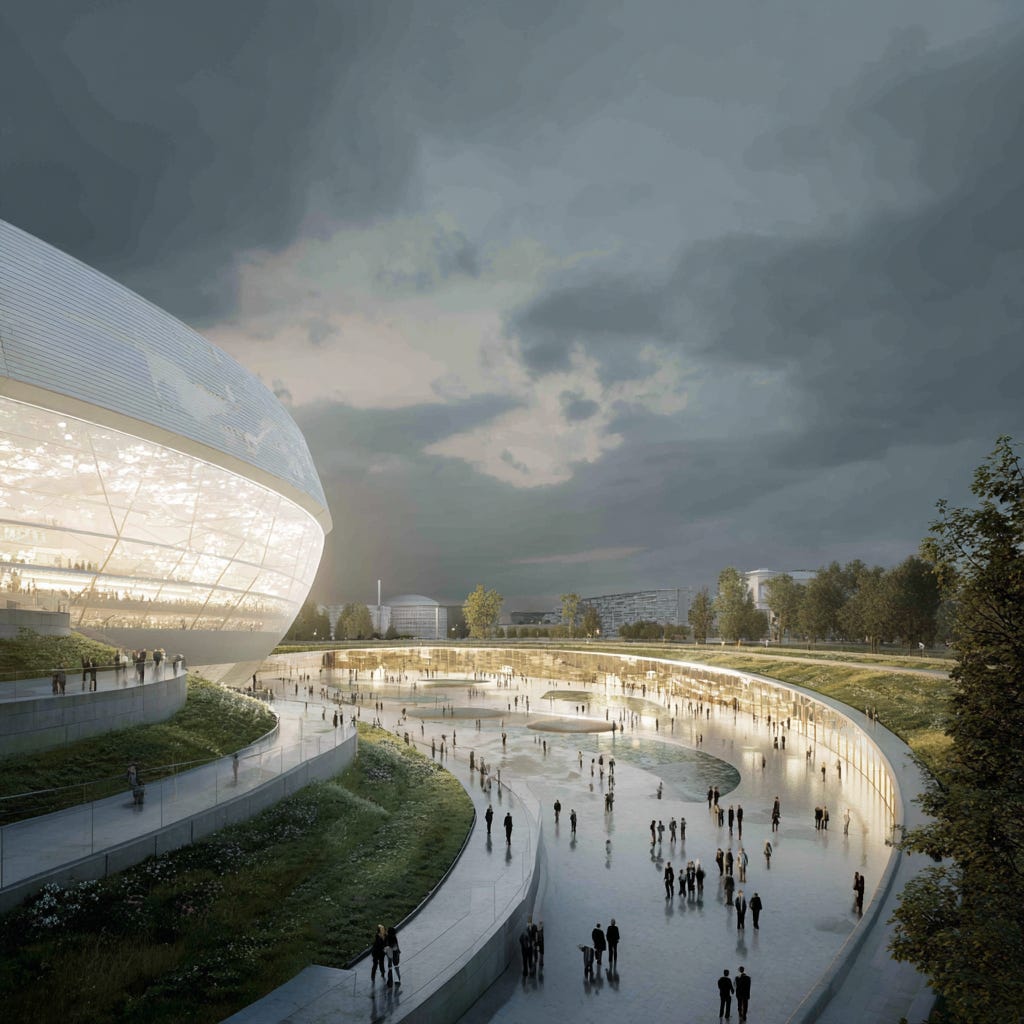
Creating a world-class innovation district is not a construction project—it’s an exercise in system design. You’re orchestrating universities, corporates, investors, regulators, and residents into a single, self-reinforcing engine. That requires a thesis about what the place is for, and the discipline to express it in space, programs, governance, and metrics for years, not months.
The hardest part is that the real product isn’t the buildings—it’s the operating system that runs inside them. Anchors (a marquee university or R&D lab) supply talent and legitimacy; dense programming (accelerators, venture clients, investor office hours) converts proximity into pilots and financings. Get those two wrong and you’ll have beautiful empty space. Get them right and the district compounds.
Governance is equally non-trivial. You need an arm’s-length, empowered operator that can move at market speed while serving public goals. That means clear decision rights, a compact board that includes the city and anchors, transparent KPIs, and the ability to curate tenants and programs without political whiplash. One counterparty for partners; one accountable owner for outcomes.
Financing adds another layer of complexity. Successful districts blend public seed (land, infrastructure) with private capex and value capture (ground leases, TIF/PILOTs), and—critically—fund OPEX for programming, not just CAPEX for concrete. Phasing matters: start with catalytic, “minimum viable” buildings and visible programs; scale only when demand and revenues are real.
Policy and hardware must meet in the middle. Mixed-use urbanism (labs next to housing, retail, and culture) keeps talent on site and wins civic support. Testbeds and regulatory sandboxes turn the city into a permissioned lab, collapsing the path from prototype to paid deployment in regulated domains like health, fintech, energy, or autonomy.
Inclusion is strategy, not charity. Graduated rents, micro-units, founder fellowships, soft-landing for international teams, and neighborhood training pipelines expand the talent pool and build legitimacy. Without visible public benefits—housing, open space, local jobs—projects stall. With them, coalitions form and the district gets room to grow.
Finally, the work must be measurable and memorable. Publish outcomes (survival, capital raised, jobs, pilot conversions) and tell a credible “why-here” story that anchors brand and recruitment. Build resilience into governance, finance, and infrastructure so the district runs through cycles. Do all this in phases, learn in public, and the flywheel turns.
Secure one or two world-class anchors (elite university/research institute and/or blue-chip R&D hub) physically embedded in the district with multi-year program, talent, and procurement commitments. Anchors confer legitimacy, supply talent and IP, create built-in demand, and stabilize the project across cycles.
Treat programming as the product: accelerators, corporate challenges, founder services, investor office hours, soft-landing, and a public event cadence. A predictable, year-round operating rhythm converts proximity into pilots, revenue, and financings.
Co-locate angels, VCs, corporate venture, public co-investment, and venture debt with clear pathways from pre-seed to growth. Capital in the building compresses fundraising time, ties checks to pilots, and raises survival rates.
Build a dense, transit-linked 15-minute district—labs/offices plus housing, retail, food, culture, and green space. Mixed use maximizes “collisions,” attracts/retains talent, extends activity past 6 pm, and earns political durability through visible public benefits.
Repurpose a recognizable asset (rail hall, airport, stadium) and pair it with a clear, repeatable brand promise (“what this place is best at”). Form and story reinforce each other, accelerating global awareness and partner gravity.
Install a single professional delivery entity (state-owned company/PPP/non-profit) with mandate, budget, and decision rights over planning, leasing, programming, marketing, and data. One accountable operator moves fast, maintains quality, and gives investors a reliable counterparty.
Build one-stop company setup, visas, incentives, public procurement routes, and supervised sandboxes/testbeds. Clear, pro-innovation rules shorten the path from prototype to paid deployment—especially in regulated and deep-tech sectors.
Bake affordability and access into real estate and programs: graduated rents, micro-units, scholarships/fellowships, local hiring/training, soft-landing, and mixed-income housing. Inclusion grows the founder/talent pool, strengthens legitimacy, and improves long-run outcomes.
Offer staged, permissioned environments (lab → closed track → open street) plus digital twins/open data and a simple front door to permits. Systematic piloting creates the evidence buyers and investors need to scale innovations.
Pick 2–4 authentic cluster strengths rooted in local advantages, then deliberately engineer cross-overs (e.g., AI×health, mobility×energy). Focus concentrates resources and dealflow; convergence multiplies IP, talent mobility, and unique products.
Provide modular, compliant, grow-in-place space (desks → shared labs → larger suites/GMP-adjacent) with flexible terms and fast onboarding. Treat space as a service with standard fit-outs and SLAs so teams never lose momentum.
Package inbound soft-landing (incorporation, visas, workspace, buyer/investor intros) and outbound export bridges (MOUs with hubs, co-branded programs). Two-way pipelines expand markets, capital access, and talent mobility.
Publish transparent, standardized spinout terms (equity/royalty ranges, license templates, diligence milestones) and modern seed docs. Predictable IP and equity structures speed deals, align incentives, and attract stronger founders and investors.
Engineer organizational, financial, and physical resilience: empowered operator, clear covenants, diversified finance, and robust energy/water/digital systems. Resilience keeps labs and programs running through political, market, or climate shocks.
Stack public seed (land/infrastructure), private capital, and value-capture tools (ground leases, TIF/PILOTs, air rights) to fund both CAPEX and OPEX. Ring-fence uplift to reinvest in programming, inclusion, and public realm over decades.
Craft a one-sentence, evidence-backed identity and express it consistently in place, program, and communications—then publish outcomes that prove it. A sharp thesis concentrates attention, guides decisions, and compounds brand and momentum.
Win one or two globally credible anchors—a top university/research institute and/or a blue-chip corporate R&D hub—physically embedded in the district with multi-year program, research, talent, and procurement commitments.
A marquee anchor is the district’s center of gravity. It is not a logo on a slide but an institution with daily on-site presence (labs, faculty/engineers, students), governance voice, and a repeatable pipeline of people, projects, and demand. Properly structured, the anchor couples status (brand validation), supply (talent & IP), and demand (corporate use-cases & procurement) so that new partners self-select into the ecosystem. The anchor’s leases, endowed programs, joint appointments, and shared labs create durable spillovers that compound over years.
Make the location magnetic and credible from day one. The anchor drives foot traffic, sets technical direction, reduces perceived risk for investors and tenants, and guarantees a living stream of challenges, pilots, and spinoffs. It shortens the time between research and revenue, and it concentrates attention, which is the scarcest resource in global innovation markets.
Legitimacy & signal: A world-class anchor broadcasts quality, lifting investor and media attention.
Talent flywheel: Continuous inflow of students, postdocs, and engineers sustains teams and founders.
Demand creation: Built-in customers (anchor business units) turn prototypes into paid pilots.
Policy leverage: Anchors unlock land, funding, visas, and regulatory flexibility others can’t.
Stability across cycles: Long leases and endowed programs cushion macro shocks.
Win the anchor with a competitive package.
Land, capex co-investment, and regulatory perks. Example: New York City offered Roosevelt Island land and city capital to secure Cornell Tech—philanthropy and university capex then multiplied it.
Make the anchor operational on day one.
Start programs before buildings are finished (temporary space, pop-up labs). Example: Cornell Tech ran studios from a temporary Manhattan base while the island campus was built, seeding early alumni, partnerships, and startups.
Co-locate complementary anchors (university + hospital + corporate R&D).
Proximity creates cross-disciplinary spillovers. Example: Kendall Square’s adjacency of MIT, teaching hospitals, and pharma R&D compressed translational timelines.
Bind the anchor into the heart of the site (not the edge).
Put labs and classrooms in the most “collisional” buildings. Example: Berlin TXL is relocating the Berlin University of Applied Sciences directly into the terminal complex to maximize daily contact with startups.
Translate research to venture by design.
Standardize spin-out terms; fund proof-of-concept; place TTOs on the floor with founders. Example: Toronto’s MaRS co-locates university/hospital labs with venture services to move IP into companies faster.
Anchor as venture client.
Write a playbook for the anchor to run challenge calls and buy from startups (SLAs, privacy, security). Example: Corporate anchors in Paris and Hyderabad run recurring problem briefs that convert to paid pilots.
Secure multi-year, performance-tied commitments.
Leases plus endowed chairs, joint labs, and student pipelines with measurable outputs (spins, pilots, hires).
Use anchor brand to recruit a second pillar.
Once one is landed, use their credibility to land a complementary global corporate lab or institute.
Integrate anchor governance without throttling speed.
Give the operator arm’s-length authority while reserving the anchor a strategic seat on the board.
Invest in anchor-specific public realms.
Maker spaces, showcase galleries, and event halls that the anchor actually uses weekly to keep the campus lively.
Why it’s the prime example: MIT’s dense, street-level presence (labs, programs, talent) plus adjacent hospitals and pharma giants created the highest-intensity translational engine in the world for certain tech and life-science domains. The anchor was never symbolic; it was (and is) operational, proximate, and intertwined with corporate R&D and venture capital. Lessons: (1) co-locate research, corporates, and capital within a short walk; (2) keep the anchor at the core; (3) let the anchor’s procurement and partnerships act as a constant demand pump for startups.
Treat programming—accelerators, venture-building, corporate challenges, founder services, investor office hours, soft-landing, and a public event cadence—as the product. Build and publish a year-round operating calendar that every stakeholder can plug into.
Programmatic density is the district’s operating system. It converts proximity into progress by giving founders, researchers, corporates, investors, and officials recurring, high-quality touchpoints that advance deals: curated cohorts, procurement-ready challenge briefs, legal/IP clinics, regulatory sandboxes, demo days, and investor pipelines from pre-seed through growth. The emphasis is on repeatability (weekly office hours, quarterly demo days, annual summits) and integration (capital on site, corporate venture clients in the room, regulators reachable). Done right, programming raises survival rates, compresses time-to-pilot and time-to-term-sheet, and creates observable momentum that attracts the next wave.
Turn buildings into a learning and deal-making machine. Programming reduces friction for founders, makes corporates active buyers, keeps investors engaged with a predictable funnel, and gives universities a clear path to market for their research. It also creates civic visibility and political durability: people can see activity and results every week.
Throughput: Converts serendipity into systematic progress; more shots on goal.
Speed: Shortens cycles from idea → pilot → purchase → investment.
Signal: Public cadence and outcomes (cohorts, raises, pilots) amplify brand and trust.
Retention: Founders stay where the next meeting and the next customer are already scheduled.
Resilience: Programming can scale up or down faster than concrete when markets move.
Publish a predictable, year-round calendar.
Monthly cohort intakes, weekly mentor hours, quarterly demo days, biannual summits. Example: Paris’s Station F runs a dense, public schedule that continuously onboards startups and keeps investors and corporates engaged.
Run corporate challenge programs that end in paid pilots.
Define problem statements, provide data access, time-box sprints, and commit to procurement pathways. Example: Hyderabad’s T-Hub vertical cohorts (e.g., mobility, health, drones) routinely translate briefs into real deployments with enterprise partners.
Co-locate capital and make it visible.
Regular investor days, open office hours, shared CRMs, and on-site funds. Example: Dubai’s Dtec pairs incubation with an on-site VC fund so teams move from program to term-sheet without leaving the campus.
Operate a true soft-landing program for international teams.
Offer space, services, compliance support, and curated intros to talent and buyers. Example: Medellín’s Ruta N “Landing” integrated foreign firms into local supply chains and hiring, materially growing the city’s tech employment base.
Instrument the funnel and publish outcomes.
Track survival, time-to-pilot, pilot-to-contract conversion, capital raised, and jobs by wage band. Example: Top campuses publish annual impact reports; the transparency cements credibility and guides iteration.
Make founder services a front-desk function.
Immigration/visa help, company formation, IP templates, data protection, regulatory sandbox access—on the ground floor with SLAs. Example: Free-zone one-stops (e.g., Dubai) reduce administrative drag to hours instead of weeks.
Blend education-to-venture pathways.
Studio courses, co-ops, and founder fellowships that feed cohorts. Example: University-run product studios (NYC/Paris/Toronto) push teams directly into incubators with a customer already engaged.
Turn the district into a stage.
Public demo nights, tech festivals, and open labs that bring citizens, media, and officials in regularly—creating civic backing and talent gravity.
Program for diversity and inclusion.
Dedicated tracks for underrepresented founders with subsidized space and targeted mentorship. Example: Inclusion programs in Paris and Toronto expanded founder pools and lifted survival rates.
Integrate regulators into programs.
“Meet the regulator” days and sandbox liaisons lower compliance risk early and unlock faster pilots in fintech, health, energy, and autonomy.
Why it’s the prime example: Station F proved that programming is the product. By layering dozens of curated tracks (corporate, vertical, international) on top of a single, colossal campus—and by co-locating mentors, investors, and services—it turned mere co-working into a conversion engine: unusually high startup survival, constant pilot activity, and a steady stream of financings. The lesson is transportable: publish the cadence, embed corporates and capital in the building, and measure outcomes obsessively. Real estate didn’t make Station F great; programmatic density did.
Co-locate angels, VCs, corporate venture, public co-investment, and debt products inside the campus with clear pathways from pre-seed to growth.
“End-to-end capital” means founders can move from idea to institutional round without leaving the district. Practically, this looks like: investor office hours on the ground floor; an internal pre-seed vehicle (or partner fund) to write first checks; corporate venture and venture-client programs to convert pilots into revenue; public instruments (matching grants, guarantees) that de-risk hard-tech; and growth investors who routinely fish the campus pipeline. The value is not just money—it’s speed and certainty: fast diligence because investors see teams weekly, standardized term sheets, and a predictable deal calendar tied to demo days and corporate challenges.
Turn the campus into a financing machine that matches capital to stage, compresses fundraising cycles, and raises survival rates. When capital is in the building—and embedded in programs—teams spend less time pitching cold and more time shipping product and closing pilots. It also pulls outside investors in, because they trust a pipeline that is curated and instrumented.
Speed to first check: On-site pre-seed eliminates months of outbound.
Pilot → purchase → funding loop: Venture-clients create data that lowers investor risk.
Signaling & quality control: Shared scouting with the campus operator reduces noise for investors.
Inclusivity: Visible, standardized pathways broaden who raises (not just the already-networked).
Resilience: Multiple capital types (equity, venture debt, grants) buffer macro swings.
Anchor an on-site VC with dry powder.
Dtec (Dubai Technology Entrepreneur Campus) houses Oraseya Capital, a government-backed VC with an AED 500 million fund (≈USD 136 m) investing from pre-seed to Series B—literally next door to the incubator desks. Dubai Silicon Oasis+3Home+3WAM+3
Publish an investor cadence (office hours + demo days).
Station F runs 30+ programs and a public rhythm that keeps investors circulating; its 5-year retrospective documents thousands of resident startups and significant capital raised, underpinned by that constant investor presence. stationf.co+1
Blend private and public instruments.
Pair venture with co-investment/matching funds or guarantees for hard-tech. (Toronto’s MaRS IAF is a long-running public early-stage fund that co-invests alongside private VCs in Ontario.) MaRS IAF
Make capital visible and walk-up.
List the on-site funds, their stages, and open slots for office hours on the campus site and in the lobby displays (Dtec explicitly markets Oraseya within the Digital Park and DIEZ ecosystem). Dubai Silicon Oasis
Tie checks to pilots.
Corporate challenge winners get a paid pilot and a pre-agreed investment window—this tight handoff is now standard in top hubs (Station F’s partner programs routinely connect startups to global funds; its “Future 40” shows follow-on from tier-one VCs). stationf.co
Why it’s the prime example: Dtec integrates formation services, coworking, challenge programs and a colocated venture fund (Oraseya Capital, AED 500 m) inside a mixed-use smart district (Dubai Digital Park). That means founders can register a company, work through a corporate brief, secure a pilot, and sit down with a fund partner in one place—a near-textbook end-to-end stack that shortens time-to-term-sheet and keeps value creation in-district. Dubai Silicon Oasis+1
Design the district as a dense, transit-linked neighborhood—labs/offices plus housing, retail, food, culture, green space, and public venues—so people can collide and stay all day (and all career).
The most productive campuses feel like city fabric, not a business park. That means short blocks and door-to-door ground-floor activity; a mobility spine (metro, bus, bike paths) that lowers car dependence; housing at multiple price points (including subsidized or graduate units); cafés and third places that stay open late; and civic amenities (schools, museum, clinics, childcare, gyms). In practice, you’re building a 15-minute district where researchers, founders, corporate buyers, students, and residents continuously overlap. This is how proximity becomes serendipity at scale.
Supercharge collisions, retention, and recruitment. Mixed-use keeps people on campus after 6 pm, turns conferences into week-long residencies, and makes it easy for junior talent (and families) to live nearby. It also derisks politics: when the district delivers housing, public space, and services, it earns broad support and room to grow.
More collisions per meter: Ground-floor activation + short walks = more chance encounters.
Talent magnet & stickiness: Quality of life (housing, parks, culture) keeps scarce talent local.
24/7 safety & vibrancy: Evening uses put “eyes on the street” and support local retail.
Political durability: Housing and public benefits create a coalition for growth.
Adaptive reuse advantage: Reusing iconic structures accelerates brand and reduces embodied carbon.
Master-plan true mix (R&D + housing + retail + culture).
MIT’s Kendall Square Initiative deliberately added six new buildings with a mix of research, two housing buildings, ground-floor retail, open space, and even a new MIT Museum—explicitly to create a vibrant mixed-use district. kendallsquare.mit.edu+1
Put retail on the ground floor and keep it porous.
MIT’s Site 2 and Site 3 buildings were designed with extensive ground-floor retail and transparent façades to maximize street-level flow and interactions. capitalprojects.mit.edu+1
Balance offices with new housing and public benefits.
Cambridge’s Kendall/Volpe redevelopment couples large commercial space with ~1,400 housing units, plus funds for affordable housing, transit, community programs, and a multi-use path—tying growth to visible public good. bostonrealestatetimes.com+1
Use policy to hard-wire social mix.
Barcelona’s 22@ plan bakes in a mixed-use transformation of 200 ha in Poblenou, requiring amenities, subsidized housing, and green areas in redevelopment projects to create a balanced neighborhood. barcelonactiva.cat+1
Embed the campus in a functioning neighborhood (not an enclave).
Cambridge’s official materials describe Kendall Square’s evolution into a mixed-use center with housing, hotels, restaurants, and shops serving MIT, life-science firms, and nearby residents—i.e., a real neighborhood, not a campus bubble. cambridgema.gov
Choose a mixed-use tech park when greenfield is the option.
Dubai Digital Park inside Dubai Silicon Oasis was planned as a smart, mixed-use district (offices, retail, residences) so employees and founders can live, work, and meet within 150,000 m²—making daily collisions routine. Bayut+2PropSearch+2
Why it’s the prime example: Over a decade, MIT and the City intentionally rebuilt Kendall from “office-heavy” into a walkable, mixed-use neighborhood: research towers interleaved with housing, cafés, the new MIT Museum, and stitched-in public benefits (affordable-housing funds, transit upgrades, a community path). The result is one of the world’s most productive innovation nodes and a place people actually want to live and linger—exactly the outcome mixed-use placemaking aims to produce. kendallsquare.mit.edu+2kendallsquare.mit.edu+2
Choose a recognizable place or form (historic building, decommissioned infrastructure, landmark district) and turn it into the project’s physical calling card, then back it with a distinctive, repeatable brand promise (“what this place is the best in the world at”).
Iconic reuse turns a site’s memory into momentum. Converting a rail hall, airport, shipyard, or factory district creates instant distinctiveness, media gravity, and community legitimacy—while often lowering embodied carbon versus new build. The brand must be more than a tagline: it’s a compact value proposition (sector focus + public accessibility + cadence of activity) repeated across space (wayfinding, ground floors, galleries), programming (events, challenges), and communications (site, reports, signage). When the form and the story reinforce each other—think “largest startup campus in a 1920s depot” or “the urban tech airport”—partners, press, and talent can recognize and remember the project in one sentence.
Win global attention early; compress trust-building; and create a place people want to visit, post about, and return to. Iconic reuse + brand is a force multiplier for deal flow (partners seek you out), talent attraction (the place is memorable and aspirational), and political support (citizens understand the benefit of giving a second life to an emblematic site).
Signal clarity: A sharp identity cuts through global noise and accelerates inbound interest.
Trust by association: Heritage assets confer authenticity and civic pride.
Speed of adoption: People “get it” faster when the story is obvious from the building.
Cost and carbon: Adaptive reuse can save capex/time and reduce embodied emissions.
Sticky memory: Strong brand architecture drives word-of-mouth and earned media.
Make the building itself the logo.
Paris’s STATION F turned the listed 1927–1929 Halle Freyssinet into “the world’s biggest startup campus” and centers its story on that reuse—one roof, 1,000+ startups, 30+ programs. The site’s “industrial masterpiece” narrative is repeated everywhere. stationf.co+2faq.stationf.co+2
Name the ambition in the brand.
Berlin rebranded Tegel Airport as Urban Tech Republic—the name itself states the thesis (urban technologies), then reinforces it via residents, testbeds, and communications. Urban Tech Republic+1
Use adaptive reuse to anchor a new mixed-use district.
Barcelona’s 22@ framework formalized how industrial land converts to knowledge-economy uses while requiring amenities, green space, and subsidized housing—so the brand is not just tech, but a complete urban renewal model. cdn.dreso.com+1
Tie the brand to recurring, public-facing programming.
STATION F’s promise is visible in public services (auditorium, food hall, fablab) and constant cohort cycles—visitors see and feel the brand at street level. WIRED
Back the story with scale facts that reporters repeat.
“34,000 m²,” “1,000 startups,” “largest startup campus” (STATION F) and “1,000 companies / 20,000 employees, university in the terminal” (Berlin TXL) give media a simple, quotable frame that travels. WIRED+1
Link to a superlative or nickname and own it.
Kendall Square embraced “the most innovative square mile on the planet,” now echoed by government and ecosystem actors—shorthand that amplifies the district’s perception. Wikipedia+1
Why it’s the prime example: Xavier Niel purchased a protected 1920s rail freight hall and converted it into a single-roof, 34,000 m² startup campus with 30+ programs and 1,000+ startups. The brand (“world’s biggest startup campus”) is inseparable from the building’s identity—Halle Freyssinet’s cathedral-like span—making the proposition instantly legible worldwide. The reuse is not cosmetic: it’s operational (auditorium, fablab, programs on site), public-facing, and relentlessly measured, which sustains the brand beyond launch-day press. stationf.co+2faq.stationf.co+2
Create a single professional delivery entity (state-owned company, PPP development corp, or non-profit) with a clear mandate, budget, and decision rights to plan, lease, program, and market the district—separate from day-to-day politics but accountable to public goals.
Successful districts centralize execution in one operator that can move at private-sector speed while serving public objectives. The operator holds or stewards land (often via leasehold/heritable building rights), sequences parcels and public realm, curates tenants (fit to thesis), runs or procures programming, publishes performance, and coordinates infrastructure (energy, mobility, digital). Governance balances oversight (board seats for city/university/private leaders) with agency (procurement authority, ability to sign MOUs, hire talent, and market internationally). Financing blends public seed (infrastructure, land) with private capex (build-to-suit, leases) and tools like TIF or ground rents. The point is to unclog delivery: one accountable team that integrates masterplanning, leasing, program operations, and brand.
Deliver faster, de-risk private participation, and sustain quality over decades. An empowered operator aligns incentives, avoids fragmented decision-making, ensures consistency of brand and tenant mix, and keeps the flywheel turning through cycles (lead generation, leasing, programs, measurement, reinvestment).
Speed & coherence: One roadmap, one PMO, fewer veto points.
Market confidence: Investors and tenants have a single counterparty.
Quality control: Curation of tenants, architecture, and public realm stays consistent.
Financial resilience: Operator can deploy value-capture (leaseholds, TIF, ground rent) and recycle proceeds.
Accountability: Clear KPIs and public reporting; easier to fix gaps and iterate.
Use a state-owned delivery company for mega-brownfields.
Berlin appointed Tegel Projekt GmbH to develop and manage Urban Tech Republic and the adjacent Schumacher Quartier, with tasks spanning building & infrastructure planning, site management, space marketing, and public communications—a textbook empowered operator. Tegel Projekt GmbH+1
Allocate land via long-term leasehold/heritable building rights.
TXL markets plots on heritable building rights so Berlin retains land ownership, aligns use with the urban-tech thesis, and creates durable revenue through ground rents—first plot marketing from 2025. Urban Tech Republic+1
Stand up a mission-driven non-profit when universities/med systems are anchors.
St. Louis’s Cortex Innovation Community is a 501(c)(3) founded by universities and a hospital system; it coordinates real estate, programming, and TIF financing for labs and public space under one roof. Wikipedia+1
Pair the operator with on-site venture & business services.
Dubai’s DIEZ/DSO structure (government authority) operates the free-zone, hosts the Dtec campus, and colocates Oraseya Capital (AED 500m)—so the operator controls licensing/visas, space, and funding levers in one stack. Home+2Home+2
Publish a mixed-use delivery plan and show visible public benefits.
MIT’s Kendall Square Initiative (with MIT as master developer/operator for its parcels) commits to a blend of housing, labs, retail, open space, and the MIT Museum at the gateway—governance plus delivery with public-facing assets builds enduring consent. kendallsquare.mit.edu+2capitalprojects.mit.edu+2
Codify transparency: dashboards, tours, open calls.
TXL runs guided tours, public FAQs (including leasehold rules), and press kits—practical tools that reduce rumor risk and help SMEs navigate entry. Tegel Projekt GmbH+1
Integrate free-zone or one-stop services when relevant.
DSO/DIEZ bundle company formation, visas, and tax advantages with space and programming, shrinking friction from months to days and making the district the easiest on-ramp in the city. Dubai Silicon Oasis+1
Why it’s the prime example: TXL combines a clear thesis (urban tech) with a state-owned, arm’s-length operator that controls sequencing, brand, and land strategy (leaseholds). Tegel Projekt GmbH’s mandate spans infrastructure, buildings, leasing, marketing, and public engagement—exactly the integrated remit districts need to avoid fragmentation. The leasehold model keeps land in public hands while enabling private build-out, and the on-site academic anchor (Berliner Hochschule für Technik) embeds a talent engine in the terminal itself—an operator-led move that ties place-making to the thesis. Tegel Projekt GmbH+1
Design built-in policy edges (visas, one-stop company setup, IP clarity, incentives, public procurement paths) and regulatory sandboxes/testbeds so startups can test, sell, and scale faster than elsewhere.
This principle couples go-to-market policy (e.g., fast-track licensing, free-zone benefits, innovation-friendly visas, public buyer programs like SBIR/PCP) with risk-managed experimentation (regulatory sandboxes, supervised testbeds) to compress the path from prototype → pilot → paid deployment. The best districts institutionalize this: a visible “front door” to the regulator; standard sandbox agreements; pre-commercial procurement templates; and free-zone style rules (100% foreign ownership, simplified registration). This turns the district into the easy button for founders operating in regulated or deep-tech domains. Examples span finance (UK FCA, MAS Singapore, ADGM), trade/ICT sandboxes in the UAE, and the EU’s requirement for national AI sandboxes under the AI Act. Artificial Intelligence Act+4FCA+4mas.gov.sg+4
De-risk innovation and shorten time to revenue. Policy advantages unlock talent and market access (company setup, visas, procurement), while sandboxes enable real-world testing with guardrails—which produces the performance data investors and customers require. Together they raise startup survival, attract foreign teams, and make the district the default venue for enterprise pilots.
Speed: Streamlined authorizations and sandbox testing collapse months of waiting into weeks.
Market access: Public procurement (e.g., pre-commercial procurement) and venture-client pathways turn pilots into contracts.
Capital attraction: Regulatory clarity + pilot evidence reduces perceived risk for investors.
Global draw: A known sandbox/free-zone advantage attracts foreign founders and corporates.
Policy feedback loop: Regulators learn alongside innovators, producing smarter rules over time.
Run a mature, high-trust regulatory sandbox (finance as a model).
The UK FCA Regulatory Sandbox lets firms test innovations with real consumers under supervision; it’s been continuously updated and expanded (most recently to “supercharged” AI testing in 2025 in partnership with NVIDIA). Use its transparency and cadence as a template. FCA+1
Offer a “fast lane” sandbox for specific product types.
Singapore’s MAS Sandbox Express provides a faster, pre-defined approval track for certain fintech products—an approach that can be mirrored for mobility drones, med-devices, or energy pilots. mas.gov.sg
Stand up sectoral sandboxes + digital labs with the regulator inside the building.
Abu Dhabi Global Market operates RegLab (since 2016) and a Digital Sandbox for collaborative testing—showing how a regulator can co-create solutions with industry on site. ADGM+1
Leverage free-zone style company setup to cut friction for foreign founders.
In Dubai Silicon Oasis/Dtec, startups get 100% foreign ownership and no local sponsor requirement—policy edges that remove common setup barriers. House your one-stop desk in the campus lobby. Dtec
Use public procurement to create early customers.
In the EU, Pre-Commercial Procurement (PCP) lets public agencies buy R&D services in stages—perfect for de-risking hard-tech while signaling demand. Provide model PCP packs and help teams apply. Research and innovation
Plug into dual-use innovation networks.
DIANA (NATO) uses accelerator sites to help startups test and scale across defence/security markets; CzechInvest is preparing a DIANA accelerator site in Czechia. Tie your sandbox to this network if dual-use is a focus. Czech Invest+1
Align with upcoming continental rules to stay future-proof.
The EU AI Act requires each Member State to establish at least one national AI sandbox by 2 Aug 2026—design your local sandbox now and map hand-offs to the national one. Artificial Intelligence Act+1
Why it’s the prime example: Since launch, the FCA sandbox has become the global reference for supervised, real-market testing—widely emulated for its clear eligibility, safeguards, and iterative cohorts. The FCA’s 2024–2025 updates and the 2025 AI “Supercharged Sandbox” show continuous evolution with industry (access to compute, datasets, and joint guidance). It demonstrates how a regulator, embedded as an enabler, can accelerate safe innovation and set a standard other sectors (health, mobility, energy) can adapt. FCA+1
Bake affordability, access, and community benefits into the district—graduated rents, smaller units, scholarships/fellowships, local hiring and training, soft-landing for international teams, and mixed-use planning with housing—so growth broadens participation.
Inclusion by design is a structural choice, not a CSR afterthought. It aligns real estate (mixed-income housing, public spaces, third places) with programmatic ladders (founder fellowships, training, soft-landing, supplier diversity) and governance (community seats, transparent KPIs). The goal: expand the founder/talent pool, prevent displacement, and earn durable civic support. Leading districts show this at two scales: campus-level programs (e.g., Station F’s Fighters track for under-resourced entrepreneurs) and district-level planning (e.g., 22@ Barcelona’s requirement that redevelopments include amenities and subsidized housing). Station F+1
Grow the pipeline of capable teams, stabilize the district politically, and improve outcomes (survival, hiring, retention) by removing economic and social barriers. Inclusion increases serendipity (more diverse networks), supports local legitimacy (visible benefits for neighbors), and protects the project through cycles (broader coalition, less backlash).
Bigger, better talent pool: Inclusion unlocks overlooked founders and workers.
Legitimacy: Visible benefits (training, housing, open spaces) build public support.
Resilience: Mixed-income residents and diversified firms cushion shocks.
Retention: Affordable options keep early-stage teams and graduates local.
Innovation quality: Diverse teams produce better solutions and markets.
Run a dedicated pathway for under-resourced founders.
Station F’s Fighters Program offers staged access (Round 1 support, Round 2 full campus access) targeted at atypical or underprivileged entrepreneurs—demonstrating how a campus can systematically widen its founder base. Station F+1
Hard-wire mixed use with subsidized housing into the plan.
22@ Barcelona formalized that each industrial-to-innovation conversion must include amenities, subsidized housing, and green areas—ensuring economic growth and neighborhood benefits move together. cdn.dreso.com
Add housing and public culture into the innovation core.
The MIT Kendall Square Initiative interleaves labs with graduate housing, retail, open space, and the MIT Museum—embedding civic assets into the tech district rather than isolating them. kendallsquare.mit.edu+2capitalprojects.mit.edu+2
Operate a true soft-landing for foreign companies (with jobs link).
Ruta N (Medellín) uses a landing program to help international firms establish quickly—documented to have attracted hundreds of companies and thousands of jobs over the last decade. ub-cooperation.eu+1
Publish inclusion metrics (participation, housing, jobs).
City and operator should report subsidized units delivered, local hires, founder demographics, and job quality each year; Barcelona and Cambridge publish planning and milestone materials that make these commitments legible. Ajuntament de Barcelona+1
Design small, affordable workspaces and shared equipment.
Keep micro-units and shared labs in the mix so early teams aren’t priced out; combine with graduated rents and time-limited subsidies.
Tie procurement and supplier diversity to incentives.
Link tax incentives/leases to local hiring and diverse supplier spend; make templates and dashboards public.
Neighborhood pipelines to tech jobs.
Partner with local schools/NGOs and run credential-to-career programs; Ruta N showcases workforce training news and placement efforts that connect residents to innovation jobs. rutanmedellin.org
Why it’s the prime example: 22@ is a city-scale innovation district that embedded inclusion from the start: every redevelopment must deliver amenities, subsidized housing, and green space alongside new productive uses. Over two decades, that framework turned a 200-hectare industrial quarter into a mixed, innovation-rich neighborhood—balancing tech growth with social infrastructure, and providing a model for pairing competitiveness with equity. The policy architecture (municipal operator, mixed-use code, public-realm obligations) shows how inclusion can be designed into the DNA of a district, not bolted on later. cdn.dreso.com
Stand up real-world, supervised test environments (streets, buildings, energy grids, data platforms) with clear rules so startups can pilot, validate, and iterate in situ.
“City-as-lab” means the district (and often the surrounding city) gives innovators permissioned, instrumented arenas—from closed tracks and digital twins to open-street pilots—backed by a front-door process, legal templates, data access, and liaison support from the operator and regulator. The stack typically combines: (1) contained sites for early risk (yards, hangars, closed circuits), (2) controlled public spaces for supervised trials (geofenced streets, buildings), (3) live city corridors and sectoral sandboxes (fintech, health, mobility), and (4) digital twins/open data to speed evidence generation and scale-up. Done right, the district becomes the easiest place in the region to test, learn, and buy innovation. CAM Testbed UK+1
Collapse the path from prototype → proof → paid deployment. Testbeds de-risk adoption for public buyers and corporates, produce credible performance data for investors, build a repeatable pipeline of pilots, and position the district (and city) as the default venue for regulated or hard-tech innovation.
Time-to-evidence: Real-world trials create datasets investors and buyers trust.
Go-to-market speed: Clear front-door + pre-agreed guardrails replace ad-hoc approvals.
Capital efficiency: Early failure (or success) in realistic settings saves burn.
Policy learning: Regulators learn alongside innovators, improving rules and confidence.
Reputation effects: A visible cadence of pilots attracts founders, corporates, and media.
Run citywide testbed programs with a published menu and intake.
Helsinki’s Testbed Helsinki gives companies structured access across five domains (EdTech, Smart Mobility, Built Environment, Circular Economy, Health & Wellbeing), with proposal intake, staff liaisons, and open data. Testbed Helsinki+1
Combine physical pilots with a digital-twin backbone.
Mobility Lab Helsinki (2022–2024) focused pilots around a mobility digital twin and a curated data catalog, concentrating trials in real districts (e.g., Jätkäsaari/Ruoholahti) and tying results to city decision-making. Budget: €1.56m from the city’s Innovation Fund. Testbed Helsinki+1
Offer a multi-level testbed stack (lab → closed track → open road).
The UK’s CAM Testbed UK network provides a national “menu” of connected & autonomous mobility testbeds—from proving grounds to public-road corridors—so teams can graduate testing stages without changing countries. CAM Testbed UK+1
Embed the operator/regulator inside the sandbox.
ADGM’s Digital Sandbox/RegLab in Abu Dhabi co-locates regulator, FIs, and startups for supervised testing—showing how oversight inside the building accelerates safe experimentation (a model that mobility/health/energy sandboxes can emulate). ADGM+1
Align local sandboxes with national/continental frameworks.
The EU AI Act requires each Member State to stand up at least one national AI regulatory sandbox by 2 Aug 2026; local sandboxes should map hand-offs to these national regimes (and reuse their templates). Artificial Intelligence Act+1
Use thematic urban labs to anchor sector pilots.
5G Barcelona markets the city as an open, neutral real-environment 5G lab, enabling cross-partner pilots and knowledge transfer—an approach any district can mirror for connectivity-heavy use cases. 5g Barcelona+1
Make testbeds part of the place brand.
Berlin’s Urban Tech Republic (TXL) explicitly commits to developing, testing, and implementing next-gen mobility and energy solutions on site—so prospective tenants understand experimentation is the norm, not the exception. Urban Tech Republic
Why it’s the prime example: Helsinki operationalized the “city as a lab” at scale. Through Testbed Helsinki, companies apply to test in real neighborhoods across defined verticals, with city staff brokering sites, permits, residents, and data. The flagship Mobility Lab Helsinki layered digital-twin infrastructure and a curated mobility data catalog onto on-street pilots, concentrating trials in Jätkäsaari/Ruoholahti and publishing learnings, tooling and results for reuse. The program’s clarity (what you can test, where, with whom), consistent intake, and open-data mindset turned pilots into policy and deployments—exactly what deep-tech districts need to convert R&D into outcomes. Testbed Helsinki+2Testbed Helsinki+2
Pick 2–4 authentic cluster strengths (anchored in local research, talent, and demand) and deliberately engineer cross-overs between them (e.g., AI × health, mobility × energy).
The winners don’t try to be everything. They commit to a clear industrial thesis rooted in local comparative advantage—documented anchors, buyer demand, and research depth—then program for convergence: co-location, shared labs and datasets, cross-disciplinary cohorts, and corporate challenge briefs that span fields. This creates a distinct identity (“what this place is best at”), raises the hit-rate for pilots and investment, and keeps the district legible to outsiders (investors, hires, media) deciding where to land. kendallsquare.mit.edu
Concentrate attention and resources where the region can win globally, while exploiting adjacent synergies that generate novel products. Focus brings dealflow quality and faster sales; convergence multiplies IP, talent mobility, and partner density across the chosen pillars.
Legibility: A sharp thesis makes it easy for founders, corporates, and investors to self-select in.
Efficiency: Shared infrastructure (labs, compute, data) is used intensively across related fields.
Demand fit: Targeted sectors map to known buyers and regulatory pathways.
Differentiation: A unique mix (e.g., urban tech + energy systems) creates moat vs. generic hubs.
Innovation yield: Cross-disciplinary collisions (AI + bio, mobility + comms) raise the chance of outsized outcomes.
Codify the sector thesis and cluster map.
Barcelona’s 22@ was formally structured around five knowledge-based sectors—ICT, Media/Cultural, Design, Energy/Environmental, and Biomedical—so land use, programs, and recruitment all reinforced the clusters. atlasofurbantech.org
Tie sector focus to a mixed-use masterplan.
22@’s planning model links productive uses with amenities, housing, and green space—embedding sector growth in a livable district that attracts and retains talent across clusters. parametricplacess13.files.wordpress.com
Program convergence through partner tracks and vertical cohorts.
Paris’s STATION F runs ~30 programs—a third by corporations (Microsoft, Meta, LVMH, etc.) and a third by schools—so founders routinely work at the seams of disciplines (e.g., AI × retail, AI × fintech) with buyer input. faq.stationf.co+1
Make anchors visible in each pillar.
Kendall Square centers MIT and adjacent institutes (Broad, Koch, Ragon, Whitehead) as sector anchors—a dense academic lattice that underwrites life-science and deep-tech convergence and signals to global firms where to co-locate. kendallsquare.org
Back the thesis with destination-grade public realm.
MIT’s Kendall Square Initiative added housing, retail, open space, and the MIT Museum to stitch the innovation pillars into a single, legible neighborhood—supporting convergence socially as well as technically. capitalprojects.mit.edu
Measure and market the cluster outcomes.
STATION F publicly reports cohort outcomes and curates “Future 40” lists with top funds, keeping the sector narrative credible and current for investors deciding where to hunt. Station F
Why it’s the prime example: From inception, 22@ chose and codified specific sectors (ICT, Media/Cultural, Design, Energy/Environmental, Biomedical) and embedded them in zoning and project rules. Over two decades, that clarity let Barcelona recruit the right anchors, tenants, and programs; concentrate shared assets (fiber, labs, education partners); and market a differentiated identity globally. By tying the clusters to a mixed-use urban plan (amenities, housing, public space), 22@ sustained talent retention and daily cross-overs between creative and tech industries—the essence of focus with convergence. atlasofurbantech.org+1
Offer modular, compliant, grow-in-place space (from desks and benches to wet/dry labs and GMP-adjacent suites) with flexible terms and fast onboarding so teams can move from idea → prototype → scale without leaving the district.
Treat space as a productized service. That means on-demand benches and micro-suites for day-zero teams; spec’d wet/dry labs with shared core equipment for seed/A rounds; pathways to larger suites and, when relevant, cleanrooms or GMP-ready floors; standardized fit-outs and utilities; and leases/SLAs that match startup cash cycles (shorter terms, options to expand, graduated rents). Add founder-facing “front desk” services (HSE, EH&S, permitting, biosafety) and make moves frictionless. At the digital end, co-work and data/compute access scale the same way. The goal is zero downtime when a company grows or pivots.
Compress time-to-setup and time-to-first-experiment, lower capex for early teams, and remove the relocation tax that kills momentum. Scalable space keeps companies in the district as they grow, intensifies use of shared infrastructure, and turns the campus into the easiest place to start and stay.
Speed: Ready-to-use benches/labs eliminate multi-month buildouts.
Capital efficiency: Shared gear/utilities reduce upfront costs.
Continuity: “Grow in place” prevents productivity dips and talent loss.
Quality & compliance: Standardized fit-outs meet safety/regulatory needs from day one.
Retention: Teams don’t outgrow the district; they climb a designed ladder of space.
Stand up a national-scale wet-lab concentration in an urban core.
Toronto’s MaRS operates 1.5M sq ft of offices, labs and event space (≈60% labs) and highlights the region’s acute lab shortage—so it built 700,000 sq ft of bespoke scaling labs and 200,000 sq ft of rentable lab/office in its South Tower to keep firms local. MaRS Discovery District+2MaRS Innovation Hubs+2
Use flexible, on-demand lab networks for day-zero to Series A.
BioLabs provides membership-based, shared wet labs across major hubs; sites offer on-demand benches and small suites (e.g., 1–2k sq ft “graduate” labs), letting startups scale without capex or long leases. BioLabs+2BioLabs+2
Blend desk-to-lab under one roof for software + hard-tech teams.
Paris’s STATION F pairs massive desk capacity (1,000+ startups, 30+ programs, 600+ investors) with partner labs and fabrication access so software, data, and prototyping teams co-habit and scale together. Station F+1
Design for live-learn-work adjacency so growth doesn’t force a move.
The Kendall Square Initiative weaves new lab/research space with graduate housing, retail, open space and the MIT Museum, making it practical for teams to grow without leaving the neighborhood. kendallsquare.mit.edu+1
Standardize move-in with checklists and SLAs.
Publish safety/permitting templates (EH&S, biosafety, hazardous storage), target move-in lead times, and offer operator assistance—mirroring how top lab hubs reduce onboarding friction highlighted by MaRS. MaRS Discovery District
Why it’s the prime example: MaRS built a downtown, scale-ready lab platform (1.5M sq ft; majority labs), then layered bespoke scaling labs (700k sq ft) and move-in-ready towers (200k sq ft lab/office) so companies can progress from first bench to enterprise footprint without leaving the ecosystem. In a market with documented lab shortages, MaRS’s productized space, shared infrastructure, and urban location directly address speed, cost, and retention—the core of founder-fit real estate. MaRS Discovery District+2MaRS Innovation Hubs+2
Build soft-landing and export bridges so foreign startups and corporates can enter your market quickly—and local scale-ups can access customers, capital, and talent in other hubs—through incentives, visas, one-stop services, and curated partner networks.
An international pipeline is a two-way operating system: inbound soft-landing (fast incorporation, incentives, workspace, introductions to buyers/investors, regulatory help) and outbound launch (MOUs with trade agencies and hubs abroad, co-branded programs, seats at foreign demo days, and country-specific playbooks). The best operators publish benefits and cohorts, co-host challenge programs with global firms, and measure results (jobs, hubs landed, export sales). This makes the district the default gateway for cross-border founders—and gives local winners a low-friction path to scale internationally.
Increase the surface area for opportunity: more qualified inbound dealflow, faster enterprise sales via trusted partners, diversified capital sources, and resilience against local slowdowns. International bridges sharpen the district’s brand, attract senior talent, and create reference customers across markets.
Market access: Curated entry lowers CAC and shortens sales cycles.
Capital diversification: Broader investor pools reduce funding risk.
Talent mobility: Visa/relocation solutions widen the available talent pool.
Brand lift: Presence in global circuits boosts credibility and PR.
Shock absorption: Multi-market revenue hedges local downturns.
Offer a published, incentive-backed landing program.
Abu Dhabi’s Hub71 Access Programme provides a 12-month package of cash and in-kind incentives plus direct routes to investors and corporate partners—clear, time-boxed soft-landing for foreign founders. Hub71
Specialist vertical landing pads that double as export bridges.
Hub71+ ClimateTech targets sustainability startups with incentives and partner access, illustrating how a vertical landing pad can align with a city thesis and corporate demand. Hub71
Partner with the regional trade agency to scale foreign hubs locally.
Catalonia Trade & Investment helped grow 160 international tech hubs (2024), supporting 88% of them—evidence that a proactive public agency can systematically convert inbound interest into operating centers. catalonia.com
Run a city-level soft-landing that ties to jobs and retention.
Ruta N (Medellín) uses landing services to help firms set up, hire and integrate; public reports cite thousands of jobs tied to companies established through these programs and continued ecosystem gains into 2024–2025. Nearshore Americas+1
Co-locate incorporation + funding under one roof.
Dubai’s DTEC/DIEZ model bundles entrepreneurship services with an on-site VC arm (Oraseya Capital, AED 500m) so inbound teams can land, set up, and pitch investors in the same campus. Home+1
Publish outcomes and keep the funnel visible.
STATION F openly reports scale (1,000+ startups, 30+ programs, 600+ investors; “8,000 startups” cumulative claims on site) and a steady inflow (≈50 startups/month), helping international founders judge fit and momentum. Station F+1
Why it’s the prime example: Hub71 packages soft-landing as a product: a clearly defined 12-month Access Programme with cash and in-kind incentives, plus curated access to regional corporates, government partners, and investors. Vertical variants (e.g., Hub71+ ClimateTech) align with Abu Dhabi’s sector thesis, while the broader platform functions as an export bridge for scale-ups entering the GCC. The transparency of benefits, cohort cadence, and partner network makes Hub71 a model for building repeatable international pipelines rather than ad-hoc MOUs. Hub71+1
Publish clear, founder-friendly spinout terms (equity, royalties, IP, data/use rights) and standard documents so deals close fast and fairly.
This principle means your university(ies) and the district operator adopt transparent, standardized playbooks for IP licensing and spinout formation, tuned by asset class (e.g., software vs. deep IP). In practice: use model equity ranges (e.g., TenU’s USIT guides), standard license term sheets and diligence milestones, lightweight option agreements so startups can validate demand before a full license, and simple early-stage investment instruments (e.g., SAFEs) when appropriate. Where the public sector funds the research, align with laws like Bayh-Dole (ownership, diligence, march-in) and national toolkits (e.g., Lambert collaboration models). The goal is to remove ambiguity, reduce negotiation time, and attract top founders and investors with predictable, internationally legible terms. Y Combinator+3TenU+3MIT Technology Licensing Office+3
Make commercialization fast, fair, and scalable. Clear terms minimize friction between inventors, TTOs, and investors; right-sized equity/royalty expectations keep teams motivated and fundable; and published templates let everyone move from “idea → company → first customer → follow-on capital” without legal drag. This accelerates pipeline throughput, improves founder retention, and signals to global investors that your district is easy to do business with.
Speed & certainty: Standard terms shrink negotiation cycles and reduce variance.
Founder incentives: Right-sized university equity/royalties keep teams motivated across rounds.
Capital attraction: Predictable IP & equity frameworks de-risk deals for VCs/corporates.
Quality control: Diligence milestones focus licenses on teams executing to plan.
Reputation effects: Publishing terms builds trust, drawing stronger founders and partners.
Adopt sector-specific equity ranges and publish them.
TenU’s USIT guide recommends universities typically hold 10–25% founding equity for IP-intensive spinouts; the 2024 USIT for Software guide advocates ~5–10% for software (low-IP) spinouts. Making these bands public creates a shared expectation and faster deals. Global Venturing+3GOV.UK+3TenU+3
Move to founder-friendly spinout equity policies.
Oxford’s policy sets founding equity at 80% founders / 20% university (90/10 in defined cases) pre-investment—a clear, published baseline that sped formation and improved optics with investors and academics. researchsupport.admin.ox.ac.uk+1
Use model collaboration/consortium agreements upstream.
The UK Lambert Toolkit reduces negotiation time on sponsored research and IP background/foreground, smoothing the path to spinouts and licenses. GOV.UK+1
Standardize license term sheets & diligence milestones.
MIT TLO and Stanford OTL publish licensing processes and sample agreements (fields of use, exclusivity, equity, milestones). Public playbooks cut ambiguity and align expectations before counsel gets involved. MIT Technology Licensing Office+2Office of Technology Licensing+2
Anchor in national frameworks and modern seed docs.
Align with Bayh-Dole (where applicable) and support early rounds with standard instruments like YC’s SAFE, which has become a widely used seed device—helpful for rapid, founder-friendly closings. Drexel University+1
Benchmark and publish outcomes.
Use AUTM/UKRI stats to monitor deal velocity, survival and growth—then iterate policies. AUTM+1
Why it’s a prime example: Oxford publicly shifted to 80/20 founder–university (with a 90/10 path) and actively supported the USIT movement, clarifying deal expectations for both deep-tech and, via USIT-Software, IP-light ventures. This clarity improves founder motivation and investor confidence; Oxford’s spinout pipeline has remained globally visible, and 2025 saw OrganOx (Oxford spinout) acquired for $1.5B, underscoring the scale possible from a mature spinout ecosystem operating with transparent rules. researchsupport.admin.ox.ac.uk+2University of Oxford+2
Engineer organizational, financial, and physical resilience into the district: empowered operator, clear covenants, diversified finance, and robust energy/water/digital systems that keep the campus operating through shocks.
This principle integrates governance resilience (an arm’s-length operator with decision rights, transparent KPIs), delivery resilience (phased plans, heritable/leasehold land strategies that retain public leverage, value-capture tools with guardrails), and infrastructure resilience (district energy, microgrids/LowEx networks, sponge-city water, redundant fiber). It also covers risk scanning (policy, construction, market), mitigation (e.g., diversified anchors and revenue), and public transparency (impact dashboards). Done right, the district keeps moving during budget cycles, elections, supply shocks, or storms—and emerges more trusted. Urban Land+1
Deliver projects on time and through cycles, protect tenants and residents from service disruptions, and maintain investor/credit confidence. Resilient governance avoids veto-point gridlock; resilient finance avoids over-reliance on any one tool; and resilient infrastructure keeps R&D, data centers, labs, and homes running—so innovation doesn’t stop when the city or grid hiccups.
Continuity: Keeps labs, pilots, and programs running under stress.
Credibility: Transparent governance and metrics sustain political and market support.
Control: Leasehold/erbbaurecht retains strategic say over uses and quality.
Financial stability: Blended finance hedges policy and market risk.
Future-proofing: Climate-ready energy/water/mobility cut operating risk and costs.
Install an arm’s-length operator with a whole-of-site mandate.
Berlin’s Tegel Projekt GmbH (state-owned) plans buildings, technical/transport/energy infrastructure, manages the site, markets plots, and runs public communications for Berlin TXL – Urban Tech Republic and the adjacent Schumacher Quartier—reducing fragmentation risk. Tegel Projekt GmbH
Use leasehold/heritable building rights to retain control and align uses.
UTR/TXL allocates plots via heritable building rights, letting Berlin keep land ownership while enabling private build-out; first plot marketing begins 2025. This preserves long-term leverage on use/quality while providing investor certainty. Urban Tech Republic
Design climate-ready district energy from day one.
Berliner Stadtwerke and E.ON are deploying a LowEx low-temperature network to supply heat/cooling to UTR and Schumacher—an efficiency and resilience play that reduces energy risk at campus scale. Energy Digital
Engineer water & heat resilience as part of placemaking.
TXL’s plan integrates sponge-city water systems (retain, reuse, slow) to handle heavy rain/heat and keep operations stable—core to a modern innovation district. Berlin TXL
Blend and govern value-capture tools carefully.
Cortex (St. Louis) uses TIF with transparent project controls and public reporting; broader research shows TIF’s mixed results—so governance discipline and accountability are essential to avoid fiscal risk. cortexstl.org+1
Publish resilience & sustainability strategies up-front.
The MIT/Kendall Square Initiative documented climate/resiliency strategies (energy and stormwater studies) as part of its entitlement process—setting clear expectations for tenants and the community. City of Cambridge
Why it’s a prime example: TXL bakes resilience into all three layers. Governance: a single, empowered public operator (Tegel Projekt GmbH) integrates planning, infrastructure, leasing, and communications. Control & finance: heritable building rights keep land in public hands while enabling private investment and long-term revenue alignment. Infrastructure: a LowEx district energy network, climate-resilient sponge-city water, and short-distance urban design create physical robustness. The combination is rare and instructive—resilience by design, not by retrofit. Berlin TXL+3Tegel Projekt GmbH+3Urban Tech Republic+3
Design a stack of financing tools—public seed (infrastructure, land), private equity/debt, and value-capture (ground leases, TIF/PILOTs, air-rights, impact fees)—to fund both CAPEX (district works, labs, public realm) and OPEX (programming, operator).
Blended finance aligns public goals with private delivery. In practice it combines: (a) public-side enables (site control, infrastructure, guarantees), (b) private capital (developer equity, bank debt, corporate build-to-suit), and (c) value-capture mechanisms that recycle uplift created by the project—e.g., ground leases on public land, tax increment or payments-in-lieu (PILOT/TIF-like) tied to new development, and land value capture from upzoning. Properly structured, this stack phases risk (public de-risks early works; private builds on demand), keeps strategic control via leaseholds, and reinvests uplift into the district (programming, inclusion, open space) over decades. ibo.nyc.ny.us+1
Guarantee that the district can start, scale, and sustain: start (fund enabling works before rents exist), scale (crowd-in private capital at each phase), and sustain (ring-fence revenues to pay for operations, inclusion, and renewal). Done right, finance becomes a flywheel, not a one-off grant.
De-risking: Early public support unlocks private build-out that wouldn’t pencil on day one.
Strategic control: Leaseholds/ground rents keep public leverage over use/quality.
Counter-cyclical capacity: Dedicated revenue streams fund operations through downturns.
Fairness: Value created by public decisions (zoning, infrastructure) partially returns to the community.
Pacing & discipline: Phased instruments (bond tranches, plot lease-ups) force realistic sequencing.
Use ground leases on public land for control + cashflow.
NYC placed Cornell Tech on Roosevelt Island under a 99-year ground lease (city land + $100M capital), enabling a ~$2B campus while retaining public control and long-run value via rent and covenants. Architectural Record
Capture uplift to fund enabling works.
Hudson Yards (NYC) financed the #7 subway extension and public realm via the Hudson Yards Infrastructure Corporation, using value-capture bonds backed by future project-area taxes/fees; the City backstopped early-year interest to bridge the ramp-up. ibo.nyc.ny.us
Deploy TIF carefully, with transparency and phasing.
Cortex Innovation Community (St. Louis) secured about $168M in TIF/public support and split the district into multiple project areas to issue TIF over time as development arrived—limiting risk while funding streets, transit, and public space. media.bizj.us
Use heritable building rights (leasehold) to align uses.
Berlin TXL – Urban Tech Republic offers plots under heritable building rights (Erbbaurecht); Berlin retains land ownership, sets use/quality through lease terms, and begins plot marketing in 2025, creating a durable revenue/control model. Urban Tech Republic+2Berlin TXL+2
Blend city investment with private redevelopment at district scale.
22@ Barcelona combined >€180M public infrastructure/space investment with large-scale private redevelopment (140+ private plans, >3M m² transformed), effectively using planning gain as value capture for amenities, housing, and green areas. atlasofurbantech.org
Land-value capture around major rail nodes.
King’s Cross (London) shows how rail-led regeneration and public-private land partnerships (KCCLP) can recycle uplift into stations, squares, and streets—an approach mirrored by LVC handbooks. Centre for Cities+1
Why it’s the prime example: Hudson Yards institutionalized value-capture at metropolitan scale. The City created HYIC, issued revenue bonds backed by future district taxes/fees, and explicitly backstopped early interest until development caught up—allowing delivery of the #7 subway extension and public realm that unlocked private towers. It’s the clearest demonstration of value-capture used to fund enabling infrastructure before private cash flows existed, with transparent city reports documenting the mechanism and backstop. Lessons: (1) separate a financing vehicle with a ring-fenced revenue model; (2) pre-commit city support for ramp-up years; (3) tie proceeds to catalytic infrastructure that multiplies private value. ibo.nyc.ny.us+1
Craft a one-sentence, defensible identity (“what this place is the best at, and why here”), then express it consistently in place, program, and comms.
The “why-here” is a tightly reasoned thesis that links local advantages (anchors, talent, supply chains, testbeds, buyers) to global demand in 2–4 sectors. It must be (a) true (evidence-based), (b) visible in the built environment (iconic reuse, signage, galleries), (c) lived via programs and corporate challenges, and (d) measured and reported. The highest performers own a memorable superlative or moniker—e.g., “the world’s biggest startup campus” (Station F) or “the most innovative square mile on the planet” (Kendall Square)—and back it up with numbers, anchors, and outcomes. stationf.co+1
Concentrate attention and intent. A crisp narrative helps founders, corporates, and investors self-select into the district; guides public investment and tenant curation; accelerates media recognition and talent attraction; and creates political durability by making benefits legible to citizens.
Legibility: Busy global actors need an instant answer to “why land here?”.
Consistency: A single thesis aligns design, leasing, and programming decisions.
Differentiation: Avoids “me-too” park syndrome; builds a moat through focus.
Momentum: A repeatable story, backed by outcomes, compounds earned media.
Accountability: Forces the operator to publish proof points against the claim.
Own a simple, verifiable superlative.
STATION F leads with “the world’s biggest startup campus” (34,000–50,000 m²; 1,000+ startups; 30+ programs; 600+ investors) on its homepage and updates the numbers—clear, memorable, and evidenced. stationf.co+2stationf.co+2
Make the place tell the story.
STATION F’s reuse of Halle Freyssinet and Berlin’s Urban Tech Republic brand embed the thesis in the architecture and language; even the TXL brandbook and project materials repeat the mission in diagrams and naming. WIRED+1
Anchor the claim with an academic/corporate lattice.
Kendall Square connects the motto to MIT’s dense lab network and adjacent institutes; MIT’s public materials explicitly reference the “most innovative square mile” narrative as part of the Initiative. kendallsquare.mit.edu
Back the narrative with public outcomes.
STATION F publishes cohort counts, survival rates, and “Future 40” lists; these metrics reinforce the claim in investor and media circles. stationf.co
Tie the story to a sector testbed.
Urban Tech Republic positions testing/implementation of urban tech as part of the brand, supported by site plans and technical hubs (e.g., FUTR Hub). Arup+1
Codify in city and operator channels.
Use city/agency sites, visitor centers, and wayfinding to repeat the thesis (Kendall’s motto appears across MIT and civic communications; even federal GSA messaging references it). U.S. General Services Administration
Why it’s the prime example: Kendall Square demonstrates how a credible narrative—“the most innovative square mile on the planet”—can steer a 20-year transformation. The claim is lived (MIT + a lattice of top institutes and global R&D labs), visible (museum, public realm, mixed-use streets), and measured (persistent concentration of venture-backed and life-science growth). Crucially, the line isn’t just branding; it appears in MIT’s own Kendall Square Initiative materials and in broader civic/federal messaging, which keeps investors, talent, and media aligned on what Kendall is for. Lesson: write the sentence, prove it in space and programs, and keep publishing the evidence. kendallsquare.mit.edu+2Wikipedia+2