




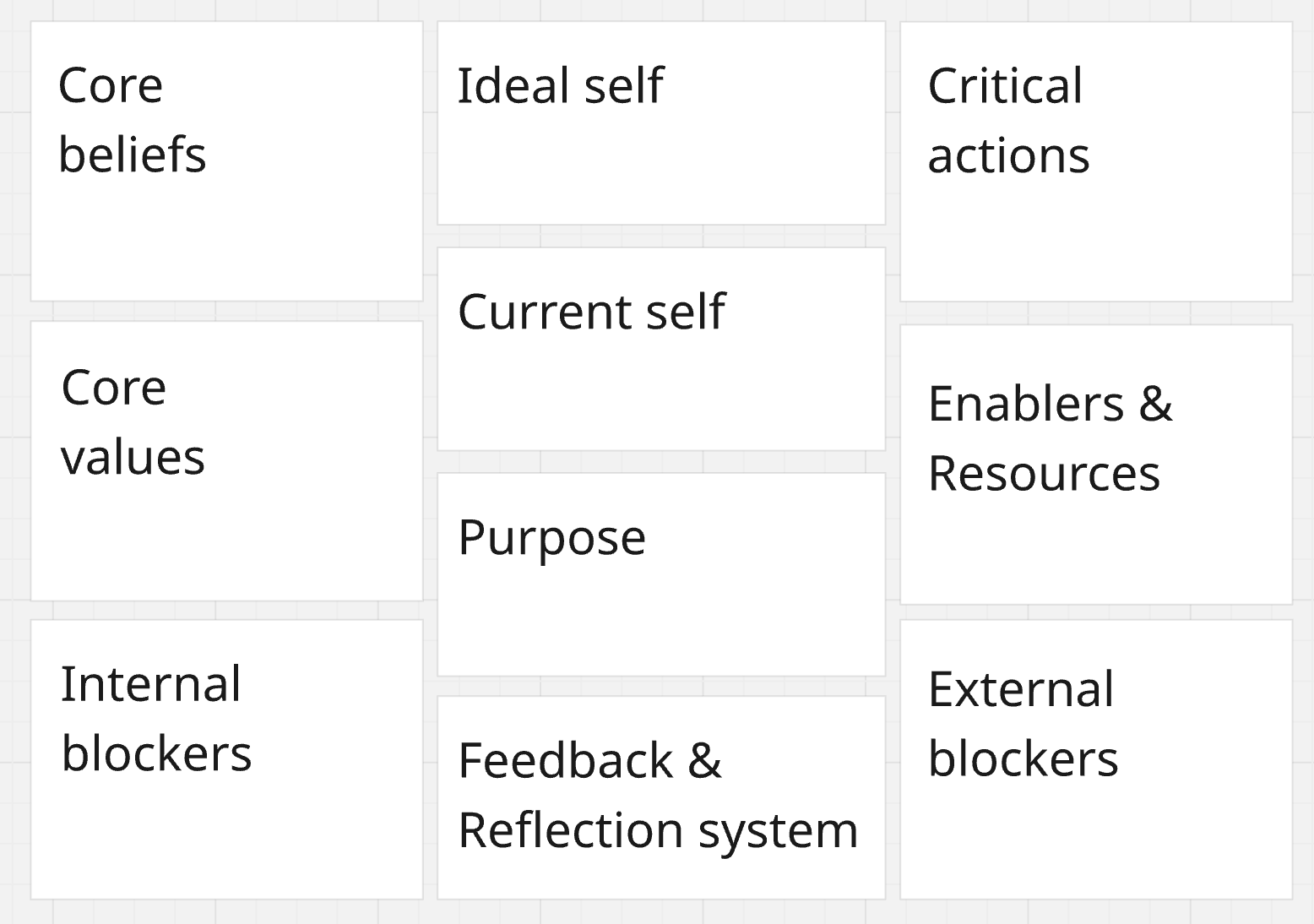
Most organizations and societies fail to realize their true potential because the majority of human capacity remains locked behind invisible barriers. These are not just about lack of skills or resources, but deep internal dynamics—fears, limiting beliefs, identity confusion, absence of purpose—that silently sabotage progress. Traditional development programs focus on technical upskilling, but neglect the underlying architecture of human performance: the mindsets, emotional frameworks, and values that determine whether knowledge ever translates into action. This is why the Human Potential Canvas is not just another framework; it is a necessary tool for the future of talent development.
The framework provides a full-spectrum map of a person’s operating system. It connects elements that most models treat in isolation—identity, vision, core beliefs, blockers, enablers, action strategies, and feedback systems—into one integrated ecosystem. By making these invisible layers explicit, it gives leaders, coaches, and mentors a practical structure for diagnosing what truly holds someone back. Is the gap caused by unclear purpose, toxic environments, misaligned values, or a broken feedback loop? With this clarity, interventions shift from surface-level fixes to root-level transformations.
For coaching and mentoring, this is revolutionary. Instead of endless motivational talk or generic goal-setting, the coach can take a client through the 10 dimensions of the canvas and identify the specific tension points: what blocks energy, what accelerates it, and where alignment is broken. This transforms coaching from an abstract conversation into a tangible blueprint, where the client sees not just where they are, but why they are stuck, and the exact levers to pull to break through. It creates a psychological map of becoming—a practical, visual guide to unlocking higher potential.
In leadership and management, the framework becomes a precision tool for developing people without wasting resources. Instead of measuring talent by output alone, leaders can map employees on the canvas and see whether the problem is capability or alignment. Often, underperformance is not a skill issue but an identity or purpose gap, or perhaps a misfit between individual values and organizational culture. By diagnosing this correctly, managers can re-engineer roles, environments, and support systems to turn frustration into flow. This approach prevents talent leakage and accelerates engagement.
The implications for talent development are profound. Societies and organizations face a critical bottleneck: the abundance of human potential that is never activated because systems focus on compliance and standardization rather than individualized empowerment. The Human Potential Canvas flips that paradigm. It creates a structured way to develop the person behind the skill, transforming passive employees into self-directed, purpose-driven contributors. This is not just about productivity—it’s about unleashing creative, adaptive thinkers who can thrive in complexity and lead innovation.
When scaled across teams and organizations, the ripple effect is enormous. Imagine companies where every individual understands their current state, ideal self, core blockers, and purpose—and is supported by systems that reinforce their enablers and feedback loops. Misalignment drops, resilience rises, and collective intelligence compounds. At a societal level, this framework tackles one of the greatest economic inefficiencies: underutilized talent. By breaking internal and external bottlenecks, it ensures that ability meets opportunity.
For governments, educational systems, and future-of-work initiatives, this approach becomes a policy-level advantage. Instead of mass-producing graduates with no clarity about identity and purpose, we can equip young people with the meta-skill of self-alignment: the ability to identify blockers, design enablers, and iterate toward their highest potential. This is how nations increase competitiveness—not just through technology, but through human systems that evolve as fast as the environment.
Ultimately, the Human Potential Canvas is a leadership technology for a new era—one where managing talent is no longer about controlling tasks, but about orchestrating potential. It turns personal growth into a structured, actionable process, giving every individual the tools to become a more powerful version of themselves and every organization the leverage to activate its deepest reservoirs of capability. The result is not only thriving individuals but adaptive, intelligent systems that drive innovation and resilience on a global scale.
Summary
1. Current Self (Identity Now)
Represents your present operating system—how you see yourself, your roles, and your self-worth.
Goal: Honest clarity about who you are today without self-deception.
Risk if Weak: Acting from false identity → self-sabotage.
2. Ideal Self (Vision)
Your North Star—a vivid, emotionally charged picture of who you want to become and the life you want to lead.
Goal: Clear, authentic, and inspiring vision aligned with values.
Risk if Weak: Drifting, chasing borrowed goals, lack of motivation.
3. Core Beliefs
Your mental coding system—assumptions about yourself, others, and the world.
Goal: Empowering beliefs that support growth and adaptability.
Risk if Weak: Self-fulfilling loops of limitation (e.g., “I can’t,” “I’m not enough”).
4. Purpose (Why It Matters)
The deep reason behind your actions—what gives meaning to effort and sustains motivation under stress.
Goal: A personal “why” that is authentic and energizing.
Risk if Weak: Success without fulfillment, motivation burnout.
5. Internal Blockers
The psychological and emotional brakes: fear, perfectionism, self-doubt, identity rigidity.
Goal: Awareness and dismantling of patterns that sabotage progress.
Risk if Weak: Paralysis, procrastination, endless self-sabotage.
6. External Blockers
Environmental and social factors that drain energy and limit growth: toxic relationships, cultural pressure, financial stress.
Goal: Design or shift contexts to remove unnecessary friction.
Risk if Weak: External forces hijack focus and motivation.
7. Enablers & Resources
The accelerators of progress: strengths, supportive people, systems, tools, energy practices.
Goal: Leverage assets to create momentum and reduce reliance on willpower.
Risk if Weak: Growth becomes a grind with no compounding effect.
8. Critical Actions
The keystone behaviors and decisions that move you from theory to transformation.
Goal: Focus on a few high-impact moves that create exponential results.
Risk if Weak: Endless planning without execution, “busyness” instead of progress.
9. Feedback & Reflection System
The self-correcting loop that turns action into mastery: track, learn, adapt.
Goal: Regular feedback cycles for continuous improvement.
Risk if Weak: Blind repetition of mistakes, plateauing, and loss of direction.
10. Core Values
Your non-negotiable principles—the foundation for decision-making and fulfillment.
Goal: Live in congruence with top values to avoid hollow success.
Risk if Weak: Inner conflict, compromise, and identity collapse under stress.
The Canvas Elements
Element 1: Current Self
The Gist
The Current Self block represents your present identity state—how you see yourself today, the roles you inhabit, and the internal scripts guiding your decisions. It’s your “operating system.” If it’s outdated, distorted, or fragile, every action you take will be misaligned because you’re acting from a false base.
Why It’s Important
You cannot design the future if you don’t map the present reality accurately.
Lack of clarity here creates a phantom chase: pursuing goals to fix insecurities instead of authentic desires.
Self-awareness reduces blind spots and stops self-sabotage loops.
When this block is strong, you act with confidence without the need for constant validation.
10 Potential Blockers to a Healthy Current Self
(Each blocker → What Healthy Looks Like → Typical Causes of the Blocker)
1. Low Self-Worth
Healthy: “My value is inherent. It’s not dependent on achievements or approval.”
Why People Block Here: Conditional love in childhood, repeated criticism, measuring worth through comparison.
2. Over-Identification with Roles
Healthy: “Roles are what I do, not who I am. I can adapt without losing myself.”
Why People Block Here: Tied identity to job, parent role, relationship status → fear of losing meaning if role changes.
3. Negative Self-Talk
Healthy: “My inner voice is a coach, not an executioner.”
Why People Block Here: Internalized parental or authority criticism, unresolved shame, perfectionist culture.
4. Lack of Self-Awareness
Healthy: “I know my patterns, triggers, and strengths. I can name what I feel and why.”
Why People Block Here: Living on autopilot, avoiding introspection, fear of what they’ll discover about themselves.
5. Learned Helplessness
Healthy: “I am an active agent; my choices shape my life.”
Why People Block Here: Trauma, repeated failures, environments where effort didn’t change outcomes.
6. Emotional Disconnection
Healthy: “I can feel emotions fully without drowning in them.”
Why People Block Here: Childhood taught emotions = weakness, over-intellectualizing, trauma response (numbing).
7. Constant Comparison
Healthy: “I measure growth against my past self, not other people.”
Why People Block Here: Social media culture, competitive upbringing, lack of internal validation mechanisms.
8. Shame Identity
Healthy: “Mistakes are events, not definitions of who I am.”
Why People Block Here: Chronic criticism, guilt-shame parenting, perfectionism.
9. External Validation Dependency
Healthy: “I like recognition, but my worth isn’t tied to applause.”
Why People Block Here: Early conditioning (“Good boy/girl if…”), approval-based love, lack of internal validation system.
10. Lack of Authentic Expression
Healthy: “I express who I truly am without fear of losing belonging.”
Why People Block Here: Fear of judgment, trauma of rejection, social masking learned in childhood.
✅ Summary of Healthy State for Current Self
Grounded sense of worth → not conditional on success or people.
Awareness of inner narrative and emotional state.
Identity not fused with external labels.
Acts from agency, not fear-driven compliance.
Element 2: Ideal Self (Vision)
The Gist
The Ideal Self is your North Star—a vivid, emotionally compelling picture of who you want to become and the life you want to create. This isn’t just about external goals (career, status); it’s about your internal state, values alignment, and desired identity. Without this clarity, you drift or chase borrowed dreams.
Why It’s Important
A clear and embodied vision acts as a psychological magnet, pulling you forward even when motivation dips.
Defines what success means on your terms, preventing societal programming from hijacking your path.
Anchors decision-making: If you don’t know where you want to go, every distraction looks like an opportunity.
Creates resilience: When obstacles arise, vision sustains perseverance.
10 Potential Blockers to a Healthy Ideal Self
(Each blocker → What Healthy Looks Like → Why People Block Here)
1. Vague or Undefined Vision
Healthy: “I know what my best future looks like in detail—how I live, who I am, and why it matters.”
Why Blocked: Fear of commitment, lack of self-reflection, avoiding clarity because it creates pressure.
2. Borrowed Dreams
Healthy: “My vision reflects my authentic desires, not what parents, society, or peers expect.”
Why Blocked: Social conditioning, external approval culture, fear of disappointing others.
3. Fear of Failure (Vision Aversion)
Healthy: “Defining my vision is exciting, not terrifying, because I see failure as feedback.”
Why Blocked: Perfectionist upbringing, shame trauma, linking self-worth to outcomes.
4. Low Imagination / Thinking Too Small
Healthy: “I allow myself to envision abundance, freedom, and boldness without self-censorship.”
Why Blocked: Scarcity mindset, early limitations (“Don’t aim too high”), lack of inspiring role models.
5. Lack of Emotional Connection
Healthy: “My vision excites and energizes me; I can feel it in my body.”
Why Blocked: Over-intellectualization, focusing only on metrics (money, status), emotional numbness from trauma.
6. Misalignment with Values
Healthy: “My vision honors my deepest principles; it feels congruent, not hollow.”
Why Blocked: Blind ambition, social comparison, chasing external success markers (title, luxury) over meaning.
7. Fear of Standing Out
Healthy: “I’m okay being visible and owning my uniqueness.”
Why Blocked: Fear of judgment, past bullying or rejection, tall poppy syndrome (cultural).
8. Indecisiveness & Overthinking
Healthy: “I make choices boldly and adjust later rather than endlessly plan without action.”
Why Blocked: Perfectionism, fear of irreversible mistakes, analysis paralysis.
9. Identity Gap Paralysis
Healthy: “I see the gap between current and ideal self as a challenge, not proof of inadequacy.”
Why Blocked: Overwhelm at distance from goal, impatience, lack of tolerance for gradual progress.
10. External Dependency for Vision Validation
Healthy: “I trust my internal compass even if others don’t get it yet.”
Why Blocked: Low self-trust, seeking constant validation, cultural fear of being “different.”
✅ Summary of Healthy State for Ideal Self
Vivid and emotionally charged vision.
Grounded in authentic values, not social scripts.
Large enough to expand potential, yet actionable.
Excites you, scares you (in a good way), and feels meaningful beyond ego.
Element 3: Core Beliefs
The Gist
Your Core Beliefs are the invisible rules you live by—unconscious assumptions about yourself, others, and the world. They are the lens through which reality is filtered, shaping every decision and action.
Healthy beliefs empower growth and resilience; limiting beliefs sabotage progress silently. This block determines whether you experience life as a field of possibility or a prison of fear.
Why It’s Important
Beliefs create self-fulfilling loops (e.g., “I can’t succeed” → avoid action → confirm belief).
They regulate risk tolerance, self-image, and relationships.
You can master habits and actions, but if the belief system contradicts your goals, you will unconsciously sabotage yourself.
10 Potential Blockers to a Healthy Core Belief System
(Each blocker → Healthy State → Why Blocked)
1. “I’m Not Enough”
Healthy: “My worth is intrinsic; growth adds skills, not value.”
Why Blocked: Conditional love in childhood, perfectionism, chronic criticism.
2. “The World Is Unsafe”
Healthy: “Life carries risk, but I can navigate uncertainty with courage.”
Why Blocked: Early trauma, chaotic environments, news/media fear culture.
3. “People Can’t Be Trusted”
Healthy: “I can set boundaries and still experience connection.”
Why Blocked: Betrayal, inconsistent caregivers, toxic relationships.
4. “Success Means Sacrifice of Self”
Healthy: “I can grow and thrive without losing authenticity or joy.”
Why Blocked: Role models who burned out, cultural hustle glorification.
5. “I Don’t Deserve Happiness”
Healthy: “Joy and fulfillment are natural states I’m allowed to experience.”
Why Blocked: Guilt conditioning, martyr scripts, cultural narratives (“life is suffering”).
6. “Change Is Dangerous”
Healthy: “Change is a natural evolution; I adapt and thrive.”
Why Blocked: Family resistance to change, punished risk-taking in youth.
7. “My Past Defines Me”
Healthy: “The past shaped me, but doesn’t set my future limits.”
Why Blocked: Trauma identity, lack of corrective experiences, rigid self-narrative.
8. “I Must Please Others to Be Loved”
Healthy: “My worth isn’t dependent on compliance; I can express my truth and belong.”
Why Blocked: Conditional affection, shame-based parenting, cultural collectivism.
9. “Failure Is Fatal”
Healthy: “Failure is feedback; risk is required for mastery.”
Why Blocked: Punishment for mistakes as a child, perfectionistic education systems.
10. “I’m Too Broken to Change”
Healthy: “I am capable of deep transformation regardless of past pain.”
Why Blocked: Chronic mental health struggles, hopelessness scripts, lack of success examples.
✅ Summary of Healthy Core Beliefs
Worth is intrinsic, not conditional.
Change = safe and possible.
Others = potential allies, not constant threats.
Failure = feedback, not identity.
Joy, abundance, and authenticity = deserved and attainable.
Element 4: Purpose (Why It Matters)
The Gist
Purpose is the deep underlying reason behind your actions—the “why” that gives meaning to the “what.” It is not a superficial goal; it’s a core driver that anchors identity and sustains motivation during adversity.
Without purpose, actions feel mechanical, progress feels hollow, and motivation dies when things get hard.
Why It’s Important
Purpose acts as psychological fuel: it turns effort into devotion.
Reduces burnout: Even under stress, when your why is strong, you persist.
Protects against comparison and social pressure: you act from internal conviction, not borrowed desires.
Purpose provides resilience—it transforms pain into meaning, making setbacks feel like steps, not walls.
10 Potential Blockers to a Healthy Sense of Purpose
(Each blocker → Healthy State → Why Blocked)
1. Lack of Clarity on Why
Healthy: “I know what energizes me and why it matters to the world.”
Why Blocked: Living on autopilot, chasing quick wins, lack of deep introspection.
2. Purpose Confused with Goals
Healthy: “Purpose is the compass; goals are milestones.”
Why Blocked: Western achievement culture focuses on outcomes, not meaning.
3. Borrowed Purpose
Healthy: “My why is mine, not inherited from parents, peers, or trends.”
Why Blocked: Social programming, family expectations, cultural norms.
4. Belief That Purpose Must Be Huge
Healthy: “Purpose can be quiet yet profound; I don’t need to ‘save the world.’”
Why Blocked: Media glorification of world-changers, shame if not ‘big enough.’
5. Fear of Declaring Purpose
Healthy: “I own my why even if others don’t understand.”
Why Blocked: Fear of judgment, past invalidation, tall poppy syndrome.
6. Identity-Purpose Misalignment
Healthy: “My why resonates with who I am and want to become.”
Why Blocked: Pursuing “safe” paths that contradict authentic values.
7. Disconnection from Impact
Healthy: “I see how what I do matters beyond me.”
Why Blocked: Feeling like a cog in a system, working in soulless environments.
8. Over-Attachment to Single Purpose
Healthy: “I allow purpose to evolve as I grow.”
Why Blocked: Rigidity, fear of reinvention, identity fused with one mission.
9. Emotional Numbness
Healthy: “My purpose lights me up emotionally.”
Why Blocked: Trauma, chronic stress, suppressed curiosity.
10. “Purpose Comes After Success” Myth
Healthy: “Purpose is the starting point, not the end prize.”
Why Blocked: Cultural narrative: “Get rich first, then find meaning.”
✅ Summary of Healthy Purpose
Feels deeply authentic, aligned with values, and energizing.
Evolving, not rigid.
Connects personal fulfillment with impact beyond self.
Acts as the North Star through chaos.
Element 5: Internal Blockers
The Gist
Internal Blockers are psychological, emotional, and cognitive patterns that originate within the self. They operate as invisible brakes on your potential. Unlike external barriers (society, lack of resources), these come from your own mind, nervous system, and habits, making them harder to detect but more powerful.
They often show up as self-sabotage, procrastination, or constant emotional loops that erode momentum.
Why It’s Important
You can have clarity (vision, purpose) and still fail if internal resistance isn’t addressed.
Internal blockers distort perception, making risks look fatal and opportunities invisible.
They create emotional drag—burning energy just to maintain baseline functioning.
Removing these is the highest-leverage move in personal transformation: without it, strategy doesn’t matter.
10 Core Internal Blockers (with Healthy State & Why Blocked)
1. Fear of Failure
Healthy: “Failure is data, not death; I iterate and grow.”
Why Blocked: Punishment for mistakes in childhood, shame-based schooling, perfectionist culture.
2. Fear of Rejection
Healthy: “My value isn’t conditional on others’ approval; rejection redirects, it doesn’t define me.”
Why Blocked: Social trauma, parental withdrawal when displeased, lack of secure attachment.
3. Procrastination from Emotional Overload
Healthy: “I can start small and build momentum without waiting to ‘feel ready.’”
Why Blocked: Associating tasks with pain, fear of outcome, dopamine hijack from distractions.
4. Perfectionism
Healthy: “Excellence matters, but progress > perfection.”
Why Blocked: Conditional praise (“only if perfect”), fear of criticism, identity tied to achievement.
5. Imposter Syndrome
Healthy: “Growth means stepping into arenas where I’m still learning—that’s normal.”
Why Blocked: Comparing inner doubts to others’ polished fronts, past invalidation of competence.
6. Overthinking & Analysis Paralysis
Healthy: “I gather enough info to act, then I adjust on the go.”
Why Blocked: Control fixation, fear of mistakes, using planning as a safety blanket.
7. Lack of Self-Trust
Healthy: “I trust my judgment and ability to course-correct.”
Why Blocked: Overridden choices in childhood, gaslighting, chronic dependence on authority.
8. Emotional Avoidance
Healthy: “I process discomfort; I don’t numb it away.”
Why Blocked: Trauma, fear of vulnerability, coping with dopamine distractions.
9. Scarcity Mindset
Healthy: “Opportunities are abundant; collaboration creates more value.”
Why Blocked: Early resource insecurity, cultural programming (“life is a zero-sum game”).
10. Identity Rigidity
Healthy: “I’m a dynamic being capable of reinvention.”
Why Blocked: Fear of losing belonging, culture shaming reinvention, over-identification with past roles.
✅ Summary of Healthy Internal State
Courage over fear, agency over helplessness, and adaptability over rigidity.
Can feel emotions without being ruled by them.
Operates from abundance and self-trust, not defense and scarcity.
Element 6: External Blockers
The Gist
External Blockers are environmental, social, and systemic forces that limit your potential from outside. Unlike internal blockers (fear, beliefs), these are contextual realities: toxic relationships, financial constraints, cultural norms, lack of opportunities, or environments that drain energy instead of amplifying it.
They matter because you can have a strong mind, but if you live in an environment that constantly contradicts your growth, you’ll hit friction every day.
Why It’s Important
Environment shapes behavior: Willpower fails in toxic contexts.
External blockers often reinforce internal ones (“See? The world is hostile”).
Removing or redesigning external conditions creates leverage: small changes in context → massive change in behavior.
Your circle, systems, and surroundings either accelerate you or keep you trapped.
10 Core External Blockers (with Healthy State & Why Blocked)
1. Toxic Relationships
Healthy: “My close circle supports my growth, respects boundaries, and uplifts me.”
Why Blocked: Fear of losing belonging, normalized dysfunction in family or culture, guilt-based loyalty.
2. Unsupportive Social Circle
Healthy: “I’m surrounded by people who inspire and challenge me constructively.”
Why Blocked: Comfort in familiarity, fear of loneliness, peer pressure.
3. Financial Instability
Healthy: “I manage resources strategically, reducing chronic stress and freeing energy for growth.”
Why Blocked: No financial literacy, scarcity programming, systemic economic disadvantage.
4. Overwhelming Work Environment
Healthy: “My work context allows performance without chronic burnout or constant fear.”
Why Blocked: High-pressure jobs, lack of autonomy, fear of job loss, survival mindset.
5. Cultural or Familial Pressure
Healthy: “I honor my values even if they diverge from tradition or expectations.”
Why Blocked: Collective shame narratives, “what will people say,” enmeshment in family identity.
6. Lack of Access to Growth Opportunities
Healthy: “I create or seek spaces for learning, mentorship, and skill-building.”
Why Blocked: Geographical, financial, or informational barriers; passive mindset (“there’s nothing I can do”).
7. Environmental Chaos (Physical Space)
Healthy: “My space supports focus and calm; it reflects order, not chaos.”
Why Blocked: Living in cluttered or unstable conditions, no control over surroundings, sensory overload.
8. Negative Media & Information Diet
Healthy: “I curate what I consume; it informs and uplifts, not drains or terrifies me.”
Why Blocked: Addiction to outrage cycles, doomscrolling, algorithmic traps feeding negativity.
9. Geographic Constraints
Healthy: “I live where opportunities and lifestyle align with my goals.”
Why Blocked: Tied to location by obligation, fear of change, economic limitations.
10. Broken Support Systems
Healthy: “I have access to mentors, networks, and people who open doors.”
Why Blocked: Isolation, mistrust of others, not leveraging social capital, fear of asking for help.
✅ Summary of Healthy External Context
Social ecosystem that empowers you.
Physical and informational environments designed for clarity and momentum.
Resources and networks that unlock mobility instead of creating dependency.
Element 7: Enablers & Resources
The Gist
Enablers & Resources are the leverage points that amplify your progress—internal strengths and external assets that accelerate movement toward your Ideal Self. Think of them as the fuel, tools, and allies that make the journey smoother and faster.
When these are strong and consciously used, you compound momentum. When they are underutilized or absent, progress feels like pushing a boulder uphill.
Why It’s Important
Enablers offset friction from internal and external blockers.
They reduce reliance on willpower (systems and tools create effortless consistency).
Resources transform growth from random to predictable.
People who succeed engineer their environment to make success inevitable—this is the essence of enablers.
10 Core Enablers (with Healthy State & Why People Miss Them)
1. Personal Strengths Awareness
Healthy: “I know my natural strengths and deploy them strategically.”
Why Missed: Over-focus on fixing weaknesses, lack of feedback culture, internalized criticism.
2. Supportive Relationships
Healthy: “I intentionally nurture bonds with people who energize and elevate me.”
Why Missed: Loyalty to draining relationships, fear of outgrowing peers, not prioritizing community.
3. Mentorship & Role Models
Healthy: “I have access to people who’ve walked the path and offer guidance.”
Why Missed: Fear of asking for help, belief that mentors are unreachable, ego-driven isolation.
4. Financial Buffer
Healthy: “I have a stable base that allows risk-taking and creative exploration.”
Why Missed: Poor financial planning, impulsive spending, no understanding of compounding resources.
5. Health & Energy Systems
Healthy: “I protect sleep, movement, and nutrition as performance assets.”
Why Missed: Overworking culture, undervaluing energy as the foundation of achievement.
6. Knowledge & Learning Channels
Healthy: “I’m plugged into high-quality information and communities for continuous learning.”
Why Missed: Passive consumption (social media noise), no filtering system for high-leverage knowledge.
7. Technology & Productivity Tools
Healthy: “I use tools and automation to amplify my cognitive and creative power.”
Why Missed: Fear of tech, lack of exploration, outdated habits.
8. Accountability Systems
Healthy: “I have structures (peers, coaches, dashboards) that keep me consistent.”
Why Missed: Resistance to external accountability, belief in self-sufficiency, avoidance of vulnerability.
9. Emotional Regulation Practices
Healthy: “I have daily habits (meditation, journaling, therapy) to process stress and reset clarity.”
Why Missed: Over-indexing on grind, cultural dismissal of inner work, reliance on willpower.
10. Physical Environment Design
Healthy: “My space is optimized for focus, creativity, and restoration.”
Why Missed: Living reactively in cluttered, distracting environments, ignoring sensory impact on cognition.
✅ Summary of Healthy Enabler Profile
Strengths-based strategy (play where you’re strong).
Rich networks & mentorship pipelines.
Systems that reduce friction and automate consistency.
Energy-first mindset: health and environment as performance multipliers.
Element 8: Critical Actions
The Gist
Critical Actions are the high-leverage moves that shift you from intention → transformation. This is where clarity (vision, purpose) becomes tangible momentum. Without this block, your framework remains a theory: nothing changes without deliberate, prioritized action.
The key is strategic minimalism: instead of drowning in endless to-do lists, identify the few actions that compound results and hit the “keystone habits” that unlock everything else.
Why It’s Important
Action dissolves fear and analysis paralysis—you learn by doing, not by waiting for perfect readiness.
80% of outcomes come from 20% of actions (Pareto Principle).
Small consistent moves outrun sporadic big pushes over time.
Without critical actions, all previous elements collapse under inertia.
10 Common Blockers to Executing Critical Actions (with Healthy State & Why Blocked)
1. Lack of Clarity on Priorities
Healthy: “I know the top 3 actions that create disproportionate results.”
Why Blocked: Trying to do everything, fear of missing out, lack of decision-making framework.
2. Waiting for Motivation
Healthy: “I act based on systems and discipline, not fleeting moods.”
Why Blocked: Misbelief that motivation precedes action, dopamine addiction to ease.
3. Fear of Imperfect Execution
Healthy: “I’d rather act imperfectly today than wait for flawless timing.”
Why Blocked: Perfectionism, shame-based self-image, over-identification with outcomes.
4. No Feedback Loops
Healthy: “Every action gives me data; I adjust instead of judging myself.”
Why Blocked: Fear of facing progress gaps, avoiding accountability, lack of tracking systems.
5. Overloading with Too Many Actions
Healthy: “I pick a few high-impact levers and master them.”
Why Blocked: Confusing busyness with progress, seeking validation through activity, avoidance of focus.
6. Emotional Avoidance Through Distraction
Healthy: “I lean into discomfort rather than escape into scrolling, gaming, or overwork.”
Why Blocked: Dopamine hijack (social media), unprocessed fear of failure/rejection.
7. Lack of Time Boundaries
Healthy: “I protect focused action windows as sacred, non-negotiable.”
Why Blocked: Poor boundaries, saying yes to others over self-priorities, reactive time use.
8. No Energy Management
Healthy: “I plan demanding actions when energy peaks, not when depleted.”
Why Blocked: Ignoring biological rhythms, neglecting sleep/nutrition, confusing exhaustion with laziness.
9. Fragmented Attention
Healthy: “I single-task with depth; I batch distractions instead of multitasking.”
Why Blocked: Tech addiction, lack of digital hygiene, constant context switching.
10. Fear of Visibility (Hiding)
Healthy: “I share my work and ideas boldly even if they’re not perfect yet.”
Why Blocked: Past ridicule, fear of judgment, trauma from exposure or failure.
✅ Summary of Healthy Action System
Prioritization: a few levers that matter most.
Execution > perfection: bias toward shipping, not waiting.
Feedback-driven: every action informs the next, reducing fear loops.
Energy, focus, and boundaries engineered into the system, not left to chance.
Element 9: Feedback & Reflection System
The Gist
This block is about creating a self-correcting loop: continuous input → reflection → refinement. Most people fail not because they take wrong actions but because they never measure, never adapt. Without feedback, you repeat the same mistakes, stay blind to progress, and eventually burn out or quit.
Feedback + reflection = the upgrade engine that turns experience into wisdom.
Why It’s Important
Ensures you learn faster than you fail.
Prevents stagnation and plateauing by revealing blind spots.
Builds resilience by framing setbacks as data, not doom.
Converts goals from static into dynamic systems that evolve with you.
10 Common Blockers to Effective Feedback & Reflection (with Healthy State & Why Blocked)
1. Avoidance of Reality Check
Healthy: “I seek data even when it’s uncomfortable—it’s my growth fuel.”
Why Blocked: Fear of confirming failure, identity fused with outcomes, shame loops.
2. No Measurable Indicators
Healthy: “I track leading indicators (behaviors) and lagging indicators (results).”
Why Blocked: Over-reliance on feelings (“I think I’m doing okay”), lack of tracking systems.
3. Over-Focus on Outcomes, Ignoring Processes
Healthy: “I measure actions and effort quality, not just final results.”
Why Blocked: Cultural obsession with results, self-worth tied to wins, impatience.
4. Taking Feedback Personally
Healthy: “Feedback is about behaviors, not my identity.”
Why Blocked: Fragile ego, history of shaming criticism, unprocessed childhood invalidation.
5. Overwhelmed by Data
Healthy: “I track only what matters most to my key objectives.”
Why Blocked: Trying to measure everything, analysis paralysis, tech clutter.
6. No Reflection Practice
Healthy: “I schedule regular check-ins to extract lessons from experience.”
Why Blocked: Living reactively, equating reflection with ‘wasting time,’ discomfort facing truth.
7. Ignoring Positive Feedback
Healthy: “I celebrate wins as much as I analyze misses.”
Why Blocked: Bias toward negatives, fear of complacency, self-critical upbringing.
8. Lack of Accountability Feedback
Healthy: “I invite honest external feedback from trusted sources.”
Why Blocked: Fear of judgment, shame vulnerability, ego protection.
9. Not Acting on Insights
Healthy: “Reflection ends with action—adjustments go into my system immediately.”
Why Blocked: Insight addiction (journaling without execution), lack of discipline.
10. No Rhythm or Structure
Healthy: “Feedback cycles are consistent (daily, weekly, monthly), not random.”
Why Blocked: Waiting for crises to reflect, no planning habit, chaotic lifestyle.
✅ Summary of a Healthy Feedback System
Clear metrics aligned with purpose and actions.
Regular reflection rituals: daily micro check-ins, weekly reviews, monthly recalibration.
External + internal feedback loops.
Immediate conversion of insights → next steps.
Element 10: Core Values
The Gist
Core Values are the non-negotiable principles that define what matters most to you—your decision filters and behavioral compass. While Purpose answers “Why am I here?”, Values answer “How do I live while I’m here?”.
When values are clear and honored, life feels congruent. When they’re unclear or violated, you experience inner conflict, burnout, and emptiness—even if you achieve your goals.
Why It’s Important
Values provide alignment under uncertainty—when plans fail, values guide action.
They protect against success without fulfillment (the trap of hollow victories).
Help you say no decisively, reducing decision fatigue.
Act as stability anchors in times of chaos: values rarely change, even when goals evolve.
10 Common Blockers to Living in Alignment with Core Values (with Healthy State & Why Blocked)
1. Unclear Values
Healthy: “I know my top 5 values and what they look like in action.”
Why Blocked: Never reflected deeply, culture rewards achievement over authenticity.
2. Borrowed Values
Healthy: “My values come from inner conviction, not societal or family pressure.”
Why Blocked: Inherited scripts (“Status > integrity”), avoiding conflict by conforming.
3. Value Conflicts
Healthy: “My priorities don’t sabotage each other (e.g., success and health coexist).”
Why Blocked: Competing commitments (career vs family), lack of integration thinking.
4. Prioritization Drift
Healthy: “I review and rank values regularly; they’re reflected in my calendar.”
Why Blocked: Overwhelm, autopilot living, chasing urgent over important.
5. Compromising Values for Approval
Healthy: “I uphold integrity even if it costs popularity.”
Why Blocked: Fear of rejection, shame conditioning, people-pleasing tendencies.
6. Confusing Aspirational Values for Lived Values
Healthy: “My values are measured by behavior, not wishful thinking.”
Why Blocked: Self-deception (“I value health” while neglecting fitness), identity inflation.
7. External Reward Hijack
Healthy: “External success aligns with internal fulfillment.”
Why Blocked: Seduced by money, fame, or status that conflict with deeper principles.
8. Lack of Boundaries to Protect Values
Healthy: “I set boundaries when my core values are threatened.”
Why Blocked: Conflict avoidance, fear of losing relationships or opportunities.
9. Reactive Living (No Value Checkpoint)
Healthy: “Major choices are filtered through my value framework.”
Why Blocked: Decisions driven by urgency, adrenaline, or societal pace.
10. Values Collapse Under Stress
Healthy: “I stay true to values even in crisis—stress tests confirm alignment.”
Why Blocked: Survival mode, fear-driven shortcuts, lack of pre-commitment rituals.
Recent Posts

The Agentic Economy: The Arguments
September 13, 2026

The ČVUT Playbook: What Czech Technical University Should Actually Do
September 10, 2026